
Approve a revised RC car quote only when the drive system, controller, intended terrain and battery package still match the assortment you are buying. For RC off-road cars, a monster-truck body is not proof of terrain capability; for gesture models, a radio-frequency label is not proof of hand-motion control. Compare the revised configuration with the agreed target, then approve it, request a corrected quote or hold the affected line before purchase-order release.
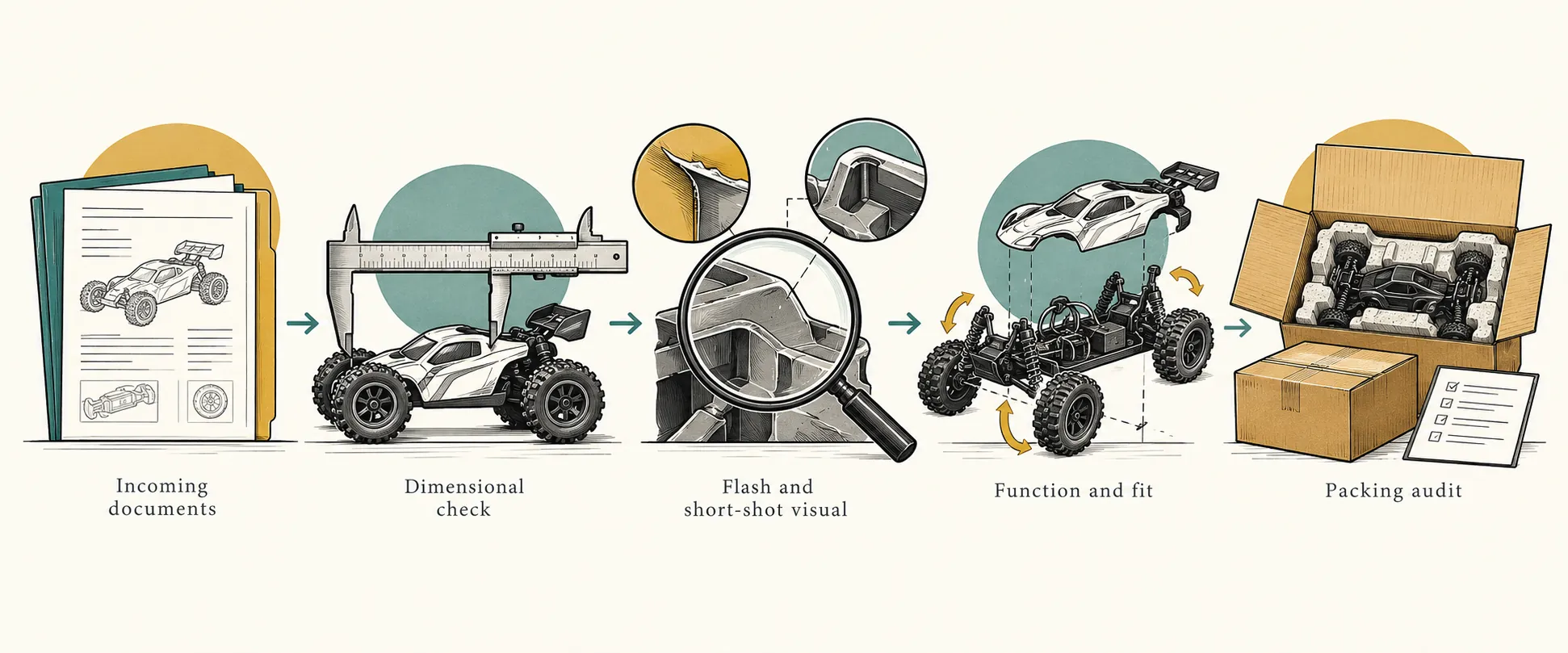
Which mechanism changes require a quote revision?
Revise the quote whenever a substitution changes the driving experience, included controller or power package—not just the body style.
Rear-wheel drive describes which wheels receive power. A 2.4 GHz designation describes the radio band. Double-sided operation describes a stunt function. These are separate specifications, and none alone establishes gesture control or suitability for rough terrain.
For a gesture assortment, request the exact hand-motion controller, its power source and the functions it operates. State whether a conventional handheld transmitter must also be included. For a stunt line, name the required actions separately, such as double-sided driving, rolling or rotation, and check those actions on the quoted configuration.
Define terrain as an actual surface, not simply “off-road.” If the sales proposition involves short grass or loose gravel, make that surface part of the sample evaluation. Do not accept a smooth-floor demonstration as confirmation of the intended outdoor use.
Which catalog fields should anchor the quote comparison?
Use each model’s recorded mechanism and packing as the comparison baseline, while reconfirming commercial terms in the revised quote.
The following entries are catalog references dated October 9, 2026. Reference MOQs are minimum quantities to reconfirm, not order multiples; units per carton describe packing and do not by themselves require full-carton ordering.
| 1:64 RWD GTR — RC-352233 | Recorded configuration: 1:64 rear-wheel-drive RC model; alloy/ABS; window box. Reference MOQ: 216 units. Packing: 72 units per carton. |
|---|---|
| 1:64 RWD BMW — RC-352235 | Recorded configuration: 1:64 rear-wheel-drive RC model; alloy/ABS; window box. Reference MOQ: 216 units. Packing: 72 units per carton. |
| 1:64 RWD Bigfoot Monster Truck — RC-352237 | Recorded configuration: 1:64 rear-wheel-drive RC monster truck; alloy/ABS; window box. Reference MOQ: 144 units. Packing: 48 units per carton. |
| 2.4 GHz double-sided stunt car — RC-283518 | Recorded configuration: 2.4 GHz RC stunt car described with double-sided operation, 360-degree rolling, drifting and rotation; ABS; color box. Reference MOQ: 120 units. Packing: 24 units per carton. |
How should buyers judge a model substitution?
Treat the GTR-to-BMW substitution as a body-style comparison first, but treat a move to the double-sided stunt car as a functional assortment change.
In a proposed GTR-to-BMW revision, the recorded scale, rear-wheel drive, material description, window-box packing, reference MOQ and carton quantity remain the same. That gives the buyer a shared baseline. It does not establish identical steering response, controllers, batteries or runtime: compare those items before accepting the substitution as equivalent.
A switch to the double-sided stunt car changes the recorded function and retail packing, as well as the reference MOQ and carton quantity. If the buying brief is a stunt assortment, evaluate that model against the required actions and control package. If the brief is a miniature body-style assortment, revise the assortment allocation rather than treating the stunt car as a like-for-like replacement.
The monster-truck option warrants a separate terrain check. Its name and RWD description identify the catalog configuration, but do not settle grass clearance, grip or obstacle handling. Keep an off-road positioning decision tied to the intended surface and the evaluated sample.
What belongs in the quote-revision worksheet?
Record the specified target beside the supplier’s revised offer and the sample observation, so each purchasing decision has a visible basis.
Complete this worksheet for each affected quote line. Preserve the previous value when something changes; do not overwrite it with the replacement specification.
| Quote identity and revision | Record supplier, quote number, previous revision/date, proposed revision/date, exact model identifier, quantity and intended sales market. Attach the relevant sample ID and specification revision. |
|---|---|
| Drive and required functions | Target: required driven wheels and driving or stunt actions. Revised offer: exact configuration and changes from the previous quote. Observation: identify the sample and record which requested functions were demonstrated. |
| Controller and gesture operation | Target: handheld transmitter, gesture controller or both; required steering and action controls. Revised offer: included controller types, power sources and radio specification. Observation: record pairing, command response and any function that differs from the target. |
| Terrain and assortment use | Target: named surfaces and intended assortment role. Revised offer: supplier-stated terrain use. Observation: record surface condition, route and behavior, including any need to reposition the vehicle or clear an obstacle. |
| Battery and charging package | Target: vehicle battery chemistry, voltage, capacity, number of packs, connector, charging equipment and controller batteries. Revised offer: specify what is included and what the retailer or end user must provide. Observation: compare the supplied components with that list. |
| Runtime and charging evaluation | Target: buyer-selected driving time and charging expectation for the intended use. Revised offer: stated runtime and test conditions. Observation: record starting charge, surface, driving pattern, operating time, endpoint and charging conditions. |
| Material, sample and retail packing | Target: agreed construction and retail presentation. Baseline: retain the model’s recorded material and packing description. Observation: identify the evaluated sample, packaging version, included accessories and any accepted differences. |
| Current commercial terms | Request current unit price and currency, quantity basis, MOQ, any explicit order multiple, units per carton, mixed-model conditions, delivery basis, payment terms, quote validity and proposed dispatch timing. Record each change against the previous quote. |
| Age marking and destination review | Record the proposed age marking, destination market and the buyer’s document-review requirements for the quoted construction, radio and battery package. Identify the reviewer and the documents reviewed; keep functional sample approval separate from safety and market review. |
| Decision, responsibility and closure | Record approve, revise or hold for the affected line; reasons and conditions; responsible approver and decision date. Give each condition an owner and due date, then record the closure evidence, reviewer and closure date before PO release. |
How should battery and runtime changes be evaluated?
Evaluate runtime against the exact battery and driving conditions in the revised offer, not against a headline number alone.
Ask for a component-by-component explanation if a lower price comes with a different battery, fewer included packs or changed charging equipment. Keep vehicle and controller power requirements separate: an included vehicle battery does not describe the whole control package.
For a practical comparison, use the same route, surface and driving pattern with each sample’s specified fully charged battery. Define the endpoint beforehand—for example, when the vehicle can no longer complete the agreed route with responsive steering—and record the elapsed time. This is a buyer’s functional screen, not a safety test or a prediction of customer return rates.
When a revised battery package differs from the evaluated sample, request a focused recheck of the affected functions and runtime before accepting the change.
When should the revised quote be approved, revised or held?
Approve a quote when the selected configuration meets the buying target, the current commercial terms are accepted and the required reviews are closed.
Choose “revise” when the vehicle remains a suitable assortment choice but the offer needs a specific correction—for example, naming the gesture controller, correcting the retail box or specifying the battery package. State the replacement wording or configuration you require.
Hold the affected line when an unresolved point could change the purchase decision, such as unconfirmed gesture operation, unevaluated target-terrain use or a battery substitution that has not been assessed. A hold on one line need not block separately acceptable lines.
Before PO release, have the named approver sign and date the decision against the exact quote revision. Close each condition with its supporting sample record, corrected specification, accepted commercial term or document-review result. The record provides traceability; it does not by itself detect an undisclosed product change.