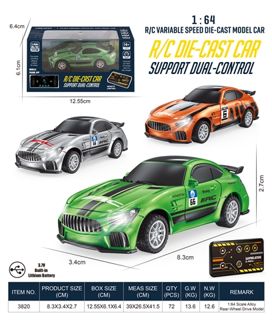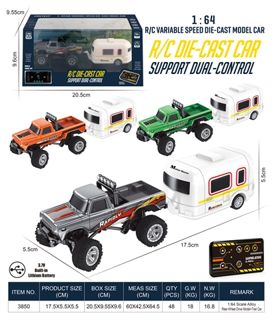
Treat "alloy" as a merchandising claim, not a specification. In small RC (roughly 1:64 to 1:18 scale, toy-grade 2.4G electronics), the alloy that actually reads as value on a shelf is the part the shopper can see and touch: the body shell, the front bumper, the roll bar, the wheel hubs, the shocks. A listing that says "alloy" while the alloy hides inside a sealed gearbox gives your buyer nothing to compare against the plastic unit next to it.
The buying decision for 2026 is narrow: is the alloy content on this tooling visible, consistently finished across the run, and heavy enough that the product feels different in hand? If yes, you can build a two-tier shelf (plastic entry SKU, alloy step-up SKU) and defend a price gap. If no, you are paying for a word. This page covers what to verify on a material map, why weight and cosmetics beat grade names, how to run a small pricing test before committing volume, and where compliance wording must stop.
What dated regulatory changes affect 2026–2027 alloy RC production?
Two dated items sit inside the Q4 2026 and Q1 2027 production calendar for alloy-body RC units. First, China's mandatory standard GB 46523-2025, General Safety Requirements for Children's Products, has an effective date of November 1, 2026, as reported by Bureau Veritas (October 2026) — relevant if your units are produced in Guangdong for the domestic China market as well as for export.
Second, from July 8, 2026, importers of most regulated consumer products must electronically file certificates of compliance with US Customs and Border Protection via a Partner Government Agency Message Set, per CPSC guidance on the Children's Product Certificate. That is a filing-workflow change, not a product change.
What these dates do not tell you about alloy RC demand
None of the above tells you anything about demand. A standard effective date does not mean alloy RC is growing. An eFiling date does not mean your category is under new scrutiny. And nothing in the regulatory material — CoreRCCar Safety Directive 2009/48/EC, CoreRCCar safety guidance, 16 CFR Part 1250 with ASTM F963, the CPC rules, tracking labels, small-parts guidance — establishes that alloy content is a regulated attribute. Alloy is not a safety rule. A Children's Product Certificate is product-specific and based on test results; it is not a blanket factory certificate, and it does not certify your alloy claim.
Equally, do not convert the trend chatter around collectible and adult-buyer behavior into an alloy number. The collectible-hunting and plush signals in circulation in 2026 point to finish, display and scarcity driving perceived value — a useful merchandising analogy, and nothing more. There is no supplied data connecting alloy content to unit growth, price realization or sell-through in RC. If a supplier shows you a market-size slide for "alloy RC," ask which SKU, which period, which market, and who measured it.
Where alloy actually shows up: SUV, pickup, sports and monster-truck bodies
The four body styles buyers ask about most read differently to a shopper, so the alloy argument has to be built per shape rather than per category.
Pickup and SUV bodies are the easiest case. A boxy cab and bed in die-cast or alloy/ABS composite gives you flat panels that take paint evenly and pick up light in a window box — the format most wholesale RC still ships in. Two catalogued examples of this approach are the Alloy Pickup 7-Channel RC Car (Pink Series) and the Alloy Jeep Wrangler 7-Channel RC Car, both recorded as Alloy/ABS with a window-box pack and a 96-piece carton. If you want a live example of an alloy-body small-scale unit a buyer could slot into a Q4 or Q1 assortment, the 1:64 Alloy RWD RC Green Monster Truck is one to pull a sample of before you commit.
Sports and low-slung bodies are harder. Thin A-pillars, long hoods and tight wheel arches punish a soft alloy shell: you get sink marks and uneven gloss where the eye lands. If your factory proposes alloy here, ask for painted samples from at least two cavities, not a single golden sample.
Monster trucks are the forgiving case and the most honest alloy story. Exposed shocks, high ground clearance and chunky hubs are visible metal real estate. That is where the weight difference between a plastic and an alloy-bodied unit is felt immediately by the buyer in a store aisle — which is exactly the perceived-value moment you are trying to buy.
Material maps, weight and cosmetics: what to ask for instead of "alloy"
Ask for a one-page material map per SKU: part name, material, process (die-cast, injection, plating), visible or concealed, and finish. A map you can read in 60 seconds is worth more than a grade name you cannot verify. On the reference lines in this catalog snapshot, the declared material is simply Alloy/ABS — that is a starting point for the map, not the map itself.
Then check three physical things. Weight: compare gross weight of the alloy and plastic versions of the same body at the same scale; if the delta is trivial, shoppers will not feel the upgrade. Cosmetics: look for paint edge bleed at panel gaps, plating adhesion on hub caps, and whether the finish is consistent between the first and last unit in a carton. Consistency across the run — not peak quality in one sample — is what keeps returns low and reviews stable.
Price the delta honestly. Alloy adds material cost, but on small RC the bigger cost drivers are usually tooling amortization, paint steps, packaging format and carton efficiency. A window box versus a polybag can move your landed cost more than the shell material does. Get the two quoted separately so the alloy decision shows up as a number instead of a feeling.
Run a two-SKU pricing test before you commit to a full alloy line
Do not re-tool your whole range on an alloy premise. Pick one body style — monster truck is the safest test bed — and order your normal plastic SKU alongside an alloy-bodied variant at the same scale, same electronics, same channel. Same everything except the shell and finish.
Two things tell you whether the step-up is real: whether the alloy unit sells at a higher price without discounting, and whether it holds that price after the novelty month. If the alloy version only moves when it is marked down to the plastic price, you have a finish cost, not a step-up cue. If it sustains a gap, you have a tier you can extend across SUV and pickup bodies next season.
Keep the test small. A single-carton trial at the factory's stated minimum is enough signal for a yes/no. The reference lines in the catalog snapshot, for instance, sit around 96 to 144 pieces per carton with minimums in the low hundreds — small enough that two parallel SKUs are a survivable test rather than a bet.
Claim discipline: what you may say, and what only a report can say
Your packaging and listing copy is a controlled field. Anything about spray finishes, lithium batteries, FCC authorization or licensed IP must be supported by the actual factory report or authorization document for that SKU — this page supplies none of those, and you should not accept them secondhand from a sales deck. If you need the claim, ask the factory for the report. If the report does not exist, the claim does not go on the box.
Keep compliance statements tied to a product configuration, an age grade and a standard edition. A test report should identify the product configuration, age grade and standard edition it covers; the applicable edition of ASTM F963 should be read from the current regulation before you quote it, and the exact edition and its incorporated regulatory status should be checked before you put the number on anything. Never convert a standard, a guidance page or an audit framework into a statement that a specific factory or SKU is certified.
For EU-bound units, CE marking and the EU Declaration of Conformity belong to the conformity process and must be matched to the product scope; CoreRCCar rules and the General Product Safety Regulation (EU) 2023/988 are separate instruments, and importer, manufacturer and product-identification information has to be mapped to the correct market role. Age grading and small-part risk go together and must be assessed on the actual configuration — including detachable accessories and packaging components. Tracking information should be permanent and support product identification where applicable, and packaging, product markings and lot control should be reviewed as one set, because they change with the SKU.
FAQ
Is demand for alloy-body small RC actually growing?
No supplied data establishes that. The direction you can defend is narrower: perceived value in 2026 is shifting toward visible finish, weight and display quality, and alloy is one way to deliver that. Treat alloy as a merchandising tier you test, not a growth category you assume.
When should I place orders for an alloy RC step-up SKU?
Plan around your own retail calendar and the factory's production lead time, then work backwards from the shelf date. Two dated items to respect: China's GB 46523-2025 takes effect November 1, 2026 for the domestic China market, and US electronic filing of compliance certificates via a PGA Message Set applies from July 8, 2026. Neither is a buying season; both are calendar constraints on Q4 2026 and Q1 2027 production.
Which body styles justify the alloy upgrade most easily?
Monster trucks first — exposed shocks, high clearance and chunky hubs put metal where shoppers see and feel it. Pickup and SUV bodies in a window box are next, since flat panels take paint evenly. Sports and low-slung bodies are the hardest to finish cleanly and the least likely to justify the price gap.
What documentation should I demand before paying for an alloy claim?
A per-SKU material map (part, material, process, visible or concealed, finish), painted samples from more than one cavity, and gross-weight data for the alloy and plastic versions of the same body. For any spray, battery, FCC or IP statement, the actual factory report or authorization for that SKU — never a verbal assurance.
Does alloy content change my compliance obligations?
No. Alloy is not a CPSC-enforced safety rule. Obligations follow the product, its age grading and the applicable rule set — children's products subject to a CPSC-enforced safety rule require third-party testing and a Children's Product Certificate, and the certificate is product-specific, not a blanket factory certificate.
How do I brief a factory so the alloy quote is comparable?
State destination market, age grade, materials and colors, packaging language, requested tests, sample policy, tooling terms and the trade term you want. Quote the shell material and the packaging format as separate lines so you can see which one is actually driving the price gap.
Sources
Need alloy and plastic versions quoted side by side?
Send the body style, scale, age grade and destination market, and ask for the material map, gross weights and the packaging cost as separate lines. That is the only version of an alloy quote you can compare. If you are still choosing which shape to test first, start with the monster-truck body and pull one sample carton before you commit a season to it.