
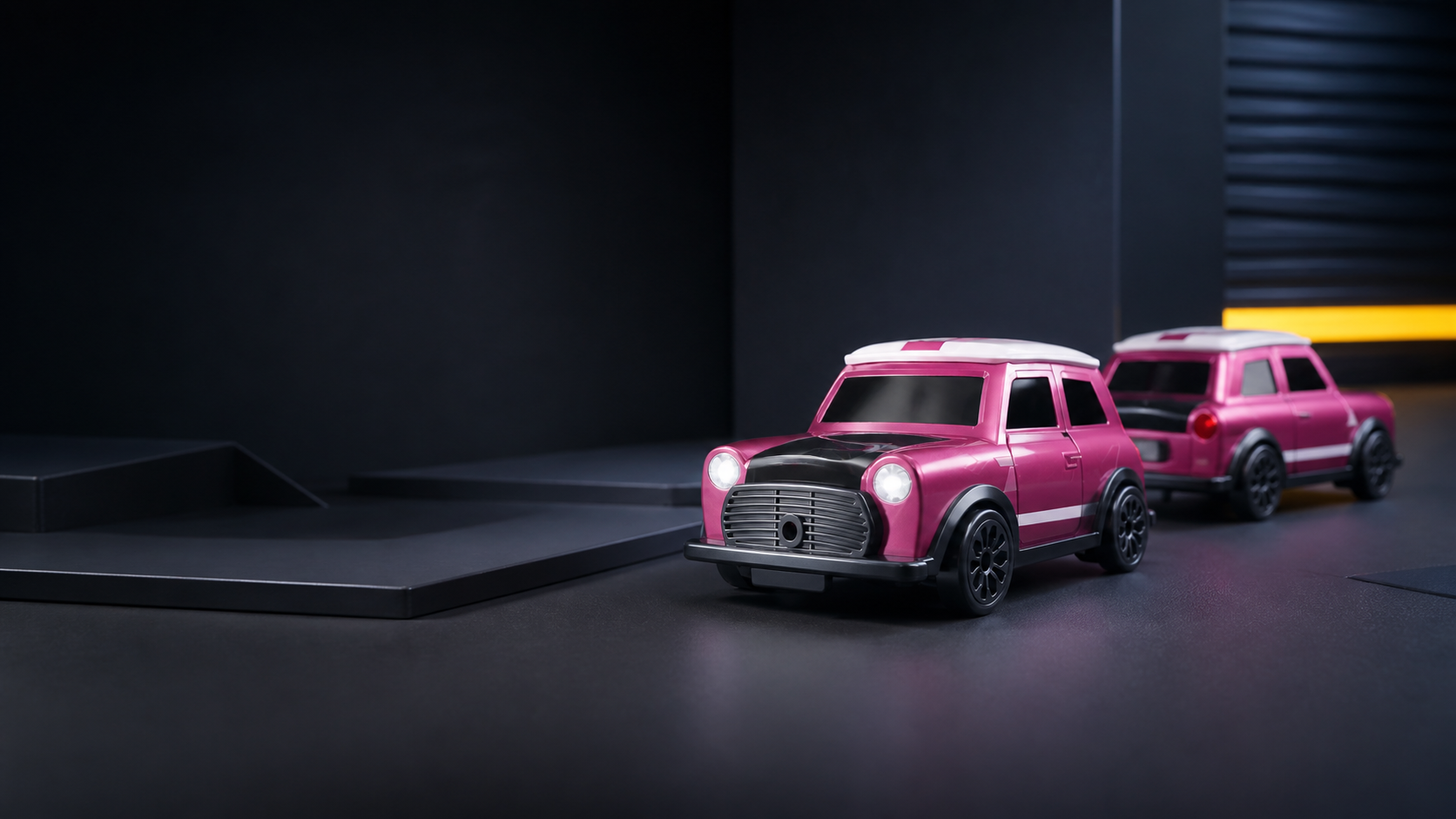
Use Amazon’s 2026 holiday gift book as a discovery-format reference, not a reason to increase RC purchase volumes. For stunt, gesture and RC off-road cars, organize the assortment by control method, demonstrated terrain capability and battery/runtime, then test a limited shelf allocation before reordering. Separate a double-sided stunt/off-road candidate from a spinning, light-and-sound candidate; give gesture control its own comparison only when the specific model’s controller and functions have been confirmed.
What does Amazon’s 2026 gift book actually signal for RC buyers?
Amazon’s gift book provides a U.S. retail merchandising reference, not an RC sales-growth measurement. For the Amazon.com 2026 edition, observed on October 9, 2026, the publisher describes a selection from its Top 100+ Toys list on pages 4–9, curated by its CoreRCCar experts. The population is that retailer’s selected assortment; the metric is editorial selection and placement, not units sold, search interest or seller inventory. About Amazon
The useful interpretation is to make a broad assortment easier to shop through a small, clearly differentiated selection. For an RC shelf, that means showing the control method and play action before stacking several visually similar cars together. This is a category-planning inference, not a claim that Amazon featured stunt, gesture or off-road RC models.
The buying consequence is a bounded trial rather than a larger seasonal commitment. For U.S. resellers, measure the response in the intended retail channel. EU and other global importers can borrow the presentation idea while basing replenishment on their own country, channel and holiday selling period.
How should stunt, gesture and off-road RC cars be separated on the shelf?
Separate these cars by what the shopper controls and what the vehicle demonstrates, because gesture control, stunt action and terrain capability describe different attributes. One vehicle may combine them, but none should be assumed from another.
Lead with control: conventional handheld remote, gesture controller, or both. A 2.4 GHz radio description identifies a wireless specification; it does not establish gesture operation, driven-wheel layout or terrain performance. For a gesture candidate, demonstrate steering, stopping and switching between supplied control modes before assigning it that shelf label.
Make stunt action visible through a short, repeatable demonstration: double-sided driving, rolling, drifting or spinning, as applicable to the selected model. Put off-road candidates through a separate demonstration on the actual surface named in the merchandising brief. An off-road catalog description is not a measured claim about grass, gravel, slopes or water resistance.
Place vehicle battery type, included batteries, charging method and observed runtime beside the action description. Record runtime under stated conditions—surface, driving pattern, lights and sound—rather than treating an uninterrupted wheel-spinning demonstration as normal driving. Use each model’s supported age labeling; gift-book discovery groups are not a substitute for item-specific age assessment.
Which two catalog candidates support a distinct holiday trial?
| Double-sided stunt/off-road candidate — RC-283518 | Recorded control and action: 2.4 GHz remote control; double-sided operation, 360-degree rolling, drifting and rotating in the catalog description. Terrain positioning: described as off-road racing. Recorded material field: ABS; this does not establish every component’s composition. Packaging: color box. Reference MOQ: 120 units. Carton quantity: 24 units. Proposed role: trial the combination of double-sided stunt action and a specifically demonstrated terrain surface. Before release: specify driven-wheel layout, supplied controller functions, vehicle and controller batteries, charging method, runtime conditions, intended terrain and model-specific age labeling; compare those targets with the sample. |
|---|---|
| Spinning light-and-sound candidate — CQ-603 | Recorded control and action: 2.4 GHz wireless remote control; 360-degree stunt spinning, LED lighting and sound in the catalog description. Packaging: color box. Reference MOQ: 120 units. Carton quantity: 24 units. Proposed role: trial a spinning, light-and-sound demonstration on the surface confirmed during sample review; do not assign an off-road claim from the spinning function. Before release: specify driven-wheel layout, supplied controller functions, construction materials, vehicle and controller batteries, charging method, runtime conditions, intended surface and model-specific age labeling; compare those targets with the sample. |
What should the buyer decision record authorize?
Authorize these two candidates for sample comparison and trial planning, not an unconditional purchase release. The catalog descriptions provide enough differentiation to write the brief; the approved sample and commercial confirmation should determine the final order.
Treat the recorded MOQ as a reference for reconfirmation, not a guaranteed current offer. A carton quantity describes packing and does not, by itself, establish an order multiple. Keep the shelf allocation separate from the procurement quantity.
| Record identity and revision | 2026 holiday RC assortment brief; planning revision 1, dated October 27, 2026. Scope: the two catalog candidates compared above. |
|---|---|
| Specified target versus observation | Target: two clearly differentiated demonstrations with explicit control, surface and battery/runtime descriptions. Catalog observation: one double-sided stunt/off-road description and one spinning, LED-and-sound description. At sample review, record the observed result beside each target and identify the sample and packaging revision. |
| Decision and release conditions | Advance to sample review. Release a shelf trial only after the buyer accepts the demonstrated functions, terrain wording, battery/runtime description, item-specific age labeling, packaging and destination-market documentation, and confirms current order terms. |
| Responsible approver and review date | Proposed approval owner: the reseller’s category buyer, with product-safety review assigned to the responsible specialist. Planned trial review: November 30, 2026. The actual approver should enter their name and approval date at release. |
| Follow-up closure | Close each condition with its sample observation, accepted wording or supporting document reference. Keep unresolved conditions attached to the affected item. A safety failure can require an immediate hold on that specification; do not wait for a similar failure in another model. |
How can a four-week shelf trial produce a reorder decision?
Use a fixed observation period, comparable placement and a predeclared reorder threshold so the trial measures a local retail response rather than enthusiasm for a demonstration. The following numbers are hypothetical buyer criteria, not sales forecasts or industry benchmarks.
For example, plan a November 2–29, 2026 trial in one U.S. toy-store location. Allocate 24 sellable units of each candidate from the retailer’s approved inventory. Place them side by side in the holiday RC area with equal facings, clearly differentiated action cards and comparable access to demonstrations. Record selling price, promotions, stockout days and changes in placement.
If the double-sided candidate sells 18 of its 24 offered units, its period sell-through is 18 ÷ 24 × 100 = 75%. If the spinning light-and-sound candidate sells 12 of 24, its sell-through is 50%. These results describe that store, placement and four-week window only—not U.S. category growth. Track returns and functional complaints separately so a headline sell-through figure does not conceal product issues.
A proposed rule is to consider replenishment at 70% or higher sell-through when the item remained available throughout the trial, the margin meets the buyer’s target and no unresolved product-safety issue blocks release. Under this example, the double-sided candidate qualifies for reorder review; the spinning candidate does not. Before changing its presentation and retesting, check whether shoppers understood its control and spinning functions.
For an EU store or another reseller market, repeat the same measurement locally rather than transferring the U.S. result. Online retailers should run a separate listing-level trial, recording units offered, units sold, traffic, conversion and promotion exposure. The gift book can inspire the display; the reorder should follow the trial.