
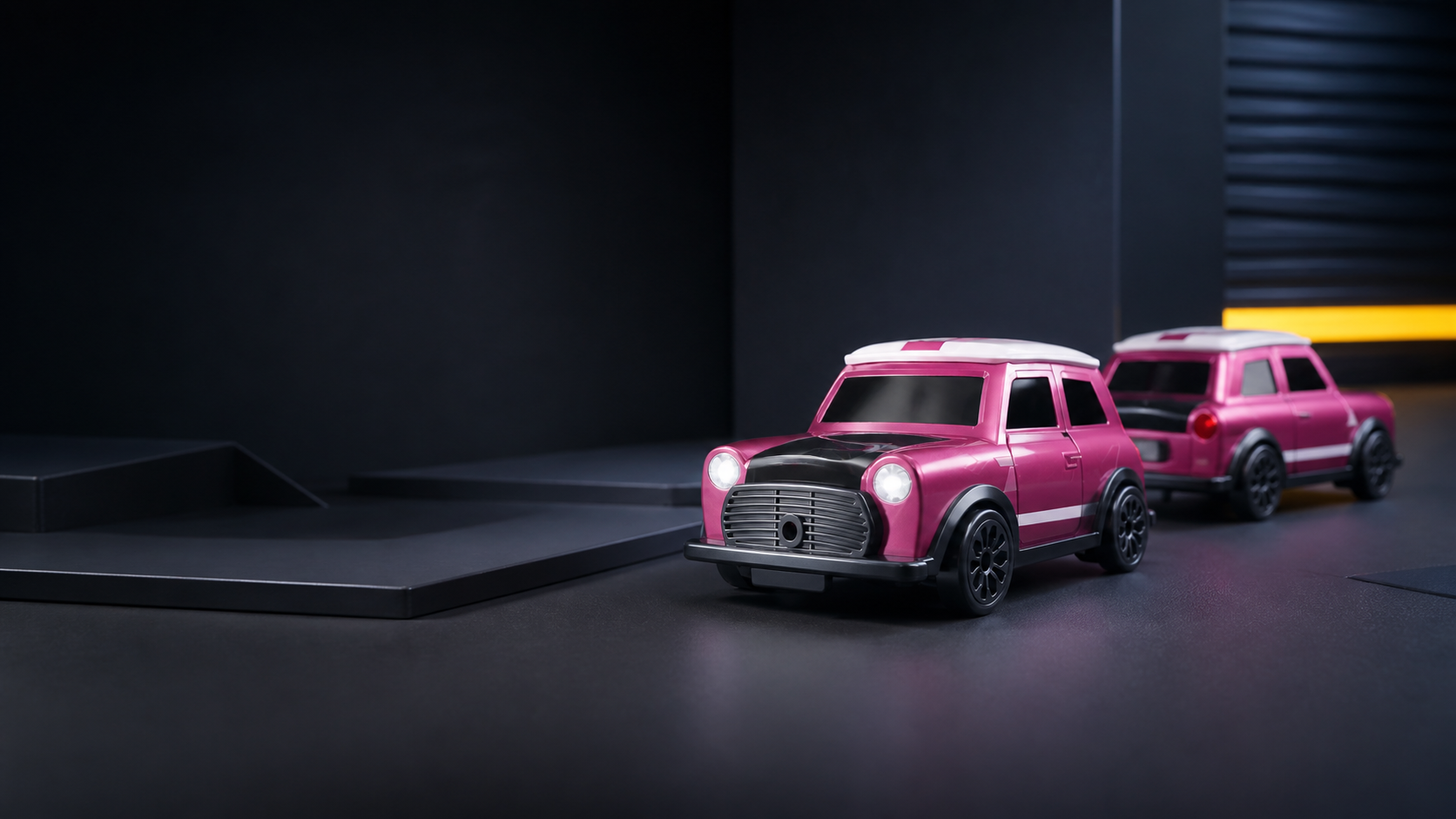
Use Amazon’s CoreRCCar selection to sharpen the RC off-road cars buyer brief—not to justify a larger order. Prioritize a clearly demonstrated control mode, a specific terrain claim and runtime stated per battery pack. For the two catalog candidates, shortlist the gesture-sensing stunt car for a bounded trial and assess the seven-channel pickup separately. Commit only after sample approval, current commercial confirmation and a shelf-test plan with a defined reorder threshold.
What does Amazon’s 2026 selection actually signal for RC buyers?
Amazon’s selection provides a US holiday merchandising reference: organize the offer around play interest, age and budget, then make the RC-specific differences easy to understand. The 2026 holiday list, observed October 9, 2026, is an expert-curated selection of more than CoreRCCar. That observation date is not a publication date. Its scope is Amazon’s US retail curation, not wholesale purchasing or measured RC sell-through. CoreRCCar We Love
The announcement names an RC monster truck at a listed $49.99. This is a product-and-price observation within that US holiday selection—not a price benchmark for an unlicensed pickup or gesture stunt car. Amazon also states that prices and availability can change. CoreRCCar We Love
The practical change belongs in the meeting agenda: replace a broad “CoreRCCar” buying bucket with distinct control and terrain profiles. Keep that interpretation separate from a demand forecast. The US selection does not establish rising stunt, gesture or off-road RC sales, and it should remain a US retail reference in EU and other international buying meetings.
Which control, terrain and battery profiles deserve attention now?
Prioritize the gesture-sensing stunt car for a demonstration-led trial; evaluate the seven-channel pickup as a separate vehicle-play proposition rather than assuming equivalent stunt or off-road capability.
For control, distinguish hand-gesture input, conventional remote control and dual control. The 1:12 stunt car’s catalog description records gesture sensing, 2.4 GHz, 4WD and drift functions. Request a demonstration of each included control device and the switching sequence before describing it as dual-control. For the pickup, request a function map for all seven channels; a channel count alone does not explain what the shopper can do.
For terrain, choose the intended surface before approving the claim. A 4WD description is not proof of short-grass performance, and a pickup body is not proof of off-road ability. Check starting, steering, reversing and recovery on the actual proposed surface. Keep any approved shelf wording as specific as the demonstrated capability.
For battery and runtime, compare minutes per pack—not an unexplained total across spare packs. Request battery chemistry, capacity, included pack count, charging method and recharge time. Record sample runtime with the surface, driving pattern and lights/music settings. These are purchasing checks, not substitutes for applicable safety testing.
1:12 Gesture-Sensing RC Stunt Car
| Item identifier | RC-289538 |
|---|---|
| Catalog identity | 1:12 gesture-sensing RC stunt car with hand control, drift functions, lights and music |
| Recorded radio and drive description | 2.4 GHz; 4WD |
| Recorded packing | Single item |
| Reference MOQ | 24 units |
| Units per carton | 24 |
Alloy Pickup Seven-Channel RC Car
| Item identifier | RC-352172 |
|---|---|
| Catalog identity | Alloy pickup seven-channel RC car |
| Recorded material | Alloy/ABS |
| Recorded packing | Window box |
| Reference MOQ | 288 units |
| Units per carton | 96 |
What should the one-page decision record capture for each RC car?
Each item’s decision record should connect the intended shelf promise to an identified sample, its observed performance and a named approval decision.
Identify the item, sample revision, packaging revision, destination market and review date. Under control, terrain and battery/runtime, enter the specified target beside the sample observation—not in the same undifferentiated notes field. Record the demonstrated control modes, exact surfaces, minutes per pack and test conditions, with references to supporting photos, video or reports.
Carry forward the catalog pack, reference MOQ and carton quantity, then attach the current quotation and allocation plan. A carton quantity is a packing fact, not automatically an order multiple. Keep the proposed shopper age and warnings item-specific; do not copy an age band from another gesture or stunt car.
Close with approve, conditional approval or hold; the conditions; the responsible buyer and quality approver; approval date; and an owner and due date for each follow-up. Record closure against the same item revision. This supports traceability, but it does not by itself detect an undisclosed construction change.
How should a bounded 2026 shelf trial determine the reorder?
Reorder from a defined local selling trial, not from inclusion of another RC vehicle in Amazon’s holiday selection.
For an explicitly hypothetical trial, offer 24 units of each approved candidate for 28 consecutive selling days in the same store’s RC vehicle bay, with comparable display space and clearly differentiated control descriptions. Use sellable stock from an agreed allocation; this shelf quantity is not an assertion that the pickup can be ordered below its reference MOQ. If the wider pickup allocation is not justified, defer that purchase rather than buying the full reference quantity solely to populate the test.
Suppose the gesture car sells 18 of 24 offered units and the pickup sells 12 of 24. Sell-through is units sold divided by units offered: 75% and 50%, respectively. Record actual prices, promotions, demonstration exposure, stockout days, returns and remaining sellable units so placement or availability differences are not mistaken for product preference.
As a proposed buyer rule—not an industry benchmark—set 70% sell-through over the trial period as the reorder gate, alongside the buyer’s margin requirement and acceptable product performance. In this example, consider a limited gesture-car reorder; hold the pickup reorder and review its proposition or placement. One safety failure can require an immediate stop and assessment regardless of sell-through.
For EU or other international channels, repeat the trial locally and name the country, store or online channel, observation period and units offered. Treat local sales as the reorder evidence and Amazon’s US selection as the merchandising reference.