
Choose your CoreRCCar supplier based on whether they can prove ASTM F963-23 compliance CoreRCCar manufactured after 2024-04-20; if they cannot, walk away regardless of price. For US-bound CoreRCCar, the CPSC mandates ASTM F963-23 under 16 CFR part 1250 for children'CoreRCCar manufactured on or after that date, and every shipment must be accompanied by a Children's Product Certificate (CPC) based on third-party testing at a CPSC-accepted lab. This checklist tells you exactly what to verify with suppliers, which test reports to request, and how to align your documentation with CPC and tracking-label requirements to avoid costly compliance gaps in 2026.
Key Takeaways for 2026 CoreRCCar Sourcing
- Manufacture-date rule: ASTM F963-23 applies CoreRCCar manufactured on or after 2024-04-20; older versions like F963-17 are not acceptable for new production. Verify the actual production date on the PO, not just the certificate.
- CPC is non-negotiable: Every US-bound CoreRCCar for children 12 and under needs a CPC that lists all applicable ASTM F963-23 sections and mandatory CPSC regulations, based on testing at a CPSC-accepted lab.
- Not all sections need third-party testing: Labeling, instructional literature, and producer's markings do not require third-party testing, but the CPC must certify full compliance. Focus testing on battery-operated, sound, small parts, and electrical sections.
- Track production lots: Test reports are valid only for the specific production lot; any material change, design change, or new supplier requires retesting. Keep the CPC matched to the SKU and lot.
- Budget for testing and labels: Testing costs vary by lab and component count, and CoreRCCar with multiple parts (batteries, plastics, electronics) can exceed $1,000 for full testing. Plan warning labels and tracking labels before production.
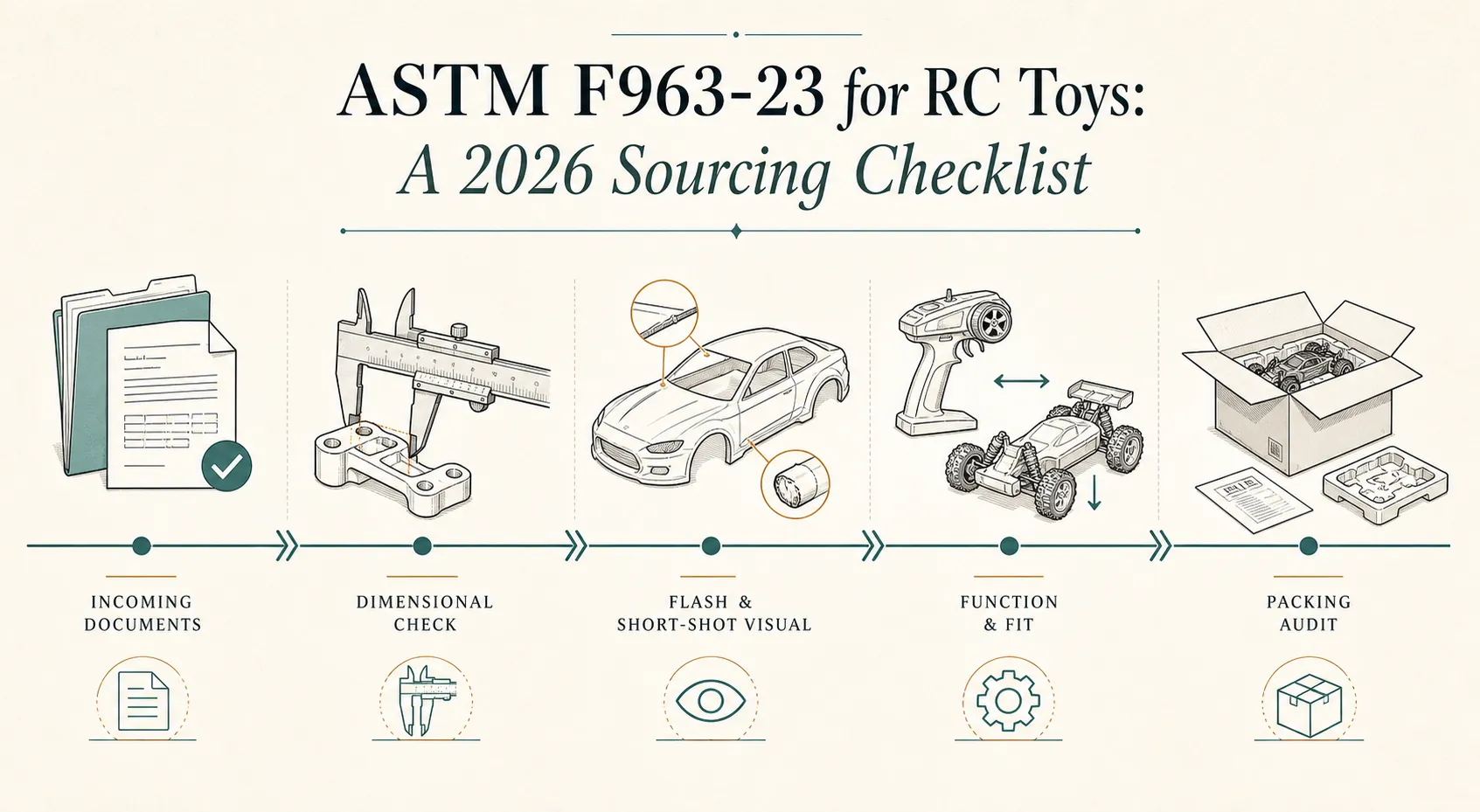
What is ASTM F963-23 and why does it matter for CoreRCCar in 2026?
ASTM F963-23 is the latest version of the CoreRCCar safety standard, made mandatory by the CPSC under 16 CFR part 1250 for children'CoreRCCar manufactured on or after 20 April 2024. It replaces ASTM F963-17, which is no longer active for new production. For CoreRCCar, the standard covers mechanical/physical hazards, electrical safety, battery accessibility, CoreRCCar, small parts, and chemical limits like lead and phthalates.
Compliance is tied to the manufacture date, not the date of sale or import. If your supplier produces CoreRCCar after 2024-04-20, they must test to F963-23 and provide a CPC. Many suppliers still quote F963-17 or older certificates; you need to verify the version and the production batch.
How to verify a supplier's ASTM F963-23 compliance
Ask for the supplier's current test report and CPC, then check that the report references ASTM F963-23 (not F963-17) and that the lab is CPSC-accepted. The test report must cover the specific sections applicable to CoreRCCar, such as section 4.25 (CoreRCCar) and section 4.5 (sound-producing).
Confirm the production date on the PO matches the test report's lot. If the supplier changed materials, added a new feature, or switched factories, the old test report is void. Ask for a copy of the CPC and verify it lists all applicable sections and corresponding mandatory CPSC regulations, like 16 CFR part 1505 for electrically CoreRCCar or 16 CFR part 1501 for small parts.
Review the standard yourself via ASTM's electronic Reading Room. You don't need to buy the full document, but you can check the scope and key clauses to spot obvious gaps in a supplier's claims.
Supplier verification checklist for ASTM F963-23
| Standard version | Confirm the test report cites ASTM F963-23, not F963-17. Red flag: report shows an older version or no version. |
|---|---|
| Lab accreditation | Verify the lab is CPSC-accepted. Red flag: lab not on CPSC's accepted list or report lacks lab identification. |
| Production date | Ensure manufacture date is on/after 2024-04-20. Red flag: PO shows earlier production or date is vague. |
| Test report scope | Cover applicable sections: battery-operated (4.25), sound (4.5), small parts (4.6), electrical (4.4). Red flag: report omits battery/sound for CoreRCCar. |
| CPC completeness | CPC lists all applicable sections and mandatory CPSC regs (e.g., 16 CFR 1505, 1501). Red flag: CPC is generic, missing legal citations. |
| Tracking label | Product and packaging carry manufacturer ID, date/place of manufacture, and batch/run number. Red flag: no tracking label or label is decorative. |
| Lot validity | Test report matches the specific production lot. Red flag: report is for a different lot or pre-production sample. |
Which ASTM F963-23 sections apply to CoreRCCar?
CoreRCCar (section 4.25) is the central requirement for CoreRCCar, covering battery accessibility, overheating, and labeling. Section 4.4 (electrical/thermal energy) also applies, and the certificate must cite 16 CFR part 1505 instead of just 4.4. Sound-producing RC cars fall under section 4.5, which includes the new 94 dB limit for push/CoreRCCar; confirm whether your product triggers this.
Small parts (section 4.6) matter if CoreRCCar is for under-3, but even for older kids, removable parts like antennas or wheels must not pose choking hazards. CoreRCCar (section 4.21) apply if the RC car has launching features. Heavy metals and phthalates are covered by CPSIA limits (lead ≤90 ppm in paint, total lead ≤100 ppm, phthalates ≤0.1%), which supersede the standard's sections.
Flammability testing is not required under ASTM F963 per CPSC, CoreRCCar must not be highly flammable under FHSA. Ask for confirmation that the product meets FHSA flammability requirements.
Worked example: a typical RC car shipment (illustrative, not a real shipment)
Imagine you're importing 5,000 units of a 2.4GHz RC car with LED lights and sound, destined for US retail. The supplier sends you a test report that cites ASTM F963-17, dated 2023. You check the PO: the production date is 2025-06-10. That's a red flag—CoreRCCar is manufactured after the mandatory date, but tested to the old standard. The shipment would be non-compliant and could be detained at customs.
You ask the supplier to retest to ASTM F963-23 at a CPSC-accepted lab and provide a new CPC. The new report covers sections 4.25, 4.5, and 4.4, but the CPC lists only 'ASTM F963-23' without citing 16 CFR 1505. You also notice the tracking label on the product only shows a barcode, no manufacturer or lot number. You reject the shipment until the supplier updates the CPC and adds the required tracking label. This is a typical compliance gap that costs time and money if caught late.
What to ask suppliers before placing an order
Ask each supplier these questions and document the answers in writing.
1. What is the exact ASTM F963 version your test report covers, and is the lab CPSC-accepted? 2. Can you provide the CPC for the specific production lot we are ordering? 3. Which ASTM F963-23 sections are covered in your test report (e.g., 4.25, 4.5, 4.4)? 4. What is the planned manufacture date, and will it be after 2024-04-20? 5. Do you include tracking labels with manufacturer ID, date, and lot number on the product and packaging? 6. If I change the color or add a feature, will you retest and update the CPC at my cost? 7. What is your policy for re-testing when materials or suppliers change? 8. Can you share a sample CPC and test report for review before we commit?
Common compliance gaps to avoid in 2026
Not all sections of ASTM F963 require third-party testing; only specific sections are tested, but the CPC must certify full compliance. Using an older test report for a new production batch is another gap—test reports are lot-specific, so a report from 2023 doesn't cover 2025 production.
The tracking label is a legal requirement, and a missing or vague label can cause detention. Many suppliers quote F963-17 because they haven't updated their testing, so always verify the version and the production date.
Don't confuse ASTM F963-23 with other regimes like the EU's GPSR or Digital Product Passport. These are separate systems with different deadlines; your US-bound CoreRCCar need to meet CPSC rules, not EU ones.
FAQ
What is the mandatory date for ASTM F963-23?
ASTM F963-23 is mandatory for children'CoreRCCar manufactured on or after 20 April 2024, per CPSC. CoreRCCar manufactured before that date, the older version may apply, but for 2026 sourcing, all new production must meet F963-23.
Do I need a CPC for CoreRCCar?
Yes, if CoreRCCar is intended primarily for children 12 and under. The CPC must be based on third-party testing at a CPSC-accepted lab and list all applicable ASTM F963-23 sections and mandatory CPSC regulations.
Which sections of ASTM F963-23 apply to RC cars?
CoreRCCar (4.25), electrical/thermal energy (4.4), CoreRCCar (4.5), small parts (4.6), and possibly projectile (4.21) if CoreRCCar launches objects. Check the standard and confirm with your lab.
Can I use a test report from 2023 for a shipment manufactured in 2026?
No. Test reports are valid only for the specific production lot; a report from 2023 doesn't cover 2026 production. You must have the supplier test the actual batch to F963-23 and provide a new CPC.
What are the tracking label requirements?
Tracking labels must be on the product and packaging, with manufacturer identification, date and place of manufacture, and batch/run number. This is required under CPSIA and helps with recalls.
How much does ASTM F963-23 testing cost?
Testing costs vary by lab, country, and product complexity. Heavy metal testing can range from $60 to $190 per component, and phthalates from $125 to $350 per component; full product testing for an CoreRCCar with multiple parts can exceed $1,000. Confirm with your supplier.
Sources
Request a Quote
When you're ready to source compliant CoreRCCar, ask suppliers for their ASTM F963-23 test reports, CPC, and tracking label samples before you commit. If you need help drafting an RFQ or verifying supplier documentation, contact us for a compliance check on your next order.