
How do you compare RC controls at the January 11–14, 2027 Hong CoreRCCar & Games Fair when similar channel labels describe different vehicles? Map each input to its response: a spinning bus and a pickup with opening doors need different demonstrations, even when both say seven-channel.
The four-channel RC-352391 tractor-trailer supplies a clean baseline: forward, reverse, left and right. The seven-channel RC-352157 graffiti bus adds three speed settings and 360-degree spins, while the seven-channel RC-352168 pickup combines driving, lighting and hands-on body features. A bigger label alone cannot explain that contrast to a customer.
Use the fair at to build a function map your store team can actually demonstrate. The five models below are catalogue preparation references, not confirmed 2027 exhibits; battery and packaging specifications come from catalogue records. This comparison has no witnessed runtime or charging test.
Give your fair route a practical starting point
Start with Electronic & Remote CoreRCCar in the. AI & CoreRCCar and Kidult World are also listed, making useful adjacent categories when the ranges you discover fit your store.
At each relevant demonstration, follow the same sequence: basic driving, selectable modes, effects, then features operated by hand. Keep the demonstrated controller beside the vehicle while taking notes. This turns a channel-count conversation into a repeatable comparison of what staff must explain and what customers actually do.
The control-comparison worksheet
Carry this catalogue function map into the fair. Keep a stunt in the driving-action column until its activation method is shown; a named action is not automatically a dedicated button. “Unspecified” leaves room for a demonstration note rather than assuming a feature is absent.
| Reference | Driving actions | Modes or input paths | Effects | Manual or physical features |
|---|---|---|---|---|
| RC-352391 — four-channel tractor-trailer | Forward, reverse, left, right | 2.4GHz handset | Lighting | Tractor tows trailer; separate powered trailer action unspecified |
| RC-352157 — seven-channel graffiti bus | Directional driving, drifting, 360-degree spins | 2.4GHz handset; high/medium/low speed | Built-in lighting | Unspecified |
| RC-352168 — seven-channel alloy pickup | Forward, reverse, left, right | 2.4GHz handset; high/medium/low speed | Headlights and taillights | Manually opening doors; liftable hood |
| RC-352401 — miniature drift car | Directional driving and drifting | 2.4GHz handset or mobile app | Headlights | Obstacle accessories for a miniature course |
| RC-306028 — six-channel stunt reference | Drifting and 360-degree rotation advertised | Gesture sensing and remote controller | Lighting and spray advertised | Unspecified |
Tractor-trailer: establish the directional baseline
The 1/14-scale RC-352391 uses a 2.4GHz remote and explicitly lists four directional commands. Towing supplies its freight-truck play mechanism; it does not add a documented powered trailer command. At a comparable fair demonstration, record the control used for each direction, the return-to-rest action and how the lighting starts.
Power requirements: the vehicle lists a 3.7V 500mAh lithium battery, while the controller needs 2 AA cells supplied separately. Keep the vehicle pack and controller cells in separate fields; neither the voltage nor capacity establishes operating time.
Its window box measures 54.4 cm × 11.5 cm × 15.5 cm—package dimensions, not vehicle dimensions. Note that elongated format when considering how the towing story will read on your shelf; assess its turning behaviour on the demonstration surface separately.
The RC-352391 supplier sheet makes the baseline visible: forward/backward and left/right labels sit beside the handset, with separate lighting graphics and a 46.7 cm length annotation. That annotation belongs to the illustrated version; a static steering legend does not demonstrate trailer tracking. The catalogue records USD 7.28–7.61 per supply unit, MOQ 108 and 36 units per carton. Preserve the supplier item reference QK-2620 beside the internal code when matching a sample to this sheet.
Graffiti bus: make the stunt activation visible
The 1:64 RC-352157 is the movement-led seven-channel reference: its 2.4GHz description combines drifting, 360-degree spins and 3 speed settings. At the fair, have a demonstrator show whether rotation starts through a dedicated input, a steering sequence or another selection. Record that distinction beside the action, not inside an assumed channel total.
Power requirements: the bus lists a built-in 3.7V rechargeable lithium battery and 2 separately supplied AAA controller cells. Battery capacity is unstated; retain that gap beside the battery rating rather than deriving a runtime from another miniature model.
Its window box measures 14 cm × 6 cm × 18 cm. That compact package gives you a useful merchandising contrast with the tractor-trailer, while the demonstration should explain how the speed settings change the same driving task.
For the bus, the recorded USD 4.03–4.21 per supply unit, MOQ 360 and 120 units per carton identify the proposed commercial configuration. Keep that record separate from a bus's control explanation: a case quantity cannot explain whether a spin is a button action or a driving sequence. Use the catalogue's 3 named speed settings as observation headings, then record the actual input and response under each.
Alloy pickup: keep opening panels out of the remote map
RC-352168 also carries a seven-channel label and offers 3 speed settings through its 2.4GHz control description. Its distinguishing play features are different: alloy body and doors, manually opening doors and a liftable hood. Show those stationary interactions separately from directional driving and the headlights and taillights.
Power requirements: the pickup lists an included built-in 3.7V rechargeable lithium battery; the controller needs 2 AAA cells, not included. Battery capacity is not stated. Keep this power configuration attached to the pickup version rather than copying a bus's demonstration duration.
The window box is 15.3 cm × 7 cm × 18.6 cm. Alongside the bus, it offers a practical fair-shortlist contrast: movement-focused stunt play versus driving plus tactile display features. Photograph the demonstrated lighting controls where permitted so staff can explain activation precisely.
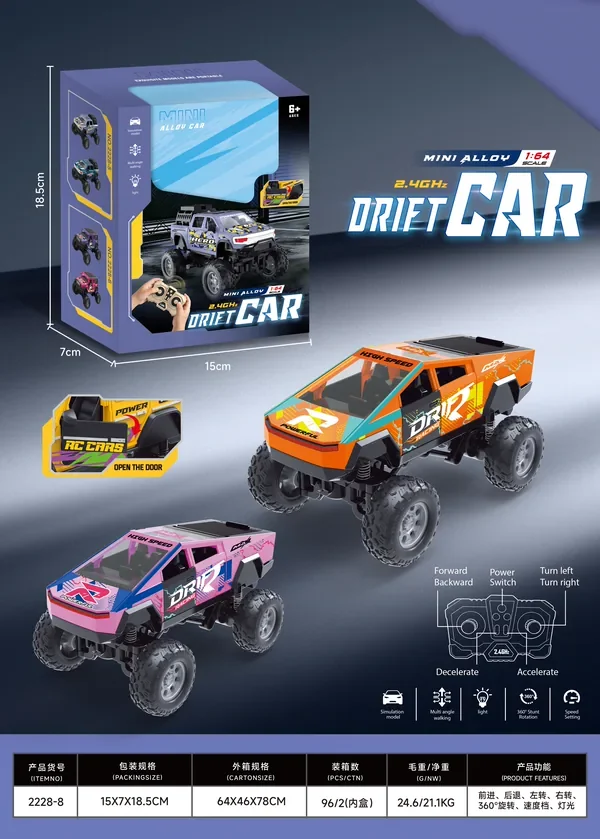
The pickup sheet shows orange and pink versions, a separate open-door inset and a controller diagram labelled for direction, speed changes and power. It also prints a 360-degree stunt icon, which the text does not assign to a specific input. Treat that icon as a separate advertised function to observe, not a resolved seventh channel. The sheet's 15 × 7 × 18.5 cm box label differs from the record's 15.3 × 7 × 18.6 cm. Keep both version labels; neither is the vehicle size. The record lists USD 5.35–5.59, MOQ 288 and 96 supply units per carton.
Mini drift car: compare the handset with the app
The 1/64-scale RC-352401 lists 4WD, directional driving and drifting, controlled through either a 2.4GHz handset or a mobile app. Its included USB cable and 3 obstacle accessories give a useful starting point for a miniature driving demonstration rather than a feature recital.
At the fair, follow the same route with each input device. Record pairing, the handover between devices, the neutral position and the stop action. Treat proportional steering and simultaneous control as separate questions, not meanings hidden inside “handset or app.”
Power requirements: the built-in vehicle battery is listed as a 3.7V 100mAh pouch lithium type; the handset requires 2 AA cells, not included. Identify the supplied charging connection and instructions with this battery, rather than turning its capacity into a playtime promise.
Storage-box packaging measures 12.05 cm × 7.1 cm × 10.95 cm. Inspect how the demonstrated controller and accessories are presented alongside it; the package measurement is not the space required for drifting.
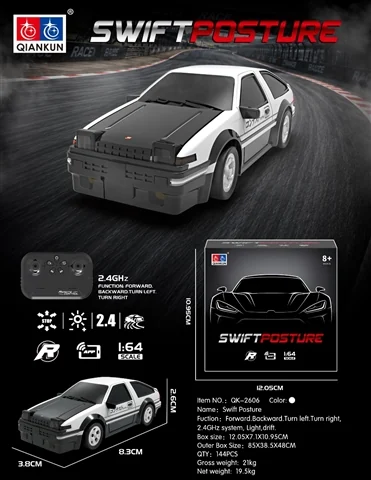
The RC-352401 sheet shows a white-and-black car, a handset and a storage-box view labelled 12.05 × 7.1 × 10.95 cm. It does not show an app screen, pairing result or a complete obstacle layout. Its 4WD wording is a supplier description, not an underside inspection. The catalogue records USD 5.25–5.48, MOQ 432 and 144 supply units per carton. For the meeting record, put the actual input device and software identity next to this vehicle version before explaining control handover.
Gesture stunt reference: identify neutral and stop
RC-306028 advertises six-channel control, 6WD, gesture sensing, a remote controller and 360-degree rotation, with lighting and spray adding visible effects. For a gesture demonstration at the fair, concentrate on the physical movement that starts an action, the position that leaves the vehicle stationary and the action that stops it.
Then record how control returns to the handset. This makes the interface understandable without assuming that each advertised effect has its own independently selectable control.
Power strip: the controller specification lists 2 AA cells, and the package lists batteries, a charger, instructions and a remote. Leave the vehicle battery rating and charging/runtime fields blank in the worksheet; the record does not supply them clearly.
The window-box packing dimensions are 28.5 cm × 23.3 cm × 14.2 cm. Keep that package format attached to this reference rather than grouping it with the miniature cars solely because their channel labels are close.
For RC-306028, the record lists USD 7.18–7.86, MOQ 120 and 24 supply units per carton. Its 95.5 × 29.5 × 88 cm outer carton and 19.2 kg gross/18 kg net weights describe shipment, not the car's physical mass or a demonstration footprint. Use the 6-channel label to locate the configuration, then observe its gesture input separately; the label itself does not identify a stop command or a mode-switch procedure.
Copy this record for each fair demonstration
SKU/configuration: ____. Controller photograph, where permitted: ____. Input: ____. Resulting action: ____. Category—driving, mode, effect or manual feature: ____. Activation method: ____. Stop method: ____. Vehicle battery/controller cells: ____. Unresolved configuration: ____.
Keep each listed battery configuration attached to its model, and record any observed operating duration with its actual conditions. Your useful shortlist entry is an explanation of a demonstrated action, with the power requirements beside it—not simply “seven-channel.”
Connect your control notes to fair meetings
The schedules Click2Match for January 4–21, 2027, and for December 11, 2026–February 10, 2027. These windows frame product discovery and follow-up around the physical visit, without implying that a particular supplier currently has appointments available.
On the floor, opens exhibitor or product details from booth/product QR codes. Its favourites, chat, enquiries and in-person or online meeting-scheduling functions let you connect a control note to a business discussion. A scan itself is not a confirmed meeting.
For admission, starts at To Visit, then covers personal and company details, matching interests and confirmation. Successful registration generates an email; upcoming registration can instead display “Information will be coming soon.”
places Exhibition Centre MTR station, Wan Chai MTR station and Wan Chai ferry pier within a 10-minute walk. Keep the fair’s listed Harbour Road entrance with your arrival notes.
Start with a shortlist you can explain
Use Browse RC cars at CoreRCCar to build your reference shortlist before the fair. Carry the function map with it: what the driver does, what the vehicle does, which features move by hand and what power each configuration needs.