
When mixed mini RC cartons reach your warehouse, the receiving checks that decide whether stock enters fulfillment are carton count, body and color ratio, label identity, controller match, visible damage, spot function checks, and a written discrepancy record — each judged against the PO, not against a guess. A lot that fails these checks should be isolated and reworked before a single unit is listed for sale, because a wrong color mix or a mismatched controller becomes returns and bad reviews long before it becomes margin.
The cost of skipping assortment checks shows up in two places: the margin you lose on a short-selling color, and the chargebacks from a retailer that receives a case with the wrong ratio. A 1/43 scale mini drift car with a 2.4G remote, for example, is a different SKU than a single-sided stunt car with a wrist controller, and a mixed carton that swaps one for the other breaks your listing and your customer's expectation. So the receiving decision is not a quality pass — it is an identity and ratio confirmation that protects the economics of the whole order.
Key Takeaways
- All receiving decisions trace back to the PO and inspection plan; if the plan does not define the assortment tolerance, sample size, or defect classes, ask the factory for those numbers before you accept the lot.
- A golden-sample or type-test report does not automatically cover a later production lot; match the report's SKU, materials, colors, and production date to the PO or it is paperwork, not protection.
- Label and tracking content is a market-rule issue: a barcode that scans to the wrong SKU, or a pack missing manufacturer/date/lot, fails a receiving check even if the unit works perfectly.
- Controller pairing is a functional identity check — confirm whether controllers are pre-paired to specific units at the factory, because a cross-paired remote turns a working car into a customer complaint.
- Any failed lot must be recorded in a nonconformance report with defect, lot, quantity, containment, and disposition, and released only after rework is confirmed — never released to stock on a verbal promise.
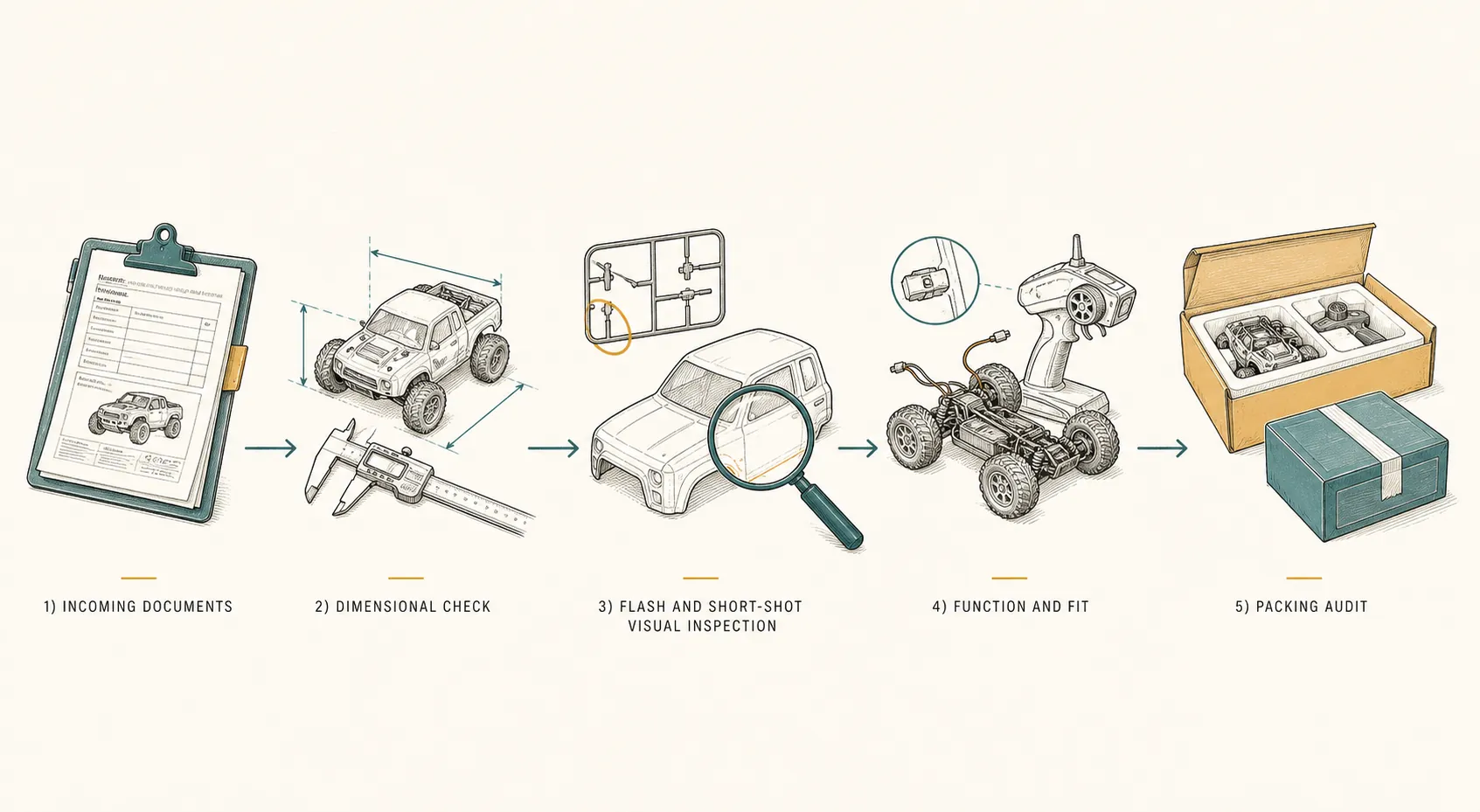
Why verify assortment ratios before units enter fulfillment stock?
The core reason is margin: a mixed carton is only worth what the correct mix of SKUs sells for, and a ratio that drifts from the PO means you are holding slow-selling colors while the fast ones are already out of stock. That is a cash-flow problem, not a cosmetic one. For an importer filling a 20GP or 40HQ container, the difference between a 60/40 body-style split and a 40/60 split can be weeks of lost sales on the popular variant.
Compliance is a second reason. A lot that carries the wrong label or a barcode that does not match the SKU is not just a picking error; for US children's products, tracking label content — manufacturer, date, and lot — is a regulatory requirement, and the CPC must be matched to the SKU, not to the factory door. So the receiving check protects both your sell-through and your legal standing.
The practical consequence of skipping the check: a mixed label reaches a retailer, the retailer's receiving clerk flags it, the chargeback hits your account, and your supplier relationship takes a hit. Line clearance at the factory is supposed to prevent this, but your receiving process is the last line of defense.
What checks should you perform when mixed mini RC cartons arrive?
Verify the carton count before you open a single carton, against the packing list and the PO. Record any shortage or overage immediately — a missing carton is a claim, a surplus carton is a discrepancy that has to be resolved before it enters stock. Ask the supplier: "What is the exact carton count and lot number on this shipment's packing list?"
Open a sample of cartons and count the assortment ratio — the mix of body styles and colors — against the PO ratio and your catalog SKU list. The tolerance for this ratio must come from the PO, not from a guess; if the PO does not state a tolerance, ask the factory: "What is the agreed assortment ratio tolerance on this PO, and does the packing list show per-SKU counts?"
Verify product identity on the units and packs: labels, barcodes, and tracking label content. Each unit or pack should carry the manufacturer, date, and lot as required for your market, and the barcode must match the SKU, not a generic factory code. A pretty barcode with no tracking content is not decoration — it is a compliance failure. Ask: "Does this lot have the required tracking label content on the product or pack, and does the barcode match the SKU?"
Check the controller match. For an RC car, the remote is part of the product identity — a controller that is paired to a different unit, or that operates on a different channel than the car, makes the product defective even if the car runs. Confirm at receiving whether the controllers are pre-paired at the factory; if they are not, you need a pairing process at your end, and that changes your labor cost. Ask: "Are controllers pre-paired to specific units at the factory, or do we need to pair them at receiving?"
Perform a visible damage inspection on a sample of units. Look for cracked bodies, missing parts, and crushed packaging — a carton that shows compression damage on the outside should be opened and checked inside, because lower cartons in a stack can crush packaging even if the outer carton looks fine. Record any damage by defect class, as defined in the PO's inspection plan. Ask: "What is the agreed defect class definition for visible damage on this PO's inspection plan?"
Run spot function checks on a sample: power on, basic movement, and controller response. A unit that does not power on, or that does not respond to its controller, fails the function check even if the rest of the lot looks fine. The sample size for function checks must come from the PO's inspection plan, not from a blog. Ask: "What is the agreed sample size for function checks on this PO's inspection plan?"
Record every discrepancy — count, ratio, identity, controller, damage, function — in a receiving discrepancy record before any unit is released to stock. The record should state the defect, lot, quantity, containment, disposition, and the responsible decision, not just a pass/fail note. If the lot fails, isolate it and do not release it until rework is confirmed. Ask: "What is the agreed rework and re-inspection process for a failed lot on this PO?"
Receiving checkpoints for mixed mini RC cartons
| Carton count | Verify against packing list and PO before opening; record shortage/overage. |
|---|---|
| Assortment ratio (body/color) | Count per-SKU/color against PO ratio within agreed tolerance; tolerance from PO. |
| Labels & tracking content | Check manufacturer, date, lot, and barcode-SKU match on unit/pack. |
| Controller match | Confirm pairing to unit; no cross-pairing between SKUs in same carton. |
| Visible damage | Inspect sample for cracked bodies, missing parts, crushed packaging. |
| Spot function checks | Power on, movement, controller response on sample; sample size from PO. |
| Discrepancy record | Document defect, lot, quantity, containment, disposition; isolate failed lot. |
How to set sample sizes for receiving checks without inventing numbers
AQL (Acceptable Quality Limit) is the standard framework for deciding how many units to inspect and how many defects to tolerate, based on ISO 2859 / ANSI/ASQ Z1.4. The key is that AQL is set separately for critical, major, and minor defects — critical defects (like a battery hazard) are typically at AQL 0, meaning zero tolerance; major defects (like a malfunctioning controller) might be at AQL 1.0; minor cosmetic defects (like a color mismatch) at AQL 2.5 or 4.0. But the actual numbers for your shipment come from the agreed inspection plan on the PO, not from a catalogue sentence.
The sample size is determined by the lot size and the inspection level. For example, for a 4,000-unit lot at General Inspection Level II, the code letter is L, which requires a sample of 200 units; at AQL 2.5, if 10 or fewer units fail, the lot passes, and if 11 or more fail, it is rejected. That is the methodology — but the exact sample size and accept/reject threshold for your mini RC shipment must be defined in your PO and inspection plan, because the factory and you have to agree on the inspection level before the lot is produced.
A type-test or golden-sample report does not automatically cover a later production lot. The report only covers the specific SKU, materials, colors, and production cohort it was issued for. So at receiving, match the report's SKU, materials, colors, and production date to the PO — if they do not match, the report is not protection for this lot. Ask the factory for the actual test report for the specific lot, not a generic certificate.
What should you record in a discrepancy report when a lot fails?
A nonconformance report (NCR) is the formal record of a failed lot. It should state the defect, the lot number, the quantity affected, the containment action (what you did to stop the problem from spreading), the disposition (rework, reject, accept with deviation), and the responsible decision-maker. It is not a pass/fail note; it is a document that lets you and the factory trace the problem and verify the fix.
When a lot fails, you isolate it — physically separate it from sellable stock — and you do not release it until rework is confirmed. Rework might mean re-labeling, re-pairing controllers, or replacing damaged units; whatever it is, the re-inspection must be agreed in the PO. Ask the factory: "What is the agreed rework and re-inspection process for a failed lot on this PO?"
Recording the discrepancy also protects your margin: it is the basis for a claim against the factory, a credit note, or a return. Without an NCR, a failed lot is just stock that does not sell.
What about claims like spray function, lithium batteries, FCC, or IP ratings?
When a mini RC product claims a spray function, a lithium battery, FCC compliance, or an IP rating, the receiving check is not the place to verify those claims — the factory's test reports are. Do not assume that because a product description says "spray" or "1200 mAh" the unit actually delivers it; ask the factory for the actual test report for the specific lot, and match it to the PO's SKU, materials, and production date. A lab report that covers a different SKU or a different cohort is not a shipment certificate.
For lithium batteries specifically, the relevant standards and transportation rules may apply at the time of shipping, but the official application date must be confirmed from the official text; do not assume a deadline. The same goes for FCC — the claim must be backed by a report that matches the product. If the factory cannot produce the report, treat the claim as unverified and decide whether to accept the lot without it or hold it.
What should you do if the assortment ratio is off but the units are perfect?
A ratio deviation is a discrepancy even if every unit works. The decision is whether to accept the lot with a deviation, request a rework (re-sorting the cartons), or reject the lot. The answer depends on your PO's tolerance: if the PO allows a 5% variance and the ratio is within that, accept it; if it is outside, you have a claim. Ask the factory for the agreed tolerance, and if the lot fails, record it in an NCR and isolate it. Accepting a wrong ratio without a documented deviation means you eat the margin loss on the over-supplied colors.
A mixed-container importer filling CBM with filler SKUs might accept a small ratio drift to avoid a costly rework, but that is a commercial decision, not a quality decision. The point of the receiving check is to make the decision explicit, with a record, so the factory knows the ratio matters for future orders.
Frequently Asked Questions
What is the first check I should do when a mixed mini RC carton arrives?
Verify the carton count against the packing list and PO before opening anything. Record any shortage or overage immediately, because a missing carton is a claim and a surplus carton is a discrepancy that must be resolved before stock enters fulfillment.
How do I know the acceptable variation in body and color ratio for my RC shipment?
The tolerance must be defined in your PO or inspection plan. If it is not, ask the factory for the agreed assortment ratio tolerance and per-SKU counts on the packing list. Do not invent a percentage; a ratio outside the agreed tolerance is a discrepancy that triggers an NCR.
Can I use a golden-sample test report to cover my whole mini RC shipment?
No. A type-test or golden-sample report only covers the specific SKU, materials, colors, and production cohort it was issued for. Match the report to the PO's SKU, materials, and production date; if they do not match, the report does not protect this lot. Ask the factory for the report for the actual lot.
What should I do if a controller is paired to the wrong car in a mixed carton?
That is a major functional defect. Isolate the affected units, record the discrepancy in an NCR, and either re-pair the controllers at your end (if the process is defined) or request rework from the factory. Confirm at receiving whether controllers are pre-paired at the factory to avoid this.
How do I set the sample size for function checks without knowing the AQL?
The sample size must come from the agreed inspection plan on the PO, which is based on the lot size and inspection level per ISO 2859 / ANSI/ASQ Z1.4. If the plan does not specify it, ask the factory for the agreed inspection level and sample size. Do not guess.
Is a failed lot allowed into stock if the damage is only cosmetic?
Only if the PO's inspection plan defines a defect class for cosmetic issues with an acceptable limit, and the sample is within that limit. If the damage is beyond the limit, isolate the lot, record an NCR, and do not release it until rework is confirmed — even for cosmetic defects.
Sources
Request a Quote
If you are sourcing mini RC cars for your next season and need a partner who can provide the packing list, per-SKU counts, and test reports that make receiving checks straightforward, request a quote with your target MOQ and destination market. The right supplier will answer your assortment ratio questions before the cartons land.