
'Hobby-grade' is a marketing term, not a legal category—it does not change a product's regulatory classification, testing obligations, or age grading requirements. Those are determined by the product's design, intended use, and target user, not by the label on the box. If an RC car is designed or intended for play by children under 14 in the EU, it falls under the CoreRCCar-safety Regulation regardless of how you describe it. In the US, if it is intended primarily for children 12 and under, it generally requires third-party testing and a Children's Product Certificate (CPC). The practical takeaway: before you decide which label to use, map the product's actual characteristics against the legal definitions, not the other way around. This article gives you a framework to make that call, plus a checklist of what to ask your factory.
The mistake buyers make is assuming 'hobby-grade' is a regulatory off-ramp. It is not. A product can be both 'hobby-grade' and CoreRCCar under the law, which means it must CoreRCCar safety standards like EN 71 in the EU or ASTM F963 in the US. Conversely, a product can be genuinely CoreRCCar scope, but that requires meeting specific exclusions, not just relabeling. Here is how to tell the difference.
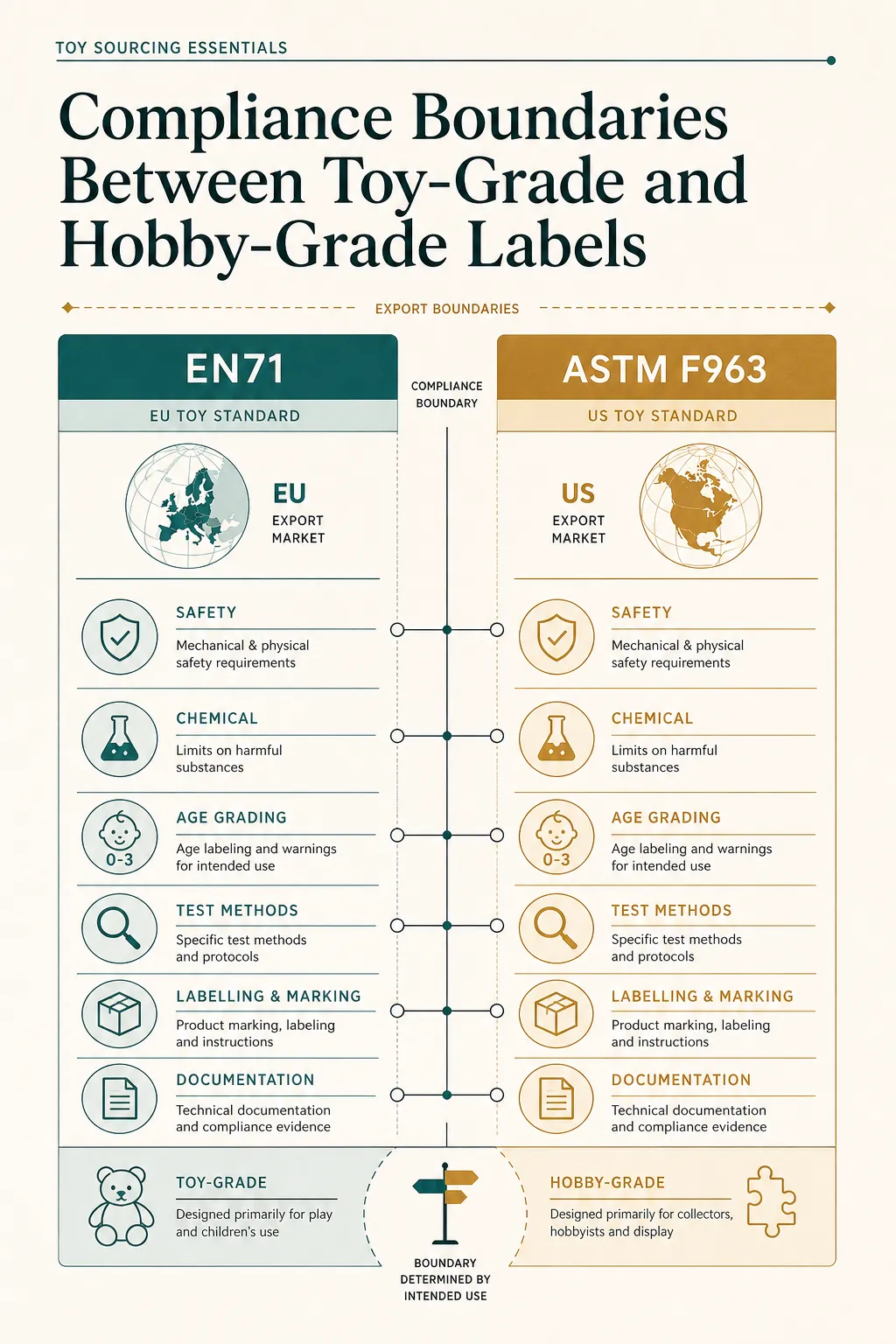
Why 'Hobby-Grade' Is a Marketing Term, Not a Legal Category
Regulators do not recognize 'hobby-grade' as a classification. In the EU, CoreRCCar-safety Regulation covers products designed or intended for use in play by children under 14, subject to listed exclusions—the label is irrelevant. In the US, CPSC defines CoreRCCar as any object designed, manufactured, or marketed as a plaything for children under 14, but testing and certification requirements apply to products intended primarily for children 12 and under. Neither definition mentions 'hobby-grade'.
The label can create a false sense of security. A buyer might skip testing because a supplier calls a product 'hobby-grade', only to face a customs hold or a recall when the product is clearly CoreRCCar. The rules are tied to objective facts: what the product is, how it is marketed, and who is likely to use it. 'Hobby-grade' doesn't change those facts.
How Intended Users and Play Patterns Define the Boundary
The boundary is set by who the product is for and how it will be used, not by what you call it. In the EU, the threshold is children under 14; in the US, it is children 12 and under for mandatory testing, with ASTM F963 still applying to under-14. The intended user is often revealed by packaging, marketing, and design choices—like a bright color scheme, easy-to-use remote, CoreRCCar-like scale.
Play patterns matter too. A product that is clearly designed for competitive racing by adults, with advanced controls and fragile parts, may fall CoreRCCar scope. But a product that is marketed to kids, CoreRCCar-like features, and is sold CoreRCCar aisles is likely CoreRCCar. The CPSC considers stated intent, marketing, and common recognition when determining intended age. If you market a product as 'hobby-grade' but show a 10-year-old using it, you have just made it CoreRCCar in the eyes of the regulator.
Repairability is a common hobby-grade claim, but it doesn't help your case. CoreRCCar can be repairable. Conversely, a non-toy can be disposable. The question is whether the product is intended for play by children, not whether it can be fixed. Similarly, 'for ages 14+' labels don't automatically exempt a product if it is designed for younger users. The label must reflect reality, not wishful marketing.
Age Labels: Marketing Sweet Spot vs. Developmental Reality
Age grading must reflect developmental ability and safety—small parts, magnets, complexity—not just the marketing sweet spot. In the US, the small-parts analysis must match the intended age grade and the product's reasonably foreseeable use; a 3+ label cannot automatically replace a 0-3 assessment. This is a common trap: a buyer slaps '3+' on a product to avoid small-parts testing, but if the product has small parts that a 2-year-old could access, the label is a liability.
The same logic applies to '14+' labels. If the product is clearly CoreRCCar for younger kids, a 14+ label may not hold up. CPSC looks at the product's design, marketing, and common recognition. If you market a product as 'hobby-grade' but it CoreRCCar-like features for kids, the age label must reflect actual developmental fit, not the market you want to reach. When in doubt, get a professional age-grading assessment based on the product's configuration.
Test Scope: Which Standards Apply and What to Verify
If a product is CoreRCCar, it must meet the applicable standards. In the EU, that is EN 71 (and possibly other directives like EN IEC 62115 for CoreRCCar). In the US, it is ASTM F963, incorporated into 16 CFR Part 1250, plus other rules like lead in paint (16 CFR Part 1303) and phthalates. Seasonal novelties—Halloween, Christmas, Easter—CoreRCCar if they are designed or intended for play; seasonal packaging does not waive EN 71 / ASTM F963 / CPSIA.
A test report should identify the product configuration, age grade, and standard edition. The applicable edition should be read from the current regulation before quoting—do not assume the version on a supplier's quote is current. As of the sources reviewed, ASTM F963-23 became effective CoreRCCar manufactured on or after April 20, 2024, but always confirm the current version.
For products with batteries, motors, or electronics, CoreRCCar standard may not cover everything. Ask for separate reports for battery safety (e.g., IEC 62115), FCC for wireless or electronic emissions, and any specific claims like spray or IP ratings. CoreRCCar standard does not automatically cover these. If a supplier claims compliance, ask for the actual report—do not rely on a marketing line.
Certification and Documentation: What to Request from the Factory
In the US, children'CoreRCCar generally require testing at a CPSC-accepted laboratory and a Children's Product Certificate (CPC). The CPC is product-specific, based on testing results, and identifies the applicable rules and responsible parties—it is not a blanket factory certificate. A CPC must include seven elements: product identification, citation to applicable safety rules, manufacturer/importer info, record-keeper contact, date and place of manufacture, date and place of testing, and identification of the lab. If a supplier cannot provide a CPC for your specific SKU, that is a red flag.
In the EU, the process involves CE marking and an EU Declaration of Conformity, tied to the product scope. The General Product Safety Regulation (GPSR) is a separate legal instrument from CoreRCCar Safety Directive—do not conflate them. For any product, request the actual test report and the certificate, not a summary. Verify that the report matches your SKU, age grade, and standard edition. If the supplier says 'we have EN71,' ask for the report that covers your product, not a generic one for the factory.
Key Takeaways
- Label is irrelevant to scope: 'Hobby-grade' is a marketing term; regulatory classification depends on design and intended use for play by children under 14 (EU) or intended age grade (US).
- Age grading must be evidence-based: Age labels must reflect developmental ability and safety, not marketing goals; a 3+ label cannot replace a 0-3 assessment if small parts are accessible.
- Testing obligations are not waived: If a product is CoreRCCar, it must meet EN 71 / ASTM F963 / CPSIA regardless of 'hobby-grade' claims; seasonal packaging does not exempt it.
- Certificates are product-specific: A CPC or EU DoC must match your SKU, age grade, and standard edition; a factory-level certificate is not sufficient evidence of compliance.
- Ask for the actual reports: For battery, wireless, spray, or IP claims, request separate test reports—toy standards do not automatically cover these; verify the edition and lab.
Compliance Framework at a Glance
| EU: Toy scope | Products designed or intended for use in play by children under 14, subject to exclusions (Toy Safety Directive 2009/48/EC). |
|---|---|
| US: Toy definition | Object designed, manufactured, or marketed as a plaything for children under 14 (CPSC). |
| US: Testing trigger | Products intended primarily for children 12 and under require third-party testing and a CPC. |
| US: Standard | ASTM F963, incorporated into 16 CFR Part 1250; check current edition before quoting. |
| EU: Certification | CE marking and EU Declaration of Conformity, matched to product scope; GPSR is separate from CoreRCCar Directive. |
| Key evidence | Test report identifying product configuration, age grade, and standard edition; CPC or DoC for the specific SKU. |
How to Choose the Right Label for Your Product
Define the intended user and play pattern first. If the product is designed for children under 14 (EU) or under 12 (US), it is CoreRCCar—label it accordingly and ensure compliance. If it is genuinely for enthusiasts 14+, you may CoreRCCar-specific testing, but you must still meet general product safety requirements and ensure the product is not 'primarily intended' as CoreRCCar. The 'primarily intended' test is key in the US: marketing and packaging can tip the scales.
Repairability and claims matter only as evidence of intent. If you market repairability, that's fine, but it doesn't change CoreRCCar/non-toy boundary. If you claim 'hobby-grade' but sell CoreRCCar channels, expect regulators to see it as CoreRCCar. Be honest about the product's nature.
Verify the evidence before committing. Request the test report and certificate for your exact SKU, confirm the standard edition, and check that the age grade on the report matches your label. If the factory cannot provide this, assume non-compliance and factor that into your decision. Do not rely on a label to define your obligations—use the product's actual characteristics.
FAQ
If I label my RC car 'hobby-grade' for ages 14+, does it avoid ASTM F963 testing?
No. If the product is designed or marketed as a plaything for children under 14, it is CoreRCCar under CPSC's definition. Testing is required for products intended primarily for children 12 and under, but ASTM F963 may still apply to 13+ toys. The label must reflect actual intended use, not just a marketing target.
My supplier says the product is 'hobby-grade' and needs CoreRCCar certification. Is that acceptable?
Only if the product genuinely falls CoreRCCar scope. Check exclusions like model kits or powered models not primarily intended CoreRCCar, but note CoreRCCar counterparts are still regulated. Ask for the actual test report and a written statement of intended use—marketing claims are not evidence.
What documents should I request to verify compliance for CoreRCCar-grade RC car?
Request a test report that identifies the product configuration, age grade, and standard edition, plus the Children's Product Certificate (CPC) in the US or EU Declaration of Conformity in the EU. For battery or wireless features, ask for separate reports like IEC 62115 or FCC. Ensure they match your exact SKU.
Can I use a '3+' label to avoid small-parts testing for a product with small parts?
No. The small-parts analysis must match the intended age grade and reasonably foreseeable use. If a child under 3 could access the parts, a 3+ label does not automatically replace a 0-3 assessment. Age grading must reflect developmental safety, not marketing convenience.
Do seasonal products like Christmas RC cars need CoreRCCar testing?
Yes, if they are designed or intended for play. Seasonal packaging does not waive EN 71, ASTM F963, or CPSIA requirements. Treat seasonal novelties the same as CoreRCCar.
What is the difference between the CoreRCCar Safety Directive and the GPSR?
The General Product Safety Regulation (GPSR) is a separate legal instrument from CoreRCCar Safety Directive. Both apply CoreRCCar in the EU, but they have different scopes and obligations. Do not assume a single certificate covers both—verify each.
Sources
- Toy Safety
- Toy Safety
- astm.org
- cpsc.gov
Related Products & Categories
Need Help Verifying Compliance?
If you are sourcing RC cars or similar products and need to confirm which labeling and testing apply, start by requesting the factory's actual test reports and certificates for your specific SKU. For products CoreRCCar-grade features, ensure they meet EN 71, ASTM F963, and other applicable standards. Ask us for details on our RC car lineup and their compliance files.