A custom colorway lets you test brand demand on an existing SKU — no new tool, no mechanism change, no electronics rework — so the real question is not whether color sells, but whether you can hold finish consistency across batches. The buyer who skips the colorway test and goes straight to a new mold is the buyer who pays for tooling on a hunch. This guide covers how to run a colorway test with an existing product, what to put in the PO, and when to step up to deeper tooling changes.
Key Takeaways
- A custom colorway is a surface-level change: it does not alter tooling, mechanism, or electronics, so the primary QC risk is finish consistency (color, flash, fit) — not function.
- Start from an existing SKU or sealed golden sample in the catalog; do not begin a colorway experiment with a new tool.
- Set the inspection checkpoint on finish before function, and for CoreRCCar verify screw closure, tool access, and the warning before CoreRCCar function.
- Freeze the master color standard in writing for reorders — the success metric is when a buyer asks for 'the next batch of #03' instead of 'do you have stock?'.
- If any color-master or mold-modification fee is involved, document fee amount, ownership, storage period, and idle-tool terms — tooling policy is a document, not a handshake.
Select the Base SKU: Start from What Already Sells
Pick a product that already has sales history or a sealed golden sample — not a new tool. Catalog SKUs like the Waterproof Stunt RC Drift Car or the Alloy Pickup 7-Channel RC Car (Pink Series) are candidates because they represent existing production lines with defined MOQs and materials.
Ask the factory: 'Which of your existing SKUs has the most stable production and the lowest defect history?' A colorway test on a shaky base SKU will fail on finish, not on color demand.
Define the Channel Hypothesis Before You Pick a Color
A colorway is a test of a channel hypothesis, not a design exercise. State which channel — Amazon, Mercado Libre, supermarket, gift — and which buyer segment the color targets. A Mercado Libre seller in CDMX buying party favors and CoreRCCar with reorders every 6–8 weeks is a concrete example: channel-specific demand testing works when the colorway matches the channel's impulse-buy pattern.
Write the hypothesis down: 'This colorway targets [channel] buyers who [behavior], and we will measure success by [metric].' If you cannot write the hypothesis, you are not ready to order.
Request the Master Color Standard: Golden Sample, Not a Photo
The argument that ends a color fight is the sealed golden sample on the QC shelf — emails do not. Ask the factory for a physical master color chip or a sealed golden sample in the new colorway before you commit to bulk. Do not approve from a photo or a Canton Fair booth sample; fair lighting lies, and the revision card does not.
When you receive the sample, verify it is labeled with the tool number and revision. If the factory cannot produce a labeled golden sample, that is a red flag for reorder continuity.
Confirm Minimum Split and Mixed Cartons Before Committing
The minimum quantity per colorway and whether mixed cartons (multiple colors per carton) are allowed determine whether you can test without committing to a full container of one color. Ask the factory directly: 'What is the minimum quantity per colorway, and can we mix colors in one carton?'
If mixed cartons are not standard, ask what the minimum split is. There is no universal number — it varies by spec — so the buyer must confirm it on the PO, not assume it.
Set the Inspection Checkpoint on Finish, Not Function
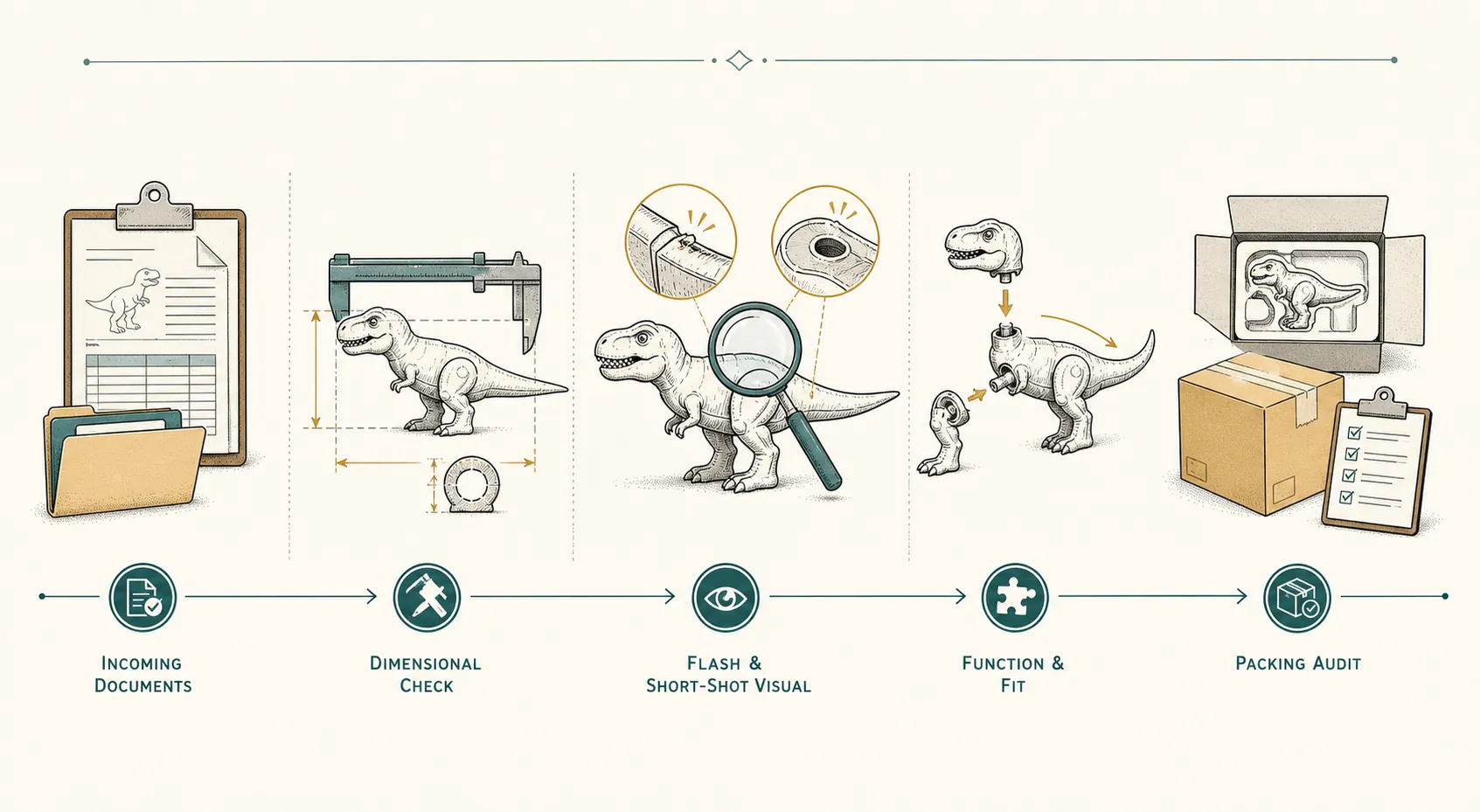
Before production, agree that QC compares bulk against the sealed golden sample for color, fit, flash, and function. For CoreRCCar, add compartment and warning checks before function: screw closure, tool access, and the warning label are verified before CoreRCCar function. A cute electronic that opens with fingernails does not ship.
Do not accept a verbal AQL number — ask for the agreed inspection plan on the PO. On the floor, a failed lot is isolated, defect class is recorded, and release happens only after rework.
Define Reorder Continuity in Writing
Agree in writing that the master color standard is frozen for reorders. The success metric is when a buyer asks 'when is the next batch of #03?' instead of 'do you have stock?' — but that only works if the factory can reproduce the same shade.
Ask the factory: 'If we reorder the same colorway in 6–8 weeks, how do you guarantee the same shade?' If the answer does not reference the sealed golden sample, push back.
Set Exit Rules and Document Any Tooling Policy
Define in the PO or contract what happens if the colorway does not sell: minimum release quantities, rework terms, and who owns the color master. Do not leave this verbal.
If the factory charges a color-master or mold-modification fee, write down the fee amount, ownership, storage period, and what happens if the tool sits idle. Tooling policy is a document, not a handshake. A buyer who paid a fee without freezing storage years or release conditions has no leverage later.
Custom Colorway vs. New Tooling: Where the Risk Sits
| Tooling change | None — uses existing mold; surface-level change only |
|---|---|
| Mechanism / electronics | Unchanged — same motor, PCB, and remote if the base SKU is kept |
| Primary QC risk | Finish consistency: color, flash, fit — not function |
| MOQ per colorway | Varies by spec — confirm the minimum split with the factory |
| Mixed cartons | Varies by factory — ask whether multiple colors per carton are allowed |
| Sample lead time | Varies by spec — request a sealed golden sample before bulk |
| Tooling / color-master fee | Possible — document fee, ownership, storage period, and idle-tool terms |
Worked Example (illustrative, not a real shipment): A Two-Destination Colorway Test
Imagine a buyer wants to test a pink colorway of an existing alloy RC pickup truck across two markets: a US Amazon store and a Mexico Mercado Libre store. The buyer orders a small run — approximately 300 units total — split 150 units for the US and 150 for Mexico, with the pink colorway applied to the existing mold.
The US cartons are packed single-color with English warning labels; the Mexico cartons are mixed-color (pink and the original color) to test shelf appeal. At QC, the inspector compares bulk against the sealed golden sample for color and flash. The US lot passes on color but fails on flash — the pink resin did not purge cleanly from the previous run. The lot is isolated, reworked, and released only after re-inspection.
The Mexico lot passes color but reveals a packaging issue: the mixed-carton instruction was a thank-you note, and corner-sensitive goods arrived dented. The lesson: claims are won on the booking file, so double-wall, corner boards, ECT, and pallet height must be written into the packing instruction — not assumed.
What to Watch This Year: Regulatory Screening Is Not Certification
CoreRCCar sold in the US, CPSC's Regulatory Robot can help identify potentially applicable rules, but its screening result does not replace the actual rule text or certification program. If a colorway change touches a button-cell compartment or a warning label, verify the compartment and warning against the current rule text — do not rely on a secondary article's title that mentions a year.
A supplier process, resin, mold, coating, component, or sub-supplier change should be notified and risk-assessed before use in a CoreRCCar. A colorway change can involve a resin change, which is exactly the kind of process change that requires notification.
FAQ: Custom Colorway Sourcing Questions
What is the minimum order quantity for a custom colorway on an existing SKU?
It varies by spec and factory. Ask the factory for the minimum quantity per colorway and whether mixed cartons are allowed. Confirm it on the PO, not assume a number.
Can I test a colorway without committing to a full container of one color?
Possibly, if the factory allows mixed cartons (multiple colors per carton). Ask directly: 'What is the minimum split per color, and can we mix colors in one carton?' If mixed cartons are not standard, the minimum split may be larger.
How do I guarantee the same shade on a reorder 6–8 weeks later?
Freeze the master color standard in writing and require the factory to compare bulk against the sealed golden sample on every lot. Ask: 'If we reorder the same colorway, how do you guarantee the same shade?' If the answer does not reference the golden sample, push back.
Who owns the color master or mold if I pay a fee?
It depends on the contract. Write down the fee amount, ownership, storage period, and what happens if the tool sits idle. Tooling policy is a document, not a handshake — a verbal agreement gives you no leverage later.
What QC checkpoint matters most for a colorway test?
Finish consistency — color, flash, fit — compared against the sealed golden sample. For CoreRCCar, verify screw closure, tool access, and the warning before discussing function. Do not accept a verbal AQL number; ask for the agreed inspection plan on the PO.
Do I need FCC or lithium test reports for a colorway change?
If the colorway change does not alter the electronics, the existing test report may still apply — but confirm with the factory. Ask: 'Can you provide the actual test report for FCC/lithium/spray on this SKU?' Do not assume the report covers the new colorway unless the factory confirms it in writing.
Sources
Ready to Test a Custom Colorway? Send Your Specs
Send your base SKU, target channel, and the colorway you want to test for a custom quote. Include your channel hypothesis and the inspection plan you expect — the factory will confirm the minimum split, mixed-carton options, and golden-sample lead time.