
Release CoreRCCar-grade RC car bulk PO only after the written specification, physical sample, approved production reference, test-document review, and packaging artwork have passed their assigned approval gates. This RC car procurement workflow separates permission to manufacture from permission to ship: bulk inspection and shipment release come later. First compare the sample with the agreed requirements—not with another unapproved sample—then retain the approved reference and carry its identity, specification revision, and authorized changes into the order.
These are recommended purchasing controls, not a substitute for applicable safety testing. A written approval trail supports traceability and change review; it cannot, by itself, reveal an undisclosed component substitution.
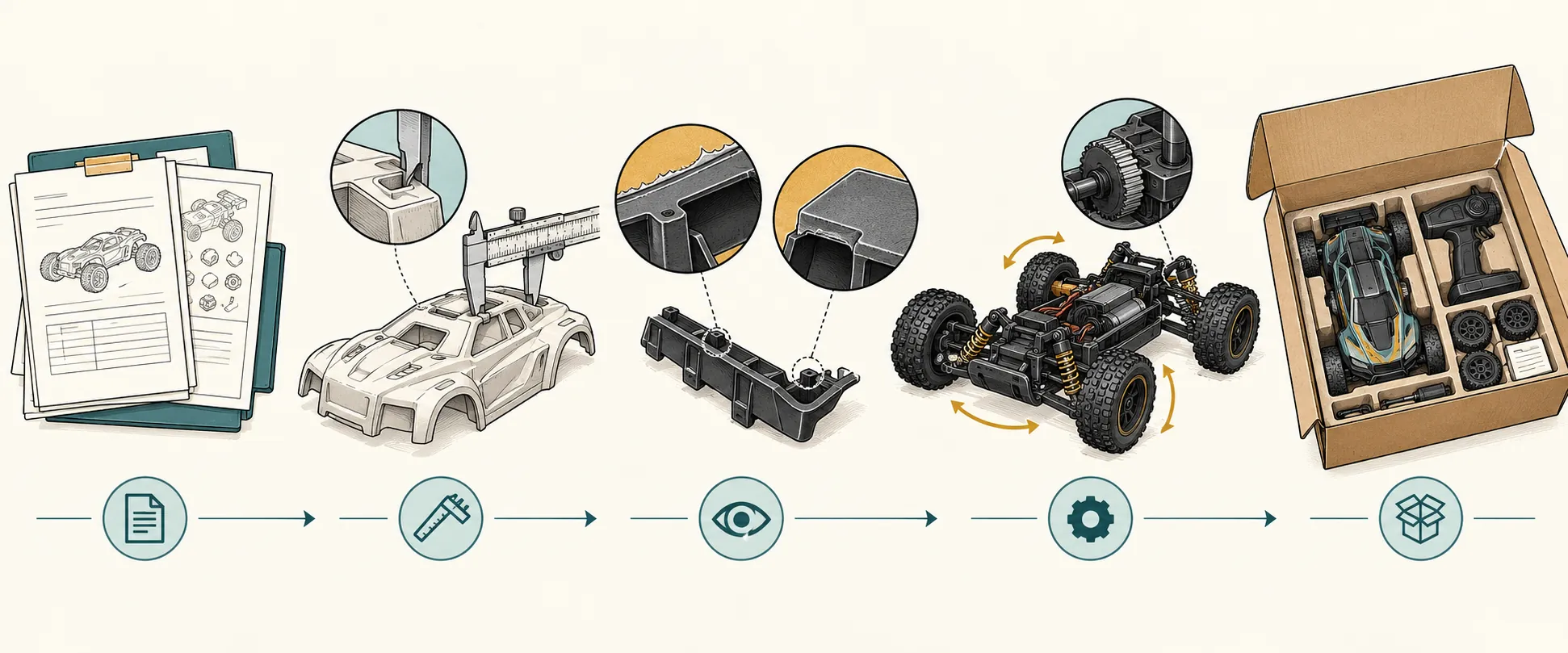
Which approval gates belong before the bulk PO, and which come later?
| RFQ and specification — before PO release | Evidence: confirmed written requirements and supplier response. Release condition: differences between the request and the offered configuration are resolved. Suggested owner: buyer with product or quality reviewer. |
|---|---|
| Physical sample approval — before PO release | Evidence: inspection against agreed dimensions, appearance, functions, materials, accessories, and packaging. Release condition: corrections are verified or an authorized specification revision is approved. Suggested owner: product or quality approver. |
| Approved production reference — after sample approval | Evidence: identified retained sample linked to the signed specification and approved deviations. Release condition: buyer and supplier acknowledge the same reference. Suggested owner: buyer and supplier quality contact. |
| Test-document review — before PO release | Evidence: item-specific reports and a documented assessment of their relevance to the ordered configuration. Release condition: the reviewer accepts the coverage and closes required follow-up. Suggested owner: designated compliance reviewer. |
| Artwork and packaging approval — before PO release | Evidence: approved artwork revision, pack specification, and physical packaging review where needed. Release condition: product, contents, instructions, and printed claims agree. Suggested owner: packaging approver with compliance review where applicable. |
| Bulk inspection — after production | Evidence: inspection record comparing production goods with the specification, approved reference, and authorized changes. Release condition: the agreed acceptance criteria are met and discrepancies are closed. Suggested owner: quality approver. |
| Shipment release — after inspection | Evidence: accepted inspection, closed corrective actions, confirmed shipment identity and quantities, and reviewed destination-specific paperwork. Release condition: the authorized buyer releases the identified goods. |
| Change control — throughout the order | Evidence: written change request, impact assessment, approval, and updated records. Release condition: affected approvals are reopened and closed before the changed configuration proceeds. |
What should the RFQ establish before requesting an RC car sample?
The RFQ should define the exact configuration the sample must demonstrate, so a supplier cannot reasonably interpret a catalog photograph as the full specification.
Identify the model, destination market, intended age grade for assessment, dimensions or scale, component-specific materials, colors, finish, required controls and functions, included accessories, battery and charging configuration, packaging language, and pack format. State the requested tests, which performance claims require evidence, and which documents the reviewer expects.
Ask the supplier to identify departures from the request in writing. A different controller, omitted cable, alternative body finish, or changed pack is a proposed deviation—not an accepted detail merely because it appears in the quotation.
Agree on the sample's purpose, configuration, approval responsibilities, and correction process. Include a sample policy covering quantity, sample and delivery fees, whether fees are credited against an order, and which samples must be returned or retained by each party. Supplier discussions can begin while the requirements are being defined; there is no need to impose an arbitrary waiting period.
Request written tooling or mold terms covering any required work, charges, payment milestones, ownership, permitted use, storage, and transfer or release conditions. If no new tooling is required, ask the supplier to confirm that. Specify the requested quotation trade term, such as FOB or CIF, with the named port or place and Incoterms edition, so the supplier's price has a clear delivery-cost and risk basis.
Which sample should become the golden sample?
Only a physical sample approved against the agreed written specification and design requirements should become the golden sample.
Use an existing-model sample to assess the starting platform. It does not approve private-label graphics, changed electronics, different accessories, or packaging that it does not contain. A customized sample should demonstrate the requested changes; identify any temporary or non-production parts before reviewing it.
If a pre-production sample is requested, define what it must represent, including the intended components, assembly, decoration, and packaging. Sample names alone do not establish production equivalence.
After acceptance, identify and retain the golden sample, link it to the approved specification revision, and record who approved it and when. Have the supplier acknowledge that reference. If buyer and supplier retain separate samples, identify both and confirm that their configurations agree.
The approved sample and written order specification work together as inspection references, consistent with the sample-review sequence described in CoreRCCar car development. Neither replaces approved change records.
What should the first RC car sample inspection check?
Inspect the first sample against the agreed specification, recording the expected result, actual observation, discrepancy, and next decision for each relevant check.
Function: pair the supplied controller with the car and operate every agreed command, such as forward, reverse, and steering. Check lights, sound, or stunt modes only where specified. Record non-response, unintended movement, intermittent operation, or a command that performs the wrong action. Hold approval of an affected function until correction is verified. Define the operating surface, power condition, distance, and observation method before making any agreed performance comparison.
Materials and assembly: compare the body, chassis, wheels, controller, and accessories with their component descriptions. Review component markings and material records where needed; appearance alone cannot establish resin grade or chemical composition. Record loose assemblies, poor fit, damaged parts, or a component that differs from the agreed configuration.
Finish: inspect color, graphic placement, print legibility, surface marks, paint coverage where specified, and panel fit under agreed viewing conditions. Compare with the approved design or color reference. A cosmetic acceptance decision does not establish coating safety.
Dimensions: measure the dimensions named in the specification using the agreed method and units. Record the measurements rather than only writing 'size OK.' Use the buyer-approved tolerances; do not invent a universal tolerance CoreRCCar-grade RC cars.
Accessories and packaging: count and identify the controller, battery items, charging accessories, instructions, and other agreed contents. Check pack fit, product identification, language, artwork placement, and the match between illustrated and actual contents. Record missing items and incorrect versions separately.
These are commercial inspection checks. Hand inspection does not establish regulatory safety or determine the product's age grade. Any screening duration, repetition count, or acceptance tolerance should be agreed as a buyer criterion, not presented as a compliance standard or a prediction of return rates.
RC car sample discrepancy record
A useful sample discrepancy record links the specified target to an observation, a release decision, and verified corrective-action closure.
Identity and revision: enter the buyer's item reference, supplier model, sample identifier and type, specification revision, artwork revision, inspection date, and reviewer. Identify the retained sample only after approval. Attach photographs or videos where they clarify the observation; a missing photograph alone does not invalidate an otherwise documented review.
Worked check: if the agreed accessory list includes a controller but the submitted sample contains none, record the target as 'controller included per approved accessory list' and the observation as 'controller absent from submitted sample.' Record the decision as 'hold sample approval; pairing and command checks remain incomplete.'
Correction and responsibility: assign the supplier contact to provide the intended controller and confirm its identity. Assign the buyer's quality reviewer to check the corrected sample, complete the functional review, and record the review date. If the supplier proposes a different controller, assess it as a change rather than simply marking the missing item resolved.
Closure: record what was received, which checks were completed, the result, and the final approver and date. If accepted, establish the approved production reference. If the correction still fails the agreed requirement, keep the approval on hold. A promise to correct the bulk goods is not the same evidence as an accepted corrected sample.
What test documents should be reviewed before PO release?
Request item-specific test documents during the sample stage and review their relationship to the configuration being ordered before releasing the bulk PO.
Early document collection is a purchasing recommendation also made in RC documentation guidance. Keep this review separate from the physical sample's commercial acceptance.
Ask for the complete report, not just a certificate image or a list of standards. Check the report number, issuing laboratory, tested model and photographs, component descriptions, test scope, results, and relevant configuration details. Ask the supplier to explain model aliases and differences between the tested item and the ordered item. Resolve authenticity questions through the issuing laboratory's verification channel.
Record how the tested construction relates to the PO and later production lot, including relevant materials, colors, and component revisions. A report on a golden sample is not automatically a shipment certificate. Conversely, a new internal item code or later batch does not automatically require a new test; coverage follows the tested construction and applicable rules.
For any proposed lithium-battery, FCC, spray-feature, or IP-rating claim, request the actual item-specific supporting report or document and have its scope reviewed before approving the claim. A working sample is not proof of certification, battery-transport suitability, or an ingress-protection rating.
Keep destination-specific requirements in separate review records. Do not treat a document accepted for one market as automatic evidence for another.
What closes artwork approval and authorizes the bulk PO?
Authorize the bulk PO when the approved product configuration, retained reference, document review, and packaging release all identify the same version.
Check artwork against the written packaging requirements and the accepted product—not only against the previous artwork file. Confirm the illustrated body color and controller, included accessories, operating instructions, language, item identification, and printed performance claims. Have the responsible reviewer approve safety-related wording rather than treating graphic approval as a safety determination.
If the golden sample was accepted before final packaging existed, approve the packaging separately and link its revision to the production record. For a changed insert or pack layout, check the physical fit and retention of the car and accessories.
The PO should reference the approved specification, sample identity, artwork revision, accessory list, inspection requirements, and change-approval procedure. Close unresolved configuration issues before authorizing manufacture. Record bulk inspection and shipment release as later hold points; they cannot truthfully be marked complete before production.
How should bulk inspection lead to shipment release?
Compare bulk goods with the approved specification, retained sample, artwork, and authorized changes, then release only the identified goods whose acceptance conditions are closed.
Agree on the inspection scope, sampling method, defect definitions, and acceptance criteria before inspection. Where component identity matters, use incoming and in-process records as well as finished-product checks; a closed body shell cannot show every internal substitution.
Repeat the relevant function, dimensions, finish, accessory, and packaging checks on selected production units. Record lot identification, inspected quantity, findings, and the basis for acceptance. Do not reduce the result to 'matches golden sample' without stating what was checked.
When a discrepancy appears, identify the affected quantity or configuration, hold the affected release, and require a documented disposition. Correction may involve rework, replacement, further inspection, or an explicitly approved commercial deviation. Record the recheck result and responsible approver before closing the issue; a commercial concession cannot waive a statutory requirement.
For shipment release, reconcile the accepted goods with the shipment item identities and quantities, confirm corrective-action closure, and review destination-specific paperwork separately. Record who authorized release and when. An accepted inspection does not guarantee customs clearance.
How should changes after sample approval be controlled?
Require written approval before a changed material, component, function, finish, accessory, or packaging version replaces the approved configuration.
The change request should identify the old and proposed versions, reason, affected orders or lots, implementation point, and consequences for function, appearance, documents, artwork, and inspection. The reviewer should specify whether drawings, a corrected sample, document assessment, or laboratory work is needed. Not every change requires the same response.
For US children's products, CPSC guidance addresses testing affected requirements after a material change and issuing a new Children's Product Certificate based on passing results; an earlier report should not simply be assumed to cover the revised construction. See CPSC third-party testing guidance. This is separate from the buyer's broader commercial change-control policy.
After approval, update the specification and affected reference records, retain the superseded revision for traceability, and identify which lots use each version. Reopen only the gates affected by the change, but close them before the changed goods proceed. The final release should identify an accepted configuration—not merely a familiar model name.