
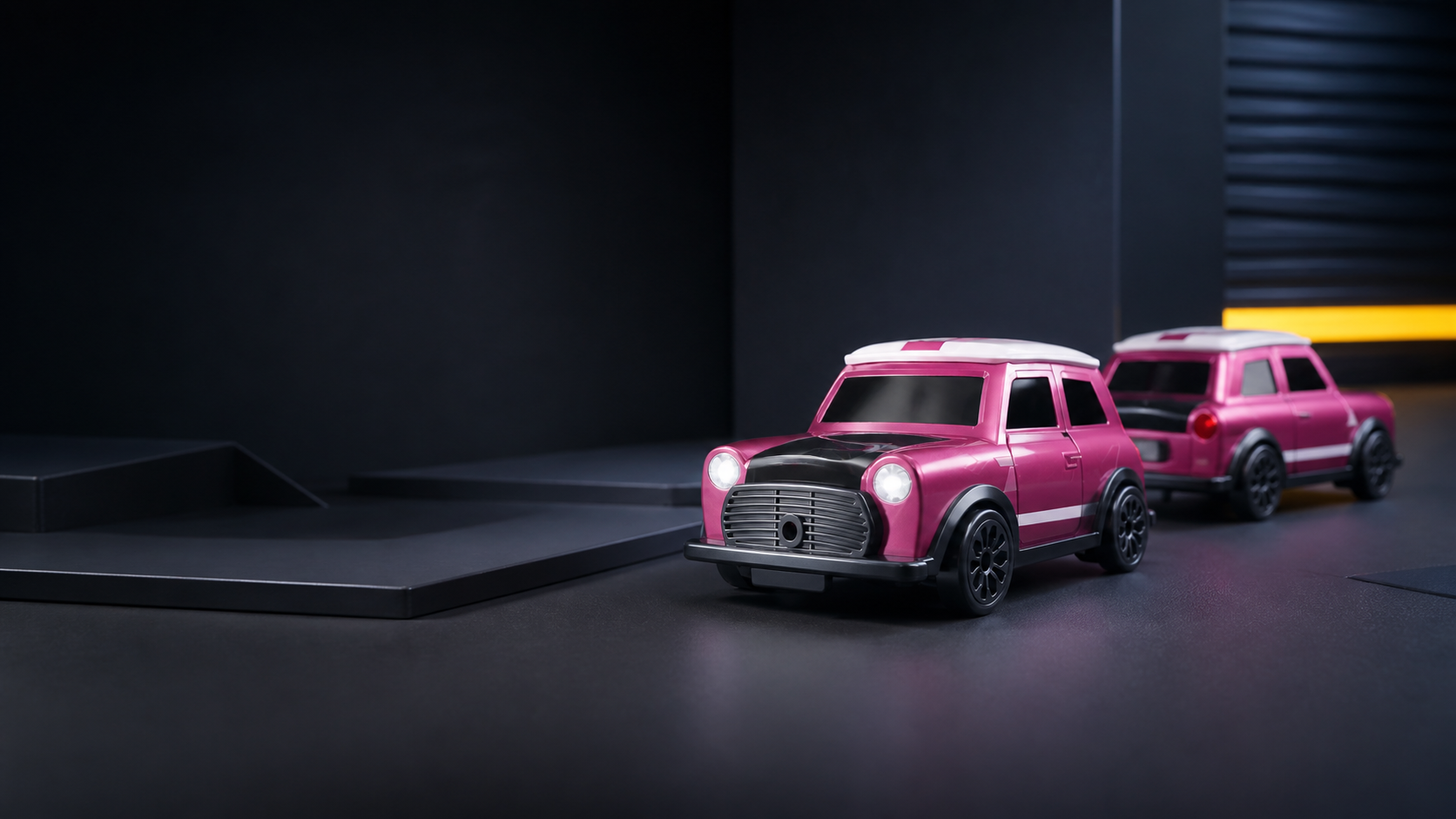
Generic scale-styled RC cars are listable when the design reads as a CoreRCCar car rather than a recognizable production vehicle — and when you can show a file trail for that decision. The practical test is not "does it look cool," it is: no real marque name or logo, no badge or grille that a shopper would read as a specific model, and artwork plus keywords that never imply affiliation. US law draws the line at whether a seller misleads buyers about brand origin or affiliation: goods that falsely bear a trademark or logo are illegal to sell, import, or distribute, while style imitation without a protected name or logo sits in a gray area governed by trademark, copyright, and design patent considerations.
This page gives you the pre-purchase-order file set for that decision: what each document proves, what it does not prove, the one file that usually arrives late, and the questions to send the factory when a file is missing. It applies to importers, Amazon sellers, supermarkets, gift distributors, and private-label buyers working from a scale-styled catalog — a 4WD all-terrain model at a 60-piece MOQ is a typical starting point. Everything below stays on FACTS: if a spray, lithium, FCC, or IP claim has no report behind it, ask for the report; do not put the claim on a listing.
Files before the purchase order
| Supplier IP statement (letter or contract clause) | Proves: the supplier asserts the design does not use third-party brand names, logos, or licensed artwork, and states who owns the tooling and artwork. Does not prove: that the assertion is accurate. Ask if missing: who designed the body mold, and can they name the design source in writing? |
|---|---|
| Badge / grille / body-line photo set (front, 3/4, close-up of any emblem area) | Proves: what is physically on the sample you were sent, at the resolution you photographed. Does not prove: that production units match the sample, or that the shape is clear of design patent. Ask if missing: golden-sample photos plus the golden sample itself, retained. |
| Listing copy and keyword sheet | Proves: the exact words your team intends to publish, including scale, function, and styling descriptors. Does not prove: that the marketplace will accept them. Ask if missing: which internal reviewer signs off before the copy goes live. |
| Packaging and artwork proof (dieline, print PDF) | Proves: what will be printed on the box, blister, and insert. Does not prove: that the artwork is original to the supplier. Ask if missing: the artwork source file and a written statement that no licensed pattern is used. |
| Test report and lab scope | Proves: which safety rules a specific laboratory covered, for a specific configuration. Does not prove: that the lab covers every rule your market requires — CPSC notes laboratory acceptance is specific to the relevant safety rules, and one laboratory may not cover every required test. Ask if missing: the report plus the lab's scope statement for the CoreRCCar configuration. |
| Spray / lithium / FCC documentation | Proves: nothing until the actual report is in hand. Does not prove: compliance, capacity, or range. Ask if missing: the report itself — do not list a spray, battery, or radio claim without it. |
| Golden sample retention record | Proves: you have a sealed reference unit and a date. Does not prove: mass-production consistency on its own. Ask if missing: how many units are retained, where, and for how long. |
The file that usually arrives late
The supplier IP statement is the document that most often shows up after the PO, not before it. It is also the one that is least useful late: once tooling is cut and packaging is printed, an IP objection becomes a rework cost instead of a design change.
A usable statement is short and specific. It should name the model, state that the body design, badges, and graphics do not reproduce a third-party brand name, logo, or licensed artwork, and identify who owns the mold and the artwork files. "No problem, it's generic" is not a document. Neither is a statement that covers a different SKU than the one on your PO.
Two things the statement cannot do. It cannot substitute for your own review of the sample, and it cannot tell you whether a shape is protected by a design patent; that is a legal question, not a supplier question. Treat the statement as one input, not as clearance. The same discipline applies to pattern and artwork: distinctive patterns and prints can become associated with a specific brand, and two-dimensional patterns can be copyrighted, so artwork needs its own source trail separate from the body design.
Where the statement is missing, ask in writing and keep the answer in the file. If the supplier will not put it in writing, that is your decision point — not a detail to resolve after the deposit.
FAQ
Is a generic scale-styled RC car automatically safe to list?
No. Style imitation without a protected brand name or logo may fall into a gray area governed by trademark, copyright, and design patent considerations — it is not automatically clear. The decision hinges on whether your listing or packaging misleads buyers about brand origin or affiliation, so run the photo, artwork, and keyword checks before you publish.
Can I use "inspired by" language to describe a scale-styled RC car?
Do not treat "inspired by" as a guarantee of legal safety — it is not. Descriptors like "affordable alternative" or "similar style" are generally more defensible than implying official affiliation, but the safer route is to drop the comparison entirely and describe the car on its own terms: scale, drive type, terrain, and features.
What should a supplier IP statement actually say?
It should name the model, state that the body design, badges, and graphics do not reproduce a third-party brand name, logo, or licensed artwork, and identify who owns the mold and artwork files. A statement that covers a different SKU, or says only "it's generic," does not do the job.
A supplier says the model is FCC compliant. Can I put that on the listing?
Not without the actual report. A verbal claim proves nothing about radio compliance, battery capacity, or range. Ask for the report itself, and if it is not provided, leave the claim off the listing — an unsupported compliance claim is a bigger exposure than an unstated one.
Does one test report cover everything my market requires?
Not necessarily. CPSC explains that laboratory acceptance is specific to the relevant safety rules and that one laboratory may not cover every required test. Match the applicable requirements and the laboratory's scope to the CoreRCCar configuration before you rely on a single report.
How do I check packaging artwork for licensed-pattern risk?
Get the artwork source file and a written statement that no licensed pattern is used, then compare the print proof against the retained golden sample. Distinctive patterns and prints can become associated with a specific brand, and two-dimensional patterns can be copyrighted, so artwork needs a source trail of its own.
Sources
- How to style your model for a commercial shoot - 500px
- Is It Illegal to Sell Designer Dupes
- Surface Pattern Design Licensing: A Complete Guide for Brands and Businesses
- The Reality About Buying Reproduction Designer Brands
Before you place the PO
Send the file list to the factory in one message: IP statement, badge and grille photos, artwork source, test report with lab scope, and the spray, lithium, or FCC report where the model carries that feature. Ask which of those they can return this week and which they cannot. The answer tells you more about the model than the sample does.