
Lock private-label RC production to an approved physical sample plus signed specifications, BOM and artwork revisions—not to a photograph alone. Golden-sample control for private-label RC orders starts by checking the first sample against the agreed design and written requirements. Only after approval should matching buyer and factory copies become retained production references. Link both to one approval record, require written authorization for changes, and compare bulk output against that controlled package before accepting the affected production.
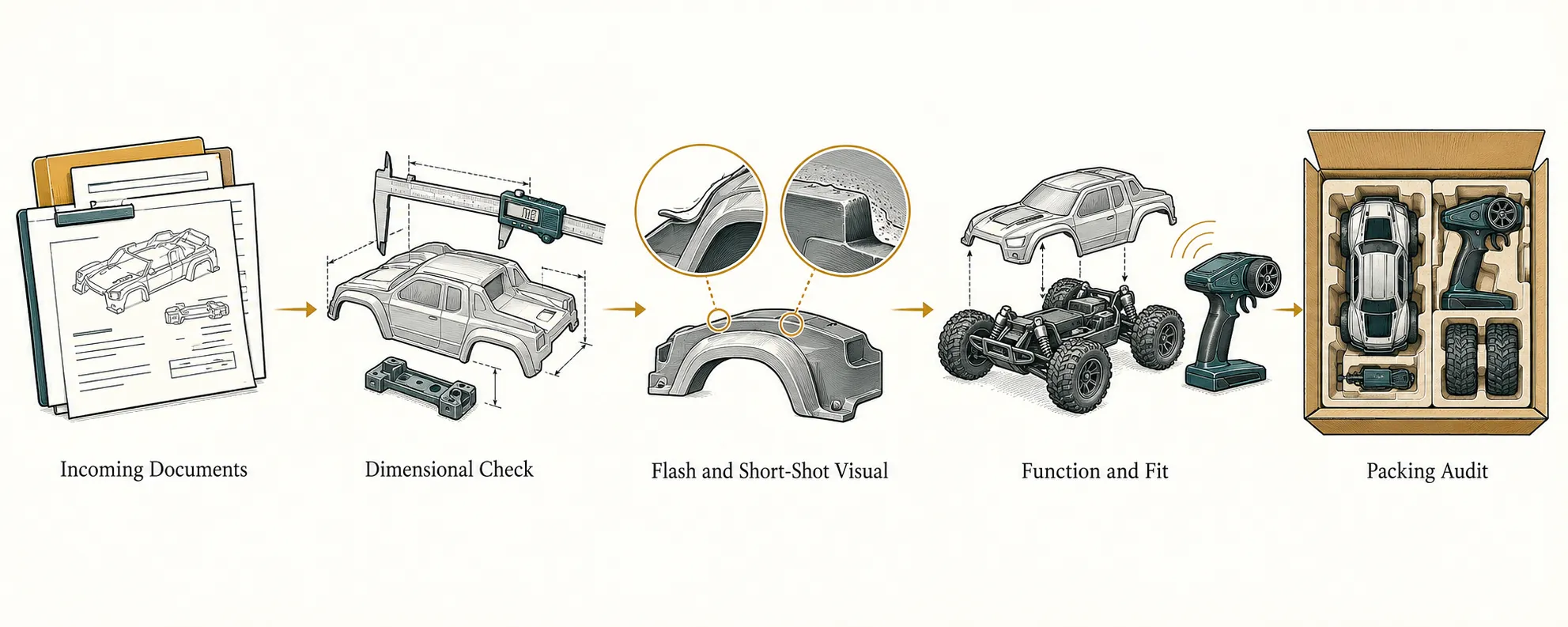
What must pass before an RC sample becomes the golden sample?
The first sample must satisfy the agreed written specification and design requirements before it becomes the approved production reference. Check the submitted unit against those requirements; do not approve it simply because it resembles an earlier photograph or demonstration model.
Confirm how the sample was made. For production approval, specify production tooling, approved bill-of-materials components and the intended assembly process. A prototype can support design evaluation, but it should not silently become the mass-production benchmark. These are purchasing controls, not regulatory requirements. Golden-sample approval checklist
Record each discrepancy before signing. Reject and resubmit a sample that misses an acceptance requirement. If approval is limited to certain attributes, name them explicitly—for example, appearance approved but packaging awaiting correction—and do not treat that limited approval as unrestricted production release.
After acceptance, identify and approve matching retained units for buyer and factory use. A first production unit can confirm the approved configuration; it replaces the existing golden sample only through a new, documented buyer approval. JS Sourcing golden-sample guide
Which RC attributes should the sample approval check cover?
| Product and controller identity | Inspect: model markings, body version, controller layout and supplied accessories. Compare with: product specification, drawings and approved bundle list. Failure signal: a different controller, accessory or configuration. Next decision: resolve the mismatch before approving the sample. |
|---|---|
| Materials and components | Inspect: accessible component markings, body and tire finish, connector arrangement and assembly details. Compare with: BOM revision, component specifications and supplier traceability records. Failure signal: a different part identifier or an unexplained construction change. Next decision: verify the component and supporting records; appearance alone cannot establish material composition. |
| Color, texture and decoration | Inspect: body and wheel colors, gloss, texture, print edges, logo position and decoration alignment under agreed lighting. Compare with: written finish requirements, approved color references and artwork. Failure signal: a visible shade, texture or print-position mismatch. Next decision: correct and resubmit, or obtain an explicit revision approval. |
| Dimensions and assembly | Inspect: specified overall dimensions, relevant clearances, body alignment, wheel rotation, fasteners and compartment fit. Compare with: controlled drawings and stated tolerances. Failure signal: a measurement outside its limit, binding, interference or incomplete assembly. Next decision: identify the cause and recheck the corrected sample. |
| Pairing and driving functions | Inspect: pairing, forward and reverse response, left and right steering, neutral behavior and each advertised mode, where fitted. Compare with: the approved function matrix and operating instructions. Failure signal: missing or reversed commands, intermittent response or an incorrect mode sequence. Next decision: hold functional approval and require correction. |
| Power and charging configuration | Inspect: specified battery or battery-holder identity, compartment fit, accessible connector details and supplied charging accessories, where applicable. Compare with: the approved BOM, electrical specification and instructions. Failure signal: a substituted power component, incompatible accessory or inconsistent label. Next decision: obtain technical review before approval; fit and operation are not proof of electrical safety. |
| Packaging and private-label content | Inspect: retail-box dimensions and fit, tray retention, item count, accessory placement, labels, barcode readability, artwork and manual revision. Compare with: packaging specification, artwork files and pack-out list. Failure signal: an omitted accessory, outdated instruction, wrong barcode or incorrect presentation. Next decision: correct the affected pack and repeat the relevant checks. |
Golden-Sample Control and Approval Record
| Product and order identity | Enter the private-label product name, buyer and factory model references, purchase-order reference, intended configuration and sample source or pilot-run reference. |
|---|---|
| Sample identity and status | Assign a unique sample-set ID and distinguish the buyer and factory retained copies. Record sample revision, approval date and status: pending, approved, limited approval or superseded. |
| Controlled document references | List the exact specification, BOM, drawing, function-matrix, test-method, artwork, label, manual and packaging revisions used for approval. |
| Target versus observation | For each checked attribute, enter the specified requirement or tolerance, actual measurement or observation, inspection conditions, result and any discrepancy reference. Record photographs as supporting evidence where useful. |
| Decision and conditions | State approve, reject or limited approval. Identify any excluded attributes, required corrections and the conditions that must close before production release. |
| Authorization | Record the buyer approver and factory quality representative, their roles, signatures and dates. Add the packaging or technical approver when responsibility is split. |
| Retained-sample custody | Record each copy's custodian, storage location, condition, seal identifier if used, access log and agreed retention review or disposal authorization. |
| Follow-up and closure | Assign each discrepancy an owner and due date. Record corrective action, reinspection evidence, closure approver and closure date. |
| Revision and production effectivity | Link approved change requests to replacement sample and document revisions. Identify the first affected production lot or order and the disposition of superseded references. |
How should bulk RC production be checked against the approved reference?
Bulk inspection should use the retained sample, current written requirements and approved change records together—not the sample alone. Make the applicable sample ID and document revisions visible on the inspection instruction.
At incoming inspection, check component identities, material records, decorated parts and packaging against the released BOM and specifications. Compare visible finish characteristics with the retained reference. For hidden components, use traceability records and any authorized component verification in the inspection plan; a matching exterior cannot establish an unchanged internal build.
During assembly, compare early production output for body fit, wheel clearance, wiring arrangement where accessible, pairing and control response. Use the agreed operating conditions so a different surface, power state or setup does not create a misleading comparison. Resolve a discrepancy before the affected operation continues unchecked.
At final inspection, select units under the agreed sampling plan and check the finished, packed configuration. Record lot identity, inspected quantity, observations and disposition. Any screening counts, operating cycles or tolerances chosen by the buyer are commercial acceptance criteria—not compliance standards or predictions of return rates.
What happens when a production unit does not match?
Hold acceptance of the affected units, identify the discrepancy and establish its scope before deciding on rework, rejection or an authorized deviation. Record the production lot, observed condition, applicable requirement, sample ID and document revisions, then assign an investigation owner.
For example, if a controller looks identical to the retained reference but its button sequence activates a different driving mode, record the expected sequence and observed response. Check the controller and receiver references, assembly records and relevant configuration settings. Appearance matching does not resolve the functional mismatch.
The factory should identify affected production and propose a correction. Reinspect the corrected units against the original requirement. If the buyer accepts a limited deviation, document its exact scope, affected quantity or lot, approver and conditions; do not silently redefine the golden sample for future orders.
If the retained sample conflicts with the signed specification, pause the disputed decision and investigate the revision history rather than choosing whichever reference gives a convenient pass. Unrelated checks can still provide valid evidence while that conflict is resolved. Golden-sample management guide
How should buyer and factory samples be stored and accessed?
Keep matching approved references with the buyer and factory, each under named custody and linked to the same approval record. Dual retention is a practical control recommendation, not a legal requirement. Golden-sample approval checklist
Store the RC unit, controller, accessories and approved packaging together, protected from crushing, contamination and conditions that could alter the finish or components. Follow the documented storage and battery-handling instructions for the actual configuration. Keep the factory reference available to authorized production and inspection staff, but record checkout, return and any change in condition.
Use a tamper-evident seal where it provides useful protection without damaging the reference. Log authorized opening and resealing rather than making normal inspection impossible. A missing photograph or broken seal calls for a condition and identity review; neither automatically erases other valid approval evidence.
If repeated operation would wear the reference, designate a working comparison unit and verify it against the retained master. Do not quietly repair, repaint or replace the master. Agree a retention review and disposal authorization rather than discarding the sample as soon as the shipment leaves.
Which changes require reapproval before production?
Require a formal change request before implementing changes to approved materials, component sources, manufacturing processes, functions or packaging. The request should explain the proposed difference, reason, affected documents, inspection implications and intended first production lot. This is a recommended purchasing rule. Golden-sample approval checklist
For RC orders, include controller or receiver substitutions, power components, body material, color, decoration, accessory bundles, labels and manuals in the change review. An apparently equivalent replacement still needs comparison with the approved requirements.
Approve a replacement retained sample when the physical configuration or packed presentation changes. Update both buyer and factory copies, release the corresponding BOM and artwork revisions, and mark earlier references as superseded. Packaging, accessory and manual changes can require an updated reference even when the vehicle itself is unchanged. Golden-sample control rules
For a document-only or inspection-method change, record whether the physical reference remains representative and why. Before release, identify how existing components, work in progress and finished stock will be handled. The change record supports traceability; it does not by itself detect an undisclosed substitution.
Does golden-sample approval establish RC safety or compliance?
Golden-sample approval establishes a production benchmark, not regulatory safety or compliance. Visual comparison and hand-operation checks cannot certify safety, determine age suitability or establish radio or ingress-protection performance. JS Sourcing golden-sample guide
If spray performance, lithium-battery, FCC or IP claims form part of the order, request the actual applicable reports and supporting documents for the claimed configuration. Check product identity, tested construction, method, results and the relevance of subsequent changes. Use the specified laboratory testing for a safety conclusion rather than improvising a hand test.
Keep destination-specific compliance paperwork separate from the golden-sample approval record, with clear cross-references where needed. Release the order only after both the agreed production-QC conditions and the separate compliance review have been addressed.