
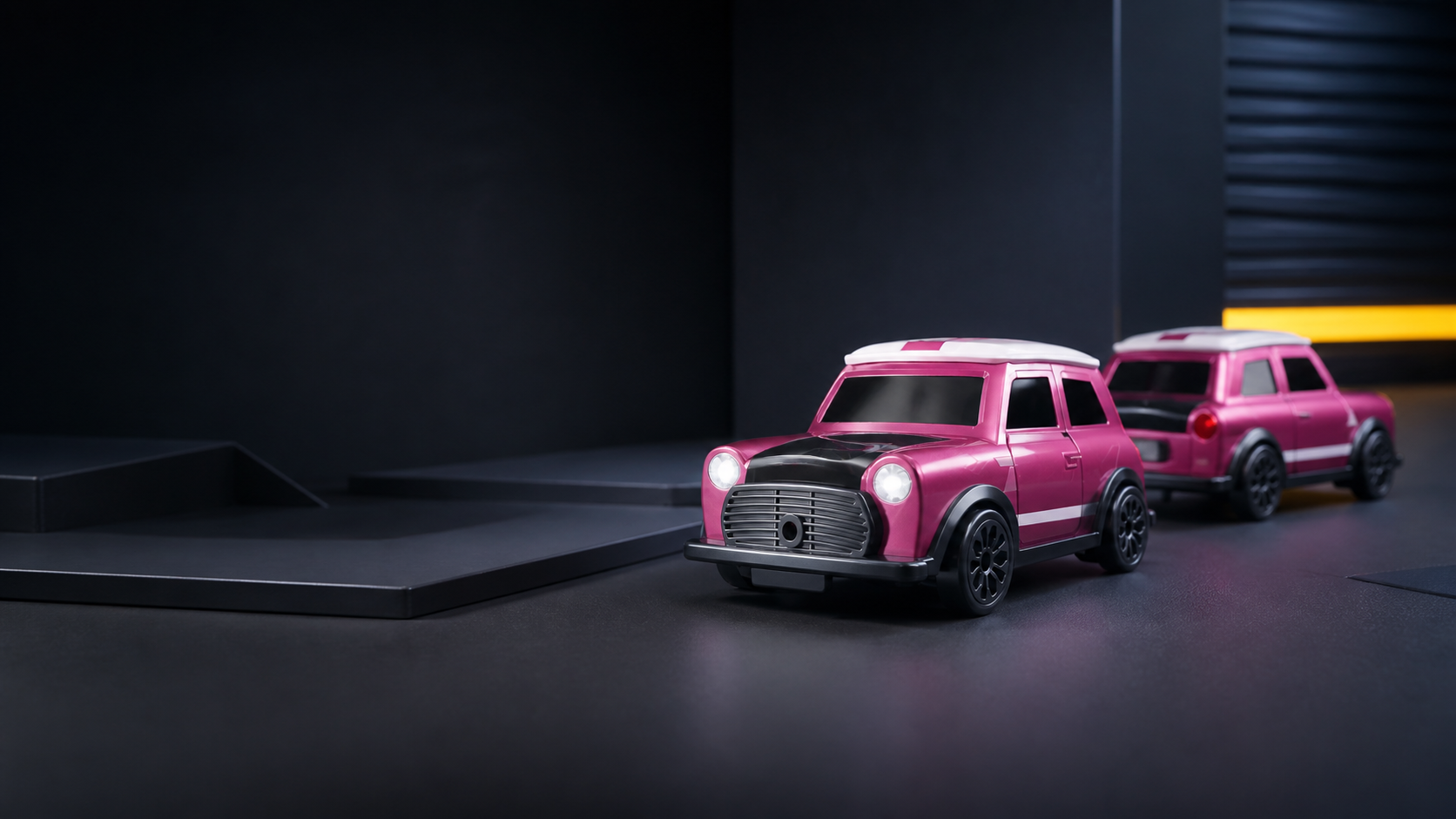
Sign off on a golden sample only when the physical unit in front of you—not a photo, not a render—matches every production-critical attribute you plan to sell, and when its revision number matches the controlled documents on your desk. In Chenghai, the argument that ends a color fight is the sealed golden sample on the QC shelf, not an email thread. Buyers who approve only a photo pay for it on the second lot. This checklist walks each attribute—sample ID, body, electronics, battery, remote, functions, color, artwork, accessories, carton, signatures, and storage—so you can decide with evidence, not impressions.
Key Takeaways for Approving an RC Golden Sample
- Physical sample beats approval by photo: A sealed golden sample with the approved material, color, decoration, dimensions, and photos is the reference for production QC. It does not replace required market testing, but it ends disputes that emails cannot.
- Tie the sample to the PO and inspection plan: Your AQL number comes from the agreed inspection plan written on the PO, not from a catalogue sentence. Record the sample serial on the PO so inspectors pull the same reference during pre-shipment checks.
- Lock the revision, not just the look: Label tool number and revision on the sample and on the document set. A revision mismatch is a red flag that production may be building to an older or newer version than you approved.
- Color approval has four variables: Color matching must use the same resin grade, surface finish, lighting condition, and approved master sample. Appearance changes with all four, so verify under controlled lighting like D65, not fair lighting.
- A report on the golden sample is not a shipment certificate: A type-test or golden-sample report does not automatically cover a later production lot. Match report SKU, materials, colors, and production date/cohort to the PO before you rely on it for customs or retail compliance.
What exactly does a golden sample lock for an RC car?
A golden sample is the final, approved physical unit that represents the benchmark for mass production. For a customized RC car, it freezes the attributes that buyers and inspectors will compare against every bulk carton: the body shell's color and finish, the fit of panels and doors, the presence of flash or sink marks, the function of every motor and light, the battery type and capacity, the remote's pairing and range, the artwork registration on decals, the accessory list, and the carton configuration. It is not a prototype. A prototype tests a concept; the golden sample should be made with the production tooling, materials, and assembly processes planned for the actual run. A booth sample at a trade fair is often a hero unit—beautifully finished by hand, lit unfairly. The factory labels tool number and revision on the table, and you should refuse to take a fair photo as the production standard. Fair lighting lies. The revision card does not.
Step 1: Confirm the sample identity before you touch the body
Start with the label, not the wheels. Verify the sample ID matches the PO line item exactly. Check that the tool number and revision code are physically on the sample—on the chassis underside, inside the battery door, or on a tag. Cross-check the revision card against the controlled document set you hold; if the sample says Rev C and your spec says Rev B, stop and ask which one production will build. Ask the factory: "What is the tool number and revision on this sample? Please send a photo of the label next to the sample ID." Sign and date the approved sample before it ships, using permanent marker or stamp, so the record is tamper-evident.
Step 2: Inspect the body and chassis for fit, finish, and flash
Compare the body against the spec drawing, not your memory. Measure critical dimensions—wheelbase, width, height—and weigh the unit. A lower weight than spec can mean thinner walls or a cheaper material, which will show up in durability complaints later. Check the plastic for flash (excess material at mold seams), sink marks, and ejector pin marks. Verify panel gaps are even and consistent. If the body has a sprayed or painted finish, confirm the coating covers evenly, has no overspray, and matches the approved color chip. For claims like "self-spray" or "spray function," ask for the actual report or a written specification—do not assume the sample's behavior is what production will deliver.
Step 3: Verify the electronics, battery, and charging system
Open the battery compartment. Confirm the battery type (Li-ion, NiMH, or alkaline) and capacity in mAh match the approved spec. Check that the connector is the correct polarity and that the battery fits securely without forcing. For lithium batteries, ask for the transport documentation—UN38.3 or equivalent—because shipping lithium cells has its own rules, and a golden sample approval does not satisfy them. Inspect the PCB, wiring, and motor connections visually. Look for loose wires, cold solder joints, or components that could shift during play. Ask the factory for the component list: motor type, ESC, servo, receiver. If the product claims waterproofing or an IP rating, request the actual test report—do not accept a marketing phrase on the box.
Step 4: Test the remote, range, and every function
Pair the remote with the car exactly as the end user would. Test forward, reverse, steering left and right, and any special functions like drifting, stunts, or spray. Cycle each function at least a few times; a function that fails intermittently will fail in the hands of a child. For range, measure the distance at which control is lost—do not estimate. If the spec says 30 m, verify under open conditions; if the factory cannot demonstrate it, ask what the tested range actually is. Record the results with units and the test date. If the product has adjustable speed or gesture control, test those modes too. Ask: "What is the tested control range in meters, and what battery runtime did you measure at full throttle?"
Step 5: Approve color and artwork under controlled light
Color is the most common source of disputes. Compare the sample's body color and printed artwork against the approved Pantone chip or master swatch under a standard light source—D65 is common—and also under a retail lighting condition, because the two can look different. The same resin grade, surface finish, and lighting are required for a match; change any one and the appearance shifts. Check logo placement, artwork registration, decal sharpness, and the spelling of legal text. A single wrong letter on a warning label can stop a shipment at customs. If the artwork is not final, do not sign. Ask the factory for the final artwork proof with the sample, and confirm the barcode scans with a real scanner, not a phone app.
Step 6: Count accessories and validate the carton
Count every accessory against the packing list: remote, USB cable, charger, batteries (if included), spare parts, and any stickers or decals. A missing accessory in the golden sample will be missing in bulk. Validate the carton with the CoreRCCar inside. Check that the inner box fits the car snugly, the insert holds the car in place, and the master carton dimensions and weight match your freight plan. Confirm pieces-per-carton data is on the packing list, because that number drives your landed cost and your customs declaration. Verify the carton marks, the destination language on labels, and the warning text required for your market.
Step 7: Collect signatures, seal the sample, and store it properly
Signoff is a document, not a mood. Collect signatures from your side (the buyer or authorized representative) and from the factory's QC and production leads. Record the date, the sample serial, the revision code, and the list of accepted deviations—if any. If you approve conditionally, write the defect list with photos and a dated re-sample commitment. A verbal "overall OK" is how bulk runs drift. After signing, seal the sample in a tamper-evident bag or box, and store it in a known location—the QC shelf, not a drawer. Keep at least three copies: one with the factory, one with your inspector, and one with you. A damaged or lost golden sample is no longer a reliable reference.
Golden-Sample Signoff Checkpoints vs. What to Verify
| Sample ID | Matches PO line; tool number and revision physically labeled; revision card aligns with controlled documents. |
|---|---|
| Body & chassis | Dimensions measured, weight recorded, flash/sink marks checked, panel gaps even, sprayed finish even. |
| Electronics | Battery type/capacity confirmed, wiring secure, PCB clean, motor connections solid, component list provided. |
| Remote & functions | Pairing works, all functions tested, range measured in meters, battery runtime measured—ask for actual values. |
| Color & artwork | Compared under controlled light (e.g., D65) to Pantone chip; logo/artwork registration correct; labels in destination language. |
| Accessories & carton | Accessory count matches packing list; carton CoreRCCar snugly; pieces-per-carton, weight, and dimensions recorded. |
| Signatures & storage | All parties sign and date; sample sealed tamper-evident; three copies retained (factory, inspector, buyer). |
A worked example: what a signoff miss looks like
Worked example (illustrative, not a real shipment): You order 3,000 units of a custom RC stunt car—1,500 for the EU and 1,500 for the US, with different label languages and warning text. The golden sample is approved from a photo because the physical sample is still in transit. The factory starts bulk production. At pre-shipment inspection, the inspector pulls the carton and finds the EU labels are in English only, the battery compartment is 2 mm too small for the approved Li-ion pack, and the red body color is two shades lighter than the Pantone chip under D65. The lot is held. Rework costs two weeks and a freight surcharge. Had the golden sample been on the QC shelf, signed and sealed, with the EU/US label versions attached and the battery fit checked, the inspector could have flagged all three issues before the first 500 units were boxed.
What to ask the supplier before you sign off
• What is the actual battery capacity in mAh, and what runtime did you measure at full throttle? • What is the tested remote-control range in meters, and under what conditions? • Can you provide the component list (motor, ESC, servo, receiver) for this model? • What inspection plan (AQL levels) is written into our PO? • Do you have FCC, RoHS, or other certification reports for this RC product? Please share the actual report. • What is the MOQ for this customized configuration? • Which Incoterms version and named place (e.g., Shantou or Shenzhen) apply to this order?
FAQ
Why can't I approve the golden sample from a photo?
A photo cannot convey the exact color under standardized light, the feel of the plastic, the fit of panels, or the function of every button. In Chenghai, the physical sample on the QC shelf is the reference that ends color disputes. Approve only the physical unit in hand.
What is the typical MOQ for a customized RC car, and can I get a sample first?
MOQ varies by model and customization; CoreRCCar-grade RC cars from Chenghai, MOQs commonly start around 36 to 120 units per model, but this depends on the configuration and the factory. Always request a pre-production sample before committing to bulk, and confirm the MOQ in writing on the PO.
Do I need a separate golden sample for each destination market?
Yes, if labeling, language, or packaging differs. A golden sample for the EU with English-only labels will not serve for the US market if warning text or certifications differ. Validate the carton and labels for each market against the CoreRCCar and inserts.
How do I handle a conditional approval—can I sign with comments?
Conditional approval is risky. If you approve with open defects, write a dated, photographed re-sample commitment with the defect list and a process change. A verbal 'overall OK' is how bulk runs drift. Do not release production until the corrected sample is sealed and signed.
Does a golden sample approval guarantee my shipment passes inspection?
No. A golden sample is a reference, not a guarantee. The inspector compares bulk units against the sealed sample, but you still need an agreed AQL plan and pre-shipment inspection. A type-test report on the golden sample does not automatically cover later production lots—match report SKU, materials, and production date to the PO.
What should I do if the factory says 'we'll fix it in mass production'?
Treat that as a red flag. If a defect is visible on the golden sample, it will likely appear in bulk. Require a dated re-sample with the fix implemented before you release production. Do not rely on a promise without a physical proof.
Sources
Request a Quote or Sample
Ready to lock your RC product specification? Send us your target spec or PO details, and we'll provide a quote, MOQ, and a pre-production sample for signoff. We work with importers, distributors, and private-label buyers.