Line inspection catches assembly drift before the unit is closed; end-of-line function testing catches a finished car that binds, steers short, or fails to charge. You need both, and you need to see the actual test plan — a supplier that only offers one final drive test is telling you its process feedback loop starts too late. When you audit a China CoreRCCar factory, ask for two separate documents: the in-process inspection stations and the EOL function checklist, then confirm which defect classes route to rework versus scrap. That pair of documents, not a catalogue photo, is what tells you whether the supplier's coverage catches both assembly defects and completed-function failures.
How Do Chenghai and Shantou Factories Split Inspection Work?
Chenghai and the wider Shantou cluster in Guangdong run on a dense subcontracting model: moulding, painting, electronics assembly, and packing often sit in different buildings within a few kilometres. That geography is the supply-chain advantage — a buyer can consolidate dozens of SKUs and still walk the whole process in a day. It is also the risk. When four workshops touch CoreRCCar, no single station sees the whole unit until the end, so the inspection plan has to be designed across handoffs rather than inside one building.
The practical consequence for importers is that in-process checks and EOL testing answer different questions. In-process checks catch drift in dimensions, colour, weight, flash, short shots and assembly before the entire lot is complete. EOL testing is the final stage of manufacturing where the finished product is tested under functional conditions against performance and quality specifications. Neither replaces the other, and a supplier that cannot describe both is usually running one final drive test and calling it quality control.
Yiwu plays a different role. It is a trading and consolidation hub, not a moulding cluster, so a Yiwu quote often means the goods were made elsewhere in Guangdong or Zhejiang and re-packed for mixed-container export. Ask where the mould sits and where the EOL station sits before you assume the quoted price reflects a factory.
What Should You Check at Each Stage of RC Car Production?
The table below maps the two control layers to the checks that matter on a 2.CoreRCCar-grade RC car, and states what you should ask for as proof. Nothing in the right column should be accepted as a verbal assurance.
| In-process: dimensional and cosmetic | Checks drift in dimensions, colour, weight, flash and short shots on moulded ABS bodies. Ask for the station list, the sampling frequency, and the reaction plan when a trend moves. |
|---|---|
| In-process: assembly before close-up | Catches missing screws, trapped wires, mis-seated gears and wrong-colour parts before the body is screwed shut. Ask which defects are recorded per lot. |
| EOL: controller pairing and channel verification | The finished unit must bind to its 2.4GHz transmitter and respond on every channel. Ask whether pairing is tested per unit or sampled. |
| EOL: steering and drive function | Verify steering travel both directions, forward and reverse, and any drift or stunt function on the actual unit, not just power-on. Ask for the pass/fail criteria. |
| EOL: lights, sound and spray | Confirm each named feature works on the finished car. For spray and any lithium or wireless function, ask the factory for the actual report rather than accepting a catalogue feature line. |
| EOL: charging and battery handling | Confirm the charger operates and the unit accepts charge. Do not accept mAh, runtime or range figures unless the factory supplies the test record behind them. |
| Defect coding and feedback | A failed lot should be isolated, the defect class recorded, and the lot released only after rework. The AQL number belongs in the agreed inspection plan on the purchase order, not in a catalogue sentence. |
| Traceability and records | Records should tie a result to a unit or lot, with date, station and responsible party, so a field issue can be traced back to a shift. |
Which Questions Expose a Weak Test Plan?
Ask for the inspection plan as a document, then read it against your own failure history. A supplier that answers in generalities — "we test every car" — has not shown you a process.
Separate unchanged components from changed materials during any OEM request. According to CPSC guidance, affected requirements must be retested after a material change to a children's product, and a new certificate issued from the resulting passing tests. Do not assume an earlier report automatically covers the revised configuration, and ask who will coordinate the document review.
Check the laboratory scope against the CoreRCCar configuration. According to CPSC, laboratory acceptance is specific to the relevant safety rules, and one laboratory may not cover every required test. For the US market, children'CoreRCCar generally require testing at a CPSC-accepted laboratory and a Children's Product Certificate, and the certificate is product-specific rather than a blanket factory credential. Request the actual file and confirm the responsible parties, dates and model identity — a catalogue listing the word CPC is not the same as supplying those records.
For the EU, toys must meet the applicable essential safety requirements under CoreRCCar Safety Directive 2009/48/EC, and CE marking plus an EU Declaration of Conformity belong to the conformity process and must be matched to the product scope. The GPSR is a separate legal instrument, so importer and product-identification duties should be mapped to your market role separately.
On the commercial side, quote packaging as its own line item. A switch from window box to polybag should show up as a number, and the packing change may alter drop-test and transit assumptions. Put drawings, colour standards and test requirements into a non-use agreement before you send them, so a moulder holding your tooling and artwork has no route to sell your product to someone else.
Pre-PO Inspection & Logistics Checklist
Use this as a pre-PO checklist. Every line should produce a document, not a conversation.
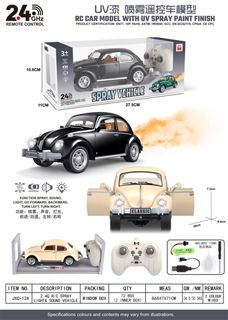
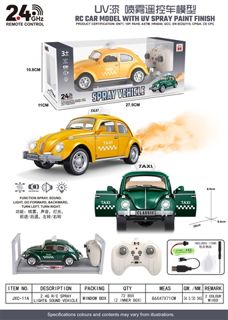
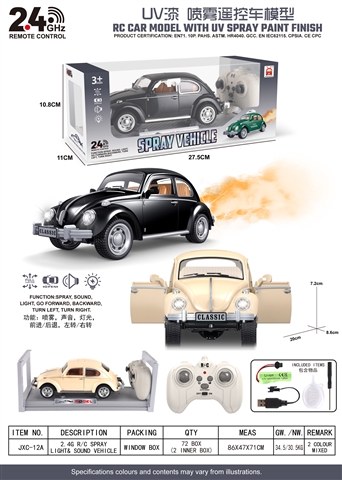
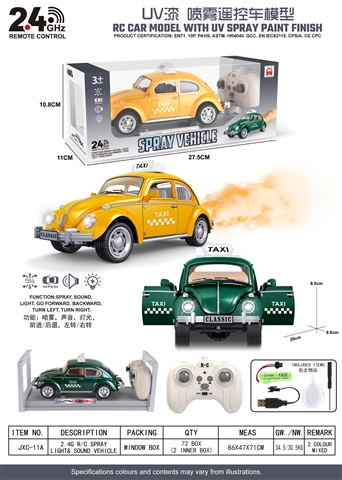
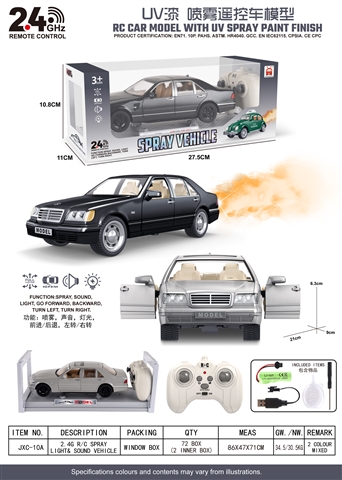
One illustration of how these checks attach to a real product: on a 2.4GHz 7-Channel Beetle RC Car with Lights, Sound and Spray, the pairing check, steering check and the lights/sound/spray confirmation all belong in the EOL station, while body fit, screw count and colour belong upstream. The catalogue snapshot for that model records MOQ 216 and a reference price band, but treat the approved sample, current quote, packing and destination documents as separate items to reconfirm before ordering. No certification, age suitability, licensing, stock or factory capacity is established by a catalogue entry.
Logistics checks that belong on the same sheet: confirm carton quantity and carton weight against the packing list, verify the shipping marks match the destination documents, and confirm that the tracking information required for the market is permanent and supports product identification where applicable. Review packaging, product markings and lot control together, because those are controlled fields that change with the SKU.
Age grading and small-part risk are connected and must be assessed for the actual configuration. Detachable accessories and packaging components need the same review discipline as CoreRCCar itself, and assemblies that look safe at sample stage can change when a sub-supplier swaps a screw or a clip.
FAQ
What is the difference between line inspection and end-of-line function testing?
Line inspection verifies individual operations while the part is being built, station by station; end-of-line testing verifies the complete assembled unit against its functional specification. In-process checks catch assembly drift early, while EOL is the last gate before shipment where a missed defect costs the most. A strong supplier runs both.
Does a feature listed in the catalogue prove it was tested?
No. A product name listing lights, sound, spray or gesture control is a specification, not a test result. Ask the factory for the EOL checklist and the pass/fail criteria for each named function, and for spray, lithium or wireless functions ask for the actual report rather than a description.
What should I ask about defect coding and rework?
Ask how a failed lot is isolated, which defect classes are recorded, and what triggers release after rework. The AQL number itself should come from the agreed inspection plan on the purchase order, not from a catalogue or a sales email.
Does an earlier test report cover my OEM change?
Not automatically. According to CPSC guidance, affected requirements must be retested after a material change to a children's product, and a new certificate issued from the passing tests. Separate unchanged components from changed materials and confirm who coordinates the document review.
Can one laboratory certificate cover everything I need?
No. Laboratory acceptance is specific to the relevant safety rules, and one laboratory may not cover every required test. Match the applicable requirements and laboratory scope to the CoreRCCar configuration for each destination market.
How do I verify a sample before placing a repeat order?
Approve a golden sample and keep it with the inspection plan. Reconfirm the approved sample, current quote, packing and destination documents before each order, and compare the incoming lot against the retained sample rather than against a photo.
Sources
Request a Quote or a Factory Audit
If you want to see how the two control layers sit on a real line, ask us for the current inspection plan and EOL checklist alongside your quote — CoreRCCar CoreRCCar-grade 2.4GHz RC cars in Chenghai and can walk you through the pairing, steering, lights, sound and spray checks station by station. Request a quote or book a factory audit and bring your own checklist; the point of the visit is to test our answers, not to take our word.