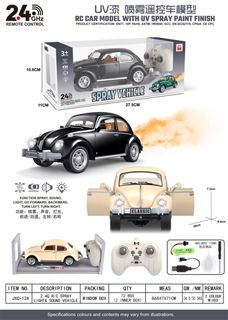
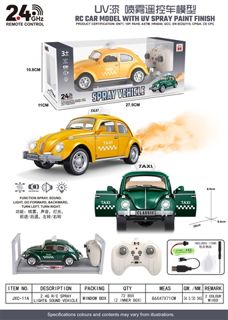
To manage RFQ revisions across similar RC body styles, put a single revision number on every quote, sample, and PO, and back it with a comparison sheet that shows exactly how one shell differs from the next. When six SKUs share the same 2.4GHz 7-channel electronics and only the body shell changes, a loose photo or an old label is how a Beetle Taxi ends up in a Mercedes-Benz S320 Police carton. The practical fix is a five-step discipline: one revision number per SKU family, a comparison sheet, labeled samples, a change log, and a written final confirmation before production.
The cost of drift is not a single bad sample. It is a container of wrong shells, a retailer chargeback, or a compliance file that no longer matches what shipped. For an import order of roughly 5,000 units split across two destinations, one mislabeled SKU can delay an entire container at port while the factory re-runs labels. Revision discipline is the cheapest insurance you will buy this season.
Key Takeaways
- Assign one revision number per SKU family and stamp it on the quote header, the sample label, and the packing list. If the number does not match across documents, stop and reconcile before any production step.
- Build a comparison sheet that lists body shell, color code, electronics, packaging, and MOQ for every similar SKU side by side. Never edit the sheet in place — supersede the old version and archive it.
- Reject any sample whose label does not show the SKU code, revision number, tool number, and date. A loose reference photo is not a production standard; the revision card is.
- Maintain a change log per SKU that records what changed, why, who approved it, and which revision it supersedes. Share it at every milestone, from quote to pre-production.
- Require a written final confirmation before production that lists SKU, revision, colors, packaging, and label artwork. Verbal approvals are not approvals.
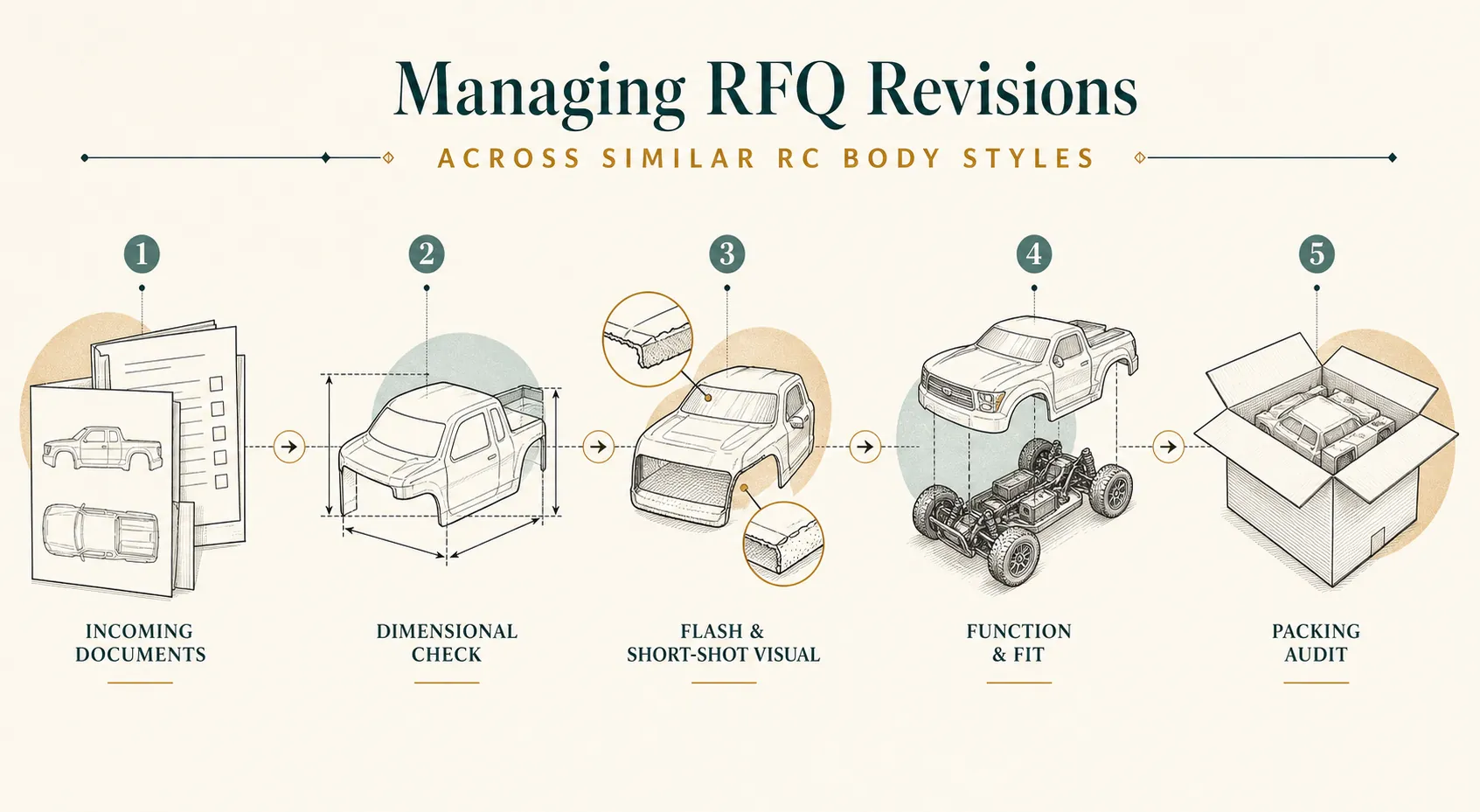
Revision Workflow Checkpoints
| Quote stage | Revision number on quote header; comparison sheet attached; no conflicting specs across similar SKUs. |
|---|---|
| Sample stage | Sample label matches SKU + revision; color matches Pantone reference; packaging sample matches spec. |
| Pre-production | Change log reviewed; superseded files archived; no open revision conflicts. |
| Final confirmation | Written sign-off; PO references confirmed revision; inspection plan includes AQL from PO (not catalog). |
Why do similar RC body styles create revision risk?
The risk is not that a factory cannot build a Beetle and a BMW M3. It is that the two shells share the same chassis, the same 2.4GHz 7-channel board, the same lights and sound, and often the same MOQ of 216 units. When the electronics and packaging options overlap, the only thing that separates one SKU from another is the shell, the color code, and the label artwork. Those are exactly the details that drift when a quote is updated verbally and a sample is approved by photo.
Consider a six-SKU family: a Beetle, a Beetle Taxi, two Mercedes-Benz S320 variants, and two BMW M3 variants. Each has its own SKU code and its own MOQ, but the bill of materials is nearly identical. One factory line can switch between them in minutes, which means a label from the previous SKU can easily stay in the hopper. That is why line clearance — stopping the line to clear labels, colors, and work instructions — is a standard step before a new SKU starts. A mixed label reaching a retailer is not a quality hiccup; it is a recall event.
Step 1: Establish a single revision number per SKU family
Give each body-shell variant a unique SKU code that persists across every document: quote, sample, PO, inspection report, and packing list. Then require the factory to stamp the revision number on the quote header, the sample label, and the packing list. If the numbers do not match across documents, stop and reconcile before any production step.
At a fair or in a showroom, a booth sample is often a hero unit — a hand-tuned example that looks better than the production run. The revision card, not the photo, is the authoritative reference. Label the tool number and revision on the sample table, and refuse to accept a fair photo as the production standard. Fair lighting lies; the revision card does not.
Step 2: Build a comparison sheet for overlapping SKUs
Create a side-by-side matrix that lists body shell, color code (Pantone), electronics spec, packaging option, label content, and MOQ for every similar SKU. Update the matrix on every revision, but never edit in place — supersede the old version and archive it. This is the document that stops a buyer from approving a Beetle Taxi sample and then receiving a plain Beetle because the quote said "Beetle."
A comparison sheet also surfaces conflicts early. If the Mercedes-Benz S320 Police SKU carries a different label text than the civilian S320, that difference must be visible in the matrix before production, not after. When a factory documents color and packaging per SKU — as with OEM CoreRCCar delivered in kraft boxes with stickers — the comparison sheet becomes the single source of truth for what each SKU should look like.
Step 3: Label every sample with SKU + revision + date
Require that each physical sample carry a label showing the SKU code, revision number, tool number, and date. Reject any sample that is unlabeled or whose label does not match the current revision. A sample without a revision label is just CoreRCCar; with the label, it is a contractual reference.
Production release should use an identified approved sample, not a loose reference photo. Color, texture, logo, and assembly all change under different lighting, so the approved physical sample — with its revision label — is the only reliable benchmark. If the factory cannot produce a labeled golden sample, treat that as a red flag.
Step 4: Maintain a change log per SKU
Keep a running log for each SKU that records what changed, why, who approved it, the date, and which revision it supersedes. Share the log at every milestone: after the quote, after the sample, and before production. The log is the audit trail that tells you whether a change was intentional or a drift.
A change log also prevents silent substitution. If a resin grade or flame-retardant additive changes, the log should capture that, because a flame-retardant additive can change the resin's processing, color, migration, and chemical profile — and a flame-retardant claim does not CoreRCCar testing. The log keeps you honest about what you actually approved.
Step 5: Require written final confirmation before production
Before the factory commits to a production run, demand a written document that lists the SKU, revision number, colors, packaging, label artwork, and electronics. Written sign-off only — no verbal approvals. The PO should reference the confirmed revision, and the inspection plan should include the AQL levels from the PO, not from a catalog sentence.
AQL (Acceptable Quality Limit) is a sampling method based on ISO 2859 that classifies defects as critical, major, or minor. Typical levels are 0% critical, up to 2.5% major, and up to 4% minor, but those are guidelines, not legal requirements. The exact AQL must be agreed with the factory and written into the PO. If a buyer wants a number, they get it from the agreed inspection plan on the PO — not from a catalogue sentence.
Worked example (illustrative, not a real shipment)
An order for 5,000 units of the Beetle Taxi RC car splits across two destinations: 3,000 to a US distributor and 2,000 to a CoreRCCar chain. The UK buyer specifies a "Beetle Taxi" label with the UK importer's logo; the US buyer wants the standard Beetle Taxi artwork. The quote revision is R3, the sample label says R3, and the comparison sheet shows the difference in label text and the Pantone color for the taxi livery.
At pre-production, the change log for the Beetle Taxi shows that R2 changed the taxi sign color from yellow to amber. The factory's line clearance step catches that the previous SKU — the plain Beetle — still has its labels in the hopper. The line stops, the labels are cleared, and the R3 Beetle Taxi runs. The AQL inspection at the factory tests 200 units under the agreed plan, finds no critical defects, and the container ships. The wrong-shell scenario never happens because the revision system caught it at the line, not at the port.
What to ask suppliers at each stage
These six questions cover the critical points of revision management. Ask them in writing, and keep the answers with the quote.
1. "What revision number is on the current quote, and does it match the sample label?"
2. "Can you provide the comparison sheet showing how this SKU differs from [similar SKU] on body shell, color code, and packaging?"
3. "What is the tool number and revision stamped on the golden sample?"
4. "Has the line been cleared of the previous SKU's labels, colors, and work instructions before this run starts?"
5. "What is the AQL and inspection plan on the PO — can you confirm it in writing?"
6. "What material documentation per SKU can you provide (e.g., material safety data, compliance reports)?"
What to ask for instead of assuming
Several claims routinely appear in catalog copy but must be confirmed with actual factory reports: mAh for batteries, range in meters, FPS for any projectile feature, and MOQ figures. A spray function, a lithium battery, or an FCC claim are all claims that need a report, not a brochure line. When a buyer asks for a spec, the factory should provide a per-SKU spec sheet with the revision number on it.
If the factory cannot produce that documentation, treat it as a gap. The same goes for compliance: a flame-retardant claim does not CoreRCCar testing, and a material documentation per SKU is a reasonable request for any buyer shipping to the EU or US. Ask, don't assume.
FAQ
What is the minimum order quantity for these RC cars?
The MOQ for each of the 2.4GHz 7-channel RC body styles listed is 216 units per SKU. Confirm the MOQ in the quote, as it can vary by color or packaging options.
How do I ensure the sample matches the final production run?
Require a labeled golden sample with SKU, revision, tool number, and date, and use that physical sample as the approval reference. Never rely on a photo; the revision card is the authority.
What AQL level should I set CoreRCCar inspection?
AQL levels are agreed between buyer and factory and written into the PO. Typical levels are 0% critical, up to 2.5% major, and up to 4% minor, but the exact numbers must be in the PO, not assumed from a catalog.
What happens if a label from the previous SKU stays in the production line?
A mixed label can reach a retailer and trigger a recall. That is why line clearance — stopping the line to remove old labels, colors, and instructions — is a standard pre-production step.
How do I track revisions when I have multiple similar SKUs?
Use a comparison sheet and a change log per SKU. The comparison sheet shows differences across SKUs, and the change log records what changed, why, and who approved it. Supersede old versions, never edit in place.
Can I rely on the factory's catalog for mAh, range, or FCC claims?
No. Those figures and certifications must come from actual factory reports or test certificates. Ask for the report per SKU and verify the revision number on it.
Sources
Request a Quote
Ready to source your next RC body style with a revision system that holds? Request a quote and ask for the comparison sheet and revision number on each SKU. We will respond with the MOQ and per-SKU spec sheet you need.