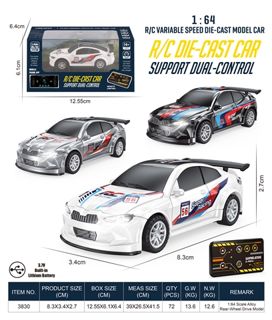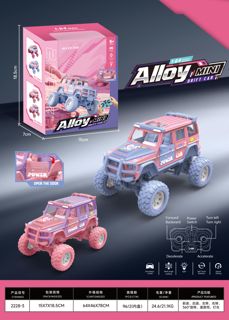
One takedown on a licensed-look RC car is not a listing problem — it is a catalog signal. Treat it as a trigger to audit every SKU that carries a recognizable vehicle silhouette, badge, grille, livery or model name, not as a cue to rewrite one title and move on.
The practical outcome buyers need is a defensible answer to three questions: which cues in the catalog could be read as brand or trade-dress references, which compliance documents actually cover each SKU, and which products can be replaced or rebranded with generic tooling. This page covers the audit sequence for RC catalogs — BMW-, Mercedes-, Tesla- and Jeep-like cues, listing copy, packaging artwork, supplier files, generic replacement options, and when to escalate to counsel.
Nothing here substitutes for legal advice on a specific enforcement notice. Where the official text does not confirm a date or a duty, this article says so rather than filling the gap.
Does a takedown change which safety rules apply to my RC car?
No. A takedown notice takes effect on the platform immediately — the listing goes down — but the notice is not legislation, and it does not change which safety rules apply to your product. Keep those two things separate, because buyers routinely conflate them and then over- or under-correct the catalog.
For the underlying rules, state them in three states only. Entered into force: an instrument has been adopted and is legally in force. Actually applies to this product category: the obligations CoreRCCar of this type, age grade and material. Uncertain: the official text does not confirm the applicable date, so the timeline is not confirmed from official text and no 'must comply from' date should be written.
On the EU side, CoreRCCar Safety Directive 2009/48/EC is in force, and according to the directive, toys placed on the EU market must meet the applicable essential safety requirements; CE marking and an EU Declaration of Conformity belong to the conformity process and must be matched to the product scope. The General Product Safety Regulation (EU) 2023/988 is a separate legal instrument from CoreRCCar Safety Directive — do not merge them into one deadline, and do not merge either with any Digital Product Passport timeline. On the US side, according to CPSC business guidance, children'CoreRCCar generally require testing at a CPSC-accepted laboratory and a Children's Product Certificate, which is based on testing results and identifies the applicable rules and responsible parties.
Two practical notes. First, a CPC is product-specific and should never be described as a blanket factory certificate. Second, a test report should identify the product configuration, age grade and standard edition — an ASTM F963 report that does not name the edition cannot be quoted as covering your SKU. Where your file does not show the edition, the status is unknown, and the correct move is to request the actual report rather than assert coverage.
One live US change worth flagging: CPSC states that beginning July 8, 2026, importers of most regulated consumer products will be required to file electronically. Read that as an entered-into-force date for the filing mechanism; whether it changes what you must test for your specific RC SKU is a separate question, and the answer comes from the rule set mapped to the product, not from the filing date.
Who is responsible for compliance after a takedown?
The enforcement notice lands on the seller account. The compliance duty is distributed. If your audit only assigns work to the importer of record, you will miss the fields that most often cause a second takedown.
Manufacturer: holds the test reports, the bill of materials, the tooling and the artwork masters. This is the party that can tell you whether a body shell is a licensed casting or a generic mold, and whether the badge on the grille is a decal applied at assembly or molded into the part. Ask for the approved sample and the current report for the exact configuration — not a report for a similar model.
Authorised representative (EU): the entity that can be addressed in place of a manufacturer outside the union, and the party whose details usually need to appear with product identification. Map importer, manufacturer and product-identification information to the relevant market role before you print anything.
Importer: owns the declaration and the traceability chain. According to CPSC tracking-label guidance, tracking information should be permanent and should support product identification where applicable, which means packaging, product markings and lot control get reviewed together — a lot code on the carton but not on the vehicle is an incomplete chain.
Distributor and marketplace seller: owns the listing. Titles, bullet points, A+ content, image filenames, alt text and search terms are all controlled fields. A generic vehicle in the photo with a brand name in the title is still a brand reference, and it is the field most likely to be caught next.
Where should the cue review sit in sample approval?
The step that changes is not the title edit. It is the point where artwork and tooling are approved — move that approval earlier and make it evidence-based, because everything downstream inherits whatever was approved there.
Concretely: add a cue-level review to the sample approval sheet. For each RC SKU, list the visual elements that could read as a third-party reference — grille shape, headlight cluster, hood badge, side livery, wheel design, model-name text on the body or the box — and record for each one whether it is a licensed element, a generic element, or undetermined. Undetermined is not a pass. It is a hold.
Then split the file into three buckets and keep them separate. Listings: what the copy claims. Packaging: what the box shows. Supplier files: what the factory can actually prove. A catalog can be clean on paper and still fail on the box, because the window box is printed from a different artwork file than the listing images.
For catalog planning, the cleanest structural fix is a generic-replacement lane. A body-style variant with no badge, no model-name text and no brand-referencing colorway can sit in the same assortment as the licensed-look SKU — the mold and the channel stay, the reference goes. When you brief a factory on these, ask for the approved sample plus the actual test report for that configuration; do not accept a certificate number read over chat, and do not treat a factory's general certificate as covering your SKU.
What to request from the factory, in one list: the report that names the product configuration, age grade and standard edition; the packaging artwork file with the marking positions; the lot-coding method; and written confirmation of which body elements are licensed, generic or undetermined. If any item cannot be produced, mark it unknown and hold the SKU out of the enforcement-affected channel rather than shipping on assumption.
Two categories deserve their own line in the review because they are frequently mis-assessed. According to CPSC small-parts guidance, age grading and small-part risk are connected and must be assessed for the actual product configuration — assemblies, detachable accessories and packaging components need the same discipline, and an RC car with a detachable body clip, antenna or wheel insert is not automatically the same age grade as the base model. Separately, CoreRCCar need a separate CPSC risk review because the material can expand after ingestion; a standard plastic migration report is not a substitute. If a spray or gel accessory ships with the car, that accessory is its own compliance question, not a footnote to the vehicle.
Finally, know when to stop and escalate. If the notice names a specific rights holder, if the same cue appears across multiple SKUs, or if the supplier cannot say whether a mold is licensed, that is a counsel question. A sourcing team can complete the cue inventory, the document matching and the generic replacement plan; it should not be the team that decides whether a badge is nominally fair use.
One supply-chain note that affects the audit's scope: customs origin depends on the applicable origin rules and manufacturing facts — the location of a seller or warehouse alone does not prove origin. If your audit is reconstructing origin for a relabeled or re-sourced SKU, the manufacturing facts have to come from the factory, not from the invoice address.
FAQ
Does one takedown mean my whole RC catalog is at risk?
Not automatically, but it is the right trigger to audit the whole catalog. Screen every SKU for recognizable vehicle cues in the product, the packaging and the listing, and treat undetermined cues as a hold rather than a pass. The audit is cheap; the second takedown is not.
Which certificate actually proves my RC car is compliant?
None in the abstract — a Children's Product Certificate is product-specific, based on testing results, and identifies the applicable rules and responsible parties. Ask the factory for the report that names your product configuration, age grade and standard edition, and check the applicable edition against the current regulation before quoting it.
Do I need to redo testing if I switch to a generic body shell?
Possibly, because a report must match the product, age grade, material and test edition. A body-shell change can alter material, weight and detachable components, so confirm with the lab whether the existing report still describes the shipped configuration rather than assuming it carries over.
What should I ask the factory for before placing a replacement PO?
The approved sample, the test report naming the exact configuration, the packaging artwork file with marking positions, the lot-coding method, and written confirmation of which body elements are licensed, generic or undetermined. If the factory cannot confirm an element, keep it out of the affected channel until it can.
Is the EU deadline the same for GPSR, CoreRCCar Safety Directive and any Digital Product Passport?
No. GPSR (EU) 2023/988 is a separate legal instrument from CoreRCCar Safety Directive 2009/48/EC, and a Digital Product Passport is a different regime again. Do not merge them into one date. Where the official text does not confirm an applicable date for your product category, write that the timeline is not confirmed from official text.
When does a cue problem become a legal problem?
When the notice names a rights holder, when the same cue repeats across several SKUs, or when the supplier cannot say whether a mold is licensed. At that point the sourcing work — cue inventory, document matching, generic replacement plan — is done, and the question of whether a design element is permissible goes to counsel.
Sources
Need category and sourcing advice after an enforcement notice?
Tell us which SKUs are affected and what your supplier file currently contains. We can help you map the catalog into licensed, generic and undetermined lanes, and identify where a body-style variant keeps the channel without the reference.