
Choose mini RC counter displays as the starting allocation when counter space is available but floor space is constrained; reserve large truck floor stock for a measured fixture and a price point your store can support. The mini RC counter display versus large truck floor stock decision should use revenue and gross margin per occupied display area, replenishment needs, and freight exposure—not vehicle size alone. Count the packaging, fixture, and demonstration area before committing.
A mini vehicle is not automatically a ready-made counter display. The mini options below have window-box packaging; specify the loaded counter tray separately. Likewise, select the actual transport-truck pack before approving floor space: a large crawler’s dimensions cannot stand in for a transporter.
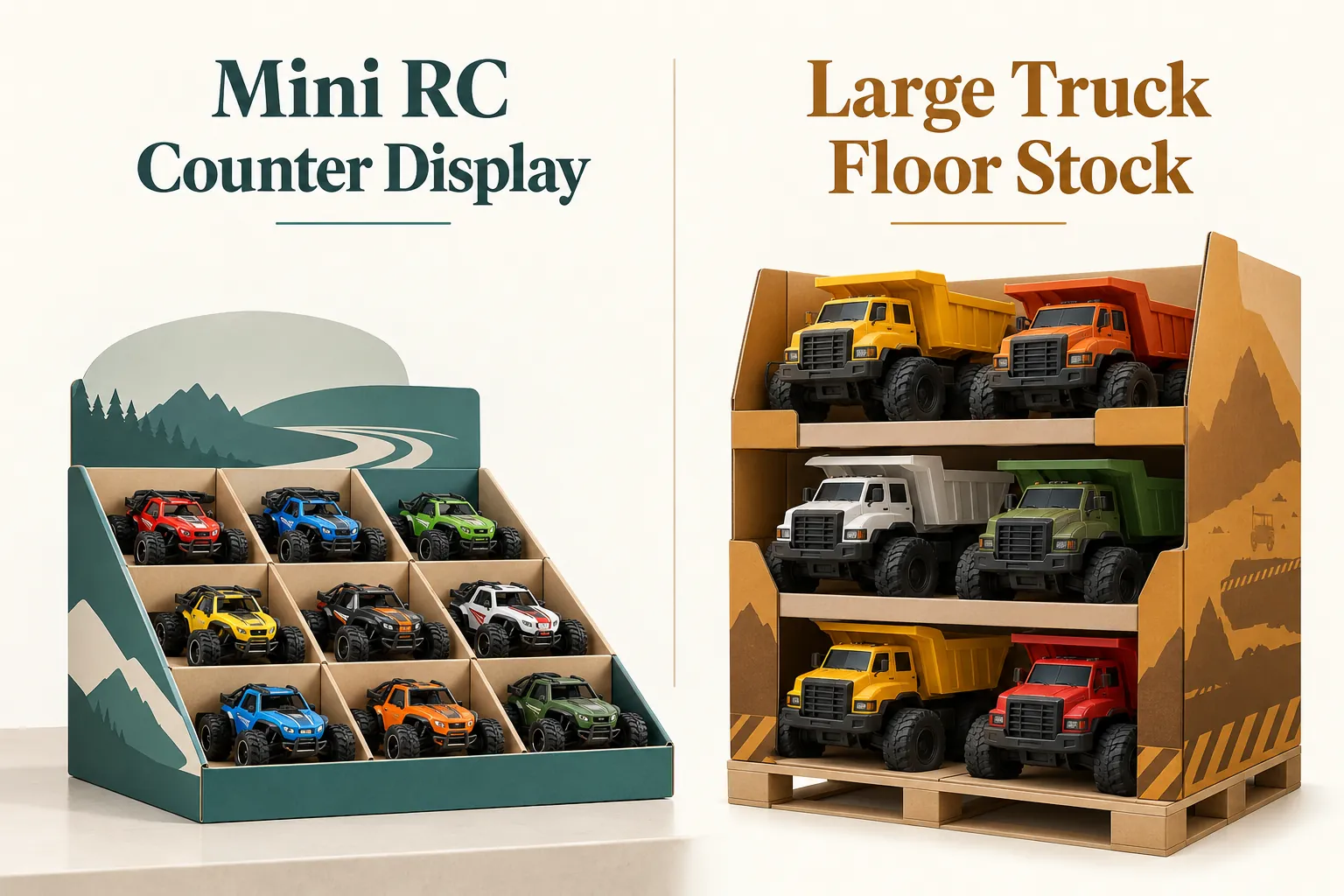
Which catalog options provide a useful starting comparison?
The two mini window-box options provide compact-format candidates, while the YK6101 supplies a separate large-package reference—not a like-for-like wholesale transport-truck quote.
The mini catalog references are dated October 9, 2026. The YK6101 dimensions and displayed retail price come from its YK6101 product listing.
| 1:64 Mini Stunt Drift RC Graffiti School Bus | Window-box packaging; catalog reference price USD 4.03; reference MOQ 360; catalog carton quantity 120. These figures apply to this exact model and require a current quotation. |
|---|---|
| 1:64 Mini Stunt Drift RC Graffiti Mini | Window-box packaging; catalog reference price USD 4.03; reference MOQ 360; catalog carton quantity 120. Treat this as a separate product selection, not an interchangeable color or an automatically combined MOQ. |
| YK6101 large-truck package reference | Listed package dimensions: 70 × 30 × 33 cm; package weight: 6 kg. This is a crawler example, not a transport-truck pack specification. |
| YK6101 price and battery configuration | Displayed retail sale price: USD 734.79. Battery and charger are optional rather than included by default. This is not a wholesale or MOQ price. |
How do you compare price points on the same commercial basis?
Compare both routes per retail-ready sellable pack with the same explicitly defined inclusions, not by dividing one catalog price by another.
For each candidate, request the quoted sales unit, vehicles per set, controller, battery, charger, accessories, and packaging. Keep the product identifier, set piece count, packs per carton, and MOQ as separate quotation fields. The mini models’ USD 4.03 reference price and the crawler’s USD 734.79 retail listing are different commercial bases; their ratio would not establish a wholesale cost advantage.
Set the intended shelf price separately from the purchase price. Then compare landed cost and gross margin per sellable pack. If a battery or charger is sold separately, keep that configuration visible in both the customer offer and the cost comparison.
How many packs will fit on the counter or floor fixture?
Approve display capacity from a measured, loaded fixture rather than from vehicle dimensions or carton quantity.
For the mini school bus and Graffiti Mini, request the finished window-box length, width, and height, plus the proposed counter tray’s loaded dimensions and pack count. Check the header height, customer access, and whether removing a pack disturbs the remaining stock. Neither a 120-unit shipping carton nor a 360-unit MOQ establishes the number of packs in a display.
For the selected large transport truck, request the finished sales-pack dimensions and test its intended orientation on the actual floor fixture. Include supports, signage, and customer access in the occupied area. Use vertical capacity only after checking shelf clearance and fixture suitability.
Treat demonstration space separately. Run a sample through the intended maneuver on a controlled surface, then measure the operating area and access clearance. A static floor display and a live driving demonstration are different space commitments.
How should carton cube and replenishment affect the allocation?
Compare measured outer-carton cube per sellable pack and the stock needed between deliveries before assigning the larger display.
Calculate carton cube as external length × width × height in meters, then divide by the confirmed number of sellable packs in that carton. Record gross carton weight alongside cube and obtain freight pricing for the actual shipment configuration. Measure production packaging again if the pack quantity or box construction changes.
The YK6101’s listed 70 × 30 × 33 cm package has a calculated geometric volume of 0.0693 m³. That is package volume—not proof of a master-carton cube, pallet requirement, or chargeable freight volume. Do not apply it to a transport truck.
Plan two replenishment clocks: backroom-to-display refills and supplier-to-warehouse deliveries. A small counter display may need frequent local refills even when purchase orders are infrequent. Use your own sales history, or a clearly labeled planning forecast, to estimate demand between receipts. Confirm supplier availability, reorder quantity, production lead time, and transit assumptions before setting the reorder point.
Keep the mini models’ reference MOQ of 360 separate from their 120-unit carton quantity. Neither figure, by itself, establishes a mandatory order multiple or a repeat-order condition.
Should you choose standard colors, a logo, or custom packaging?
For an initial space test, prefer a quoted standard configuration and approve custom branding only after the loaded display fits the intended location.
Request the available color mix, quantity by color, expected availability date, and reorder conditions for each selected model. A listed color is a catalog choice, not confirmation of inventory or immediate shipment.
Quote custom color, product logo, window-box artwork, and counter-tray artwork as separate options. Ask for the MOQ, price adjustment, approval sample, and timing for each requested change; do not carry the base product MOQ into a custom-color quotation. An unlisted customization option is a request to quote, not proof that customization is unavailable.
Have the packaging printer supply its own dieline and artwork requirements. Approve a physical loaded pack or tray before releasing artwork that changes the display footprint.
What product documents should accompany the chosen configuration?
Request documents matched to the exact construction, intended age group, destination market, and battery configuration as a purchasing check.
Match the sample, quotation, packaging, and reports by model identity and revision. Ask the factory to identify the tested construction and explain coverage for the selected mini or truck configuration; a broad family description alone is not a useful match.
If the offer includes spray functionality, lithium batteries, an FCC claim, or an IP rating, request the corresponding specification and supporting report for that configuration. Do not add those features to the comparison merely because they appear on another RC model. A packaging fit check or in-store demo is not safety testing.
Which format should receive the limited retail space?
Allocate the initial counter position to a mini RC window-box option; approve large transport-truck floor stock only when its measured fixture, margin case, and replenishment plan justify the additional space.
For the mini route, choose between the school bus and Graffiti Mini by sample presentation, pack fit, and the current quotation—not by their identical reference price alone. For the truck route, evaluate the actual transport-truck candidate rather than treating the crawler reference as its substitute.
Compare planned revenue per occupied area over the same trading period: expected packs sold × intended selling price ÷ display area. Run the same comparison using gross margin instead of revenue. Label forecasts as forecasts, include demonstration space where it is dedicated to the product, and assess counter and floor space against their respective alternative uses.
Document the allocation with the chosen model and configuration revision, target footprint and margin, observed sample measurements, and the decision conditions. Assign a responsible buyer and approval date, then record who will close each packaging, quotation, or availability condition and when it was closed. This creates a traceable approval record without pretending that sales performance has already been demonstrated.