The most expensive mistake in this category is treating one multi-car 2.4GHz demo — a video, a trade-show run, a single sample set — as proof of how a production lot will behave. A demo failure tells you a failure happened; it does not tell you which variable caused it. Before you accept a multi-unit performance claim, require that controller identity, startup order, distance, power state and environmental interference be isolated one at a time, on a defined SKU and a defined sample construction.
What follows is deliberately bounded. The supplied evidence for this article covers report and sample identity, lot traceability and incoming-component checks — not RF pairing behaviour. So this page tells you which pairing and demo variables deserve controlled testing before a multi-unit claim, and flags plainly where the evidence stops. It does not rank failure drivers, and it does not state a market size, growth rate or supplier generalisation, because no such figures were supplied.
Key Takeaways
- A multi-car demo is an uncontrolled experiment unless controller identity, startup order, distance, power state and environmental interference are varied one at a time. Observing a failure does not identify its cause.
- A test report is only usable when its identity matches the actual SKU, model, material, colour, age grade and sample construction — so any performance claim should be tied to the same identifiers as the report.
- A type-test or golden-sample report does not automatically cover a later production lot. Match report SKU, materials, colours and production date or cohort to the PO before quoting a claim.
- Incoming wheels, axles, batteries, fasteners, inserts and printed parts should be checked before assembly, because a finished-toy test may not isolate which supplier component caused a defect.
- A Children's Product Certificate is product-specific and is not a blanket factory certificate, and it does not evidence 2.4GHz pairing reliability, range or multi-car behaviour. Ask for the actual report, not a certificate number.
What does the evidence actually cover — documents and components, or radio behaviour?
The traceable observations available here concern documentation and component identity, not radio behaviour. A test report is useful only when the report identity matches the actual SKU, model, material, colour, age grade and sample construction. That is a statement about traceability, and it applies directly to how you read any RC demo claim: if the claim cannot be pinned to a named SKU and a named sample, it is not a claim you can schedule production against.
The second traceable observation is about lot coverage. A type-test or golden-sample report does not automatically cover a later production lot, and importers should match report SKU, materials, colours and production date or cohort to the PO. The demo set you approved and the cartons you receive are two different pieces of evidence until someone matches them.
The third is component-level. Incoming wheels, axles, batteries, fasteners, inserts and printed parts should be checked before they enter assembly, because a finished-toy test may not isolate the supplier defect. For a multi-car RC product, that is where variation between units is most likely to enter unnoticed — several small components, several suppliers, one assembled unit.
Regulatory instruments constrain how you word a compliance claim, not how a 2.4GHz link performs. According to CoreRCCar Safety Directive 2009/48/EC, toys placed on the EU market must meet the applicable essential safety requirements, and CE marking and the EU Declaration of Conformity must be matched to the product scope. According to CoreRCCar safety business guidance, children'CoreRCCar generally require testing at a CPSC-accepted laboratory and a Children's Product Certificate. According to 16 CFR Part 1250 and the ASTM F963 standard page, a test report should identify the product configuration, age grade and standard edition. None of these documents describes pairing, startup order or interference, and none should be quoted as if they did.
What can be inferred from a multi-car demo — and what cannot?
What can be inferred: any multi-unit RC claim should be traceable to a defined SKU and a defined test configuration, because that is exactly the discipline the available evidence demands of reports and samples. If a supplier cannot tell you which unit, which sample and which configuration produced the result they are showing you, the result is not reproducible and should not be planned against.
What cannot be inferred: which of the five named variables — controller identity, startup order, distance, power state, environmental interference — drives failures in multi-car 2.4GHz demos. No supplied fact, source or trend item in this material describes 2.4GHz RF behaviour, pairing protocols, controller identity, startup sequencing or multi-unit interference. Treating the list of variables as a ranking would be inventing a finding.
Name the correlation trap precisely. If four cars are switched on in a room and one fails to respond, the observation is consistent with interference, with a startup-order collision, with a depleted battery, with a defective unit, and with several of those at once. Without varying one factor at a time and repeating the trial, none of those explanations is excluded. A single demo, at any unit count, supports a question — not a cause.
A demo observed on one sample set cannot be generalised to a supplier, a product line or a factory's whole output. Production variation between units is a real category of explanation, and the supplied material points at incoming-component checks as the place where that variation is caught. That is a process observation, not proof about any specific factory.
What should OEM and buying teams put in writing before accepting a multi-unit claim?
Turn the ambiguity into contract language rather than opinion. Before you accept a multi-unit claim, require the supplier to state the SKU, the sample construction, the unit count, the number of repeated trials, and the exact configuration used. If they cannot, the claim stays out of your listing copy and out of your planning.
Design the test so the variables are separable. Run each configuration as its own trial set with a fixed unit count, repeat it enough times that a single fluke does not become a conclusion, and record what changed between runs. A failure taxonomy written before the test — no response, delayed response, wrong unit responding, loss of control after movement, failure to recover after power cycle — is more useful than a pass or fail verdict, because it tells you which variable to isolate next.
Decide what recovery looks like in advance. Whether a unit recovers after a power cycle, a re-pair, or a move to a different position is part of the product's usable behaviour, and it should be observed rather than assumed. If recovery behaviour is unknown for a given SKU, mark it unknown and test it — do not carry a supplier's verbal assurance into a product page.
Keep compliance evidence and performance claims in separate folders. A Children's Product Certificate is product-specific and is not a blanket factory certificate; it addresses applicable children's product safety rules, not RF pairing, range or multi-car behaviour. CE marking and the EU Declaration of Conformity belong to the conformity process and must be matched to the product scope — they are not evidence of pairing reliability. Where a claim concerns spray, lithium batteries, FCC equipment authorisation or IP rating, use only what the actual report states, or ask the factory for that report. This article does not supply figures for mAh, range or certification numbers, and you should not accept invented ones.
For OEM and ODM work, note that these are commercial production models, not safety certificates: the order must separately define design ownership, tooling, IP, testing, branding and production responsibility. A multi-car performance claim is a commercial claim, and it belongs in the same written scope as the tooling and the branding.
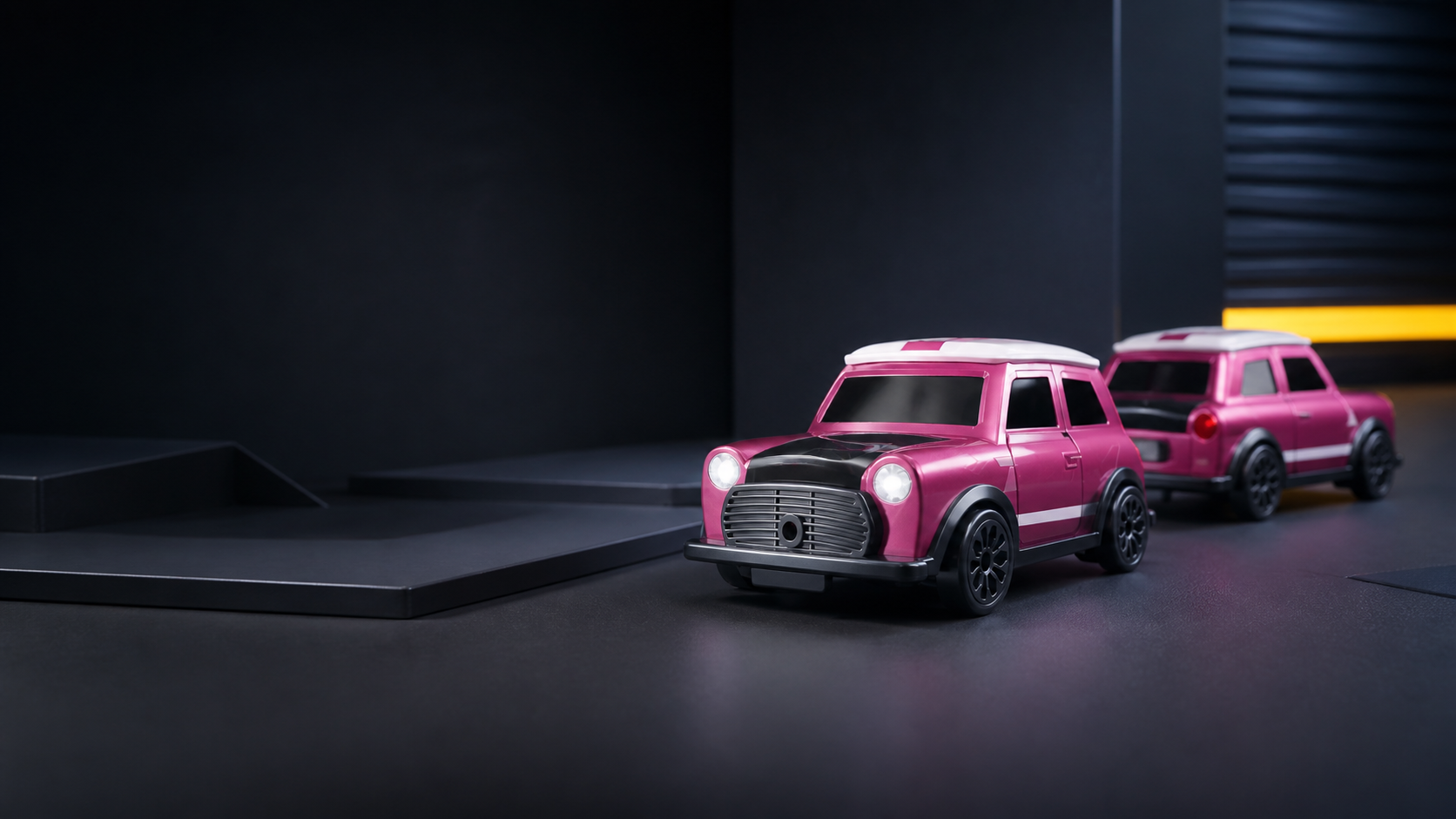
If you are building an assortment around 2.CoreRCCar-grade models and need a defined sample to test against, start from a spec you can name — for example the 1/32 mini RC car with LED light in our catalogue — and ask for the matching report and sample construction before any demo claim is repeated in your channel.
Evidence and limits
| Claim: A test report is usable only when its identity matches the actual SKU, model, material, colour, age grade and sample construction. | Source: approved QC fact on report/product identity. Limitation: it establishes traceability of documents, not RF pairing behaviour or demo failure causes. |
|---|---|
| Claim: A type-test or golden-sample report does not automatically cover a later production lot; match report SKU, materials, colours and production date or cohort to the PO. | Source: approved procurement fact on lot coverage. Limitation: says nothing about unit-to-unit RF variation within a lot. |
| Claim: Incoming wheels, axles, batteries, fasteners, inserts and printed parts should be checked before assembly, because a finished-toy test may not isolate the supplier defect. | Source: approved QC fact on incoming components. Limitation: identifies where variation can enter, not which component drives a given demo failure. |
| Claim: Toys placed on the EU market must meet applicable essential safety requirements, and CE marking and the EU Declaration of Conformity must be matched to the product scope. | Source: Toy Safety Directive 2009/48/EC. Limitation: conformity instrument only — not evidence of 2.4GHz link performance. |
| Claim: Children'CoreRCCar generally require testing at a CPSC-accepted laboratory and a Children's Product Certificate, which is product-specific. | Source: CoreRCCar safety business guidance and CPC page. Limitation: a CPC does not certify pairing reliability, range or multi-car behaviour. |
| Claim: A test report should identify the product configuration, age grade and standard edition. | Source: 16 CFR Part 1250 and the ASTM F963 standard page. Limitation: the applicable edition must be read from the current regulation before a report is quoted. |
| Claim: Controller identity, startup order, distance, power state and environmental interference are variables that deserve controlled isolation before a multi-unit claim. | Source: this article's stated test-design requirement. Limitation: no supplied fact or source describes 2.4GHz RF behaviour, so no ranking or dominant driver can be asserted from this material. |
FAQ
Is demand for 2.4GHz CoreRCCar-grade cars growing, and should I plan volume on that basis?
No growth figure can be supported from the material supplied for this article, so treat any specific market-size or growth number you are quoted as unverified. Plan volume on your own sell-through and on a defined SKU with a matched sample and report, not on a demo video.
How many units and repeated trials should a multi-car 2.4GHz demo include before I accept the result?
The supplied evidence does not provide a unit count or trial count, so no number can be quoted as a standard. Set your own rule: fix the unit count, run each configuration as a separate repeated trial set, and record what changed between runs so a single result cannot be mistaken for a pattern.
Which variables should I isolate first — controller identity, startup order, distance, power state, or interference?
Isolate them one at a time rather than ranking them, because the available evidence does not show which variable drives failures. Vary one factor per trial set and hold the others constant; that is the only way the observation distinguishes between explanations.
Does a Children's Product Certificate or test report prove a car's pairing reliability or range?
No. A CPC is product-specific and addresses applicable children's product safety rules; a type-test or golden-sample report does not automatically cover a later production lot. Neither evidences 2.4GHz pairing reliability, range or multi-car behaviour — ask for the actual report and read its scope.
What documentation should I request before repeating a supplier's multi-unit performance claim in my listing?
Request the report whose identity matches the SKU, model, material, colour, age grade and sample construction, plus a statement of the test configuration, unit count and repeated-trial count behind the claim. If any of those is missing, keep the claim out of your listing copy.
How do I handle production variation between units in the same order?
Treat incoming wheels, axles, batteries, fasteners, inserts and printed parts as checkpoints before assembly, because a finished-toy test may not isolate which supplier component caused a defect. If variation is observed but the cause is not isolated, record it as unknown and test it rather than attributing it to a design or a supplier.
Sources
Request a Quote
If you need a defined sample, a named SKU and the matching report before you run your own repeat-trial test, tell us the configuration you intend to test and the market you are selling into. We will confirm what can be documented for that SKU and what has to be marked unknown until the factory supplies the actual report.