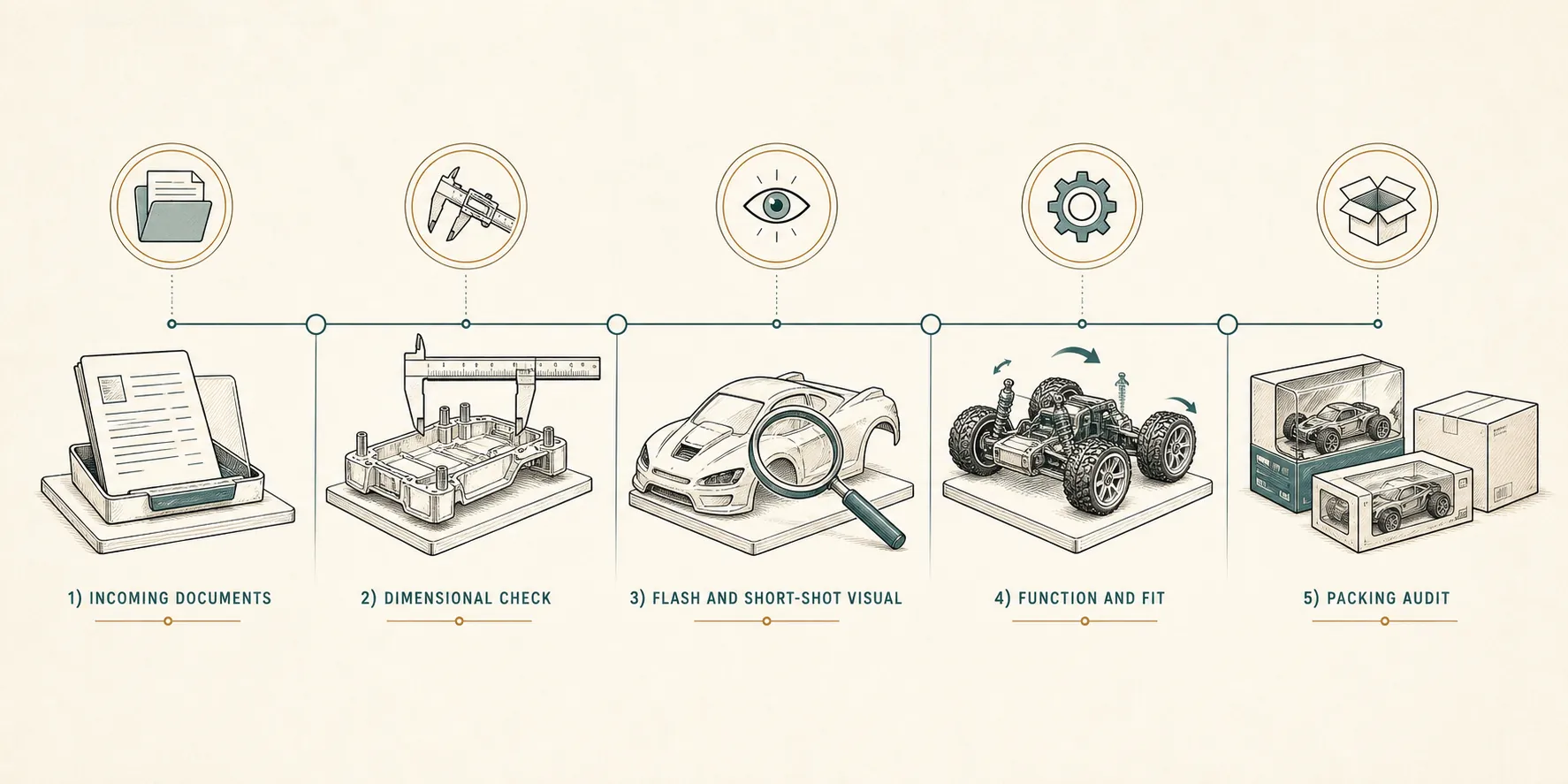
Approving artwork before you freeze the tooling and the golden sample is the fastest way to ruin an OEM RC launch. When a box, a display, and a manual share design assets, the approvals must follow a dependency order: dielines first, copy second, translations third, and only then the final artwork sign-off. Sequence it this way and a typical 25–35 day confirmation-to-release window stays realistic; sequence it wrong and every format change ripples through production. The timeline below walks through each gate, with the supplier questions to ask at every step.
Key Takeaways
- Golden sample is the standard: The sealed physical sample on the QC shelf, not a photo or a Fair booth shot, settles colour, fit, flash, and function disputes. Approve only the physical piece.
- Dielines before copy: Approve dielines for box, display, and manual before any copy is frozen. A die-cut change after copy freeze forces rework across all three formats.
- Copy freeze once, then translate: Lock the master English copy before dispatching translations. A late copy edit creates a ripple through every language version and delays the artwork release.
- Testing runs parallel to artwork: Submit the correct market-specific test file the moment the golden sample is frozen, not after artwork. Testing and artwork overlap to compress the 25–35 day confirmation-to-release window.
- Release only with signed revisions: Box, display, and manual all need a signed-off revision matching the golden sample's tool number and revision card. No verbal colour changes in peak season.
OEM vs ODM vs Stock + Logo for an RC Range
| Who owns the design | OEM: you provide the design; ODM: factory design with your brand; Stock + Logo: existing product with your logo printed. |
|---|---|
| MOQ | OEM: typically higher, depends on mould and packaging; ODM: often 216 units per SKU for an existing RC car; Stock + Logo: lowest, often one carton. |
| Tooling / mould | OEM: new mould or modifications, cost negotiable; ODM: existing mould, no tooling cost for standard bodies; Stock + Logo: none. |
| Lead time | OEM: 25–35 days to confirm, then tooling and production; ODM: faster since mould exists; Stock + Logo: fastest, often 2–3 weeks. |
| Best for | OEM: you own the design and volume justifies a mould; ODM: you want speed and a proven product; Stock + Logo: you need low MOQ and quick market entry. |
What You Can Customize in an OEM RC Range
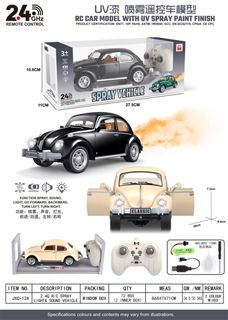
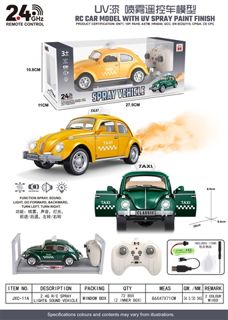
In an OEM project you can change nearly everything that touches the buyer's hand: body colour, wheel style, decals, lights, sound, and the spray function. The six 2.4GHz 7-channel RC cars in this range are ABS-bodied, and each is offered with a 216-unit MOQ per SKU. You can pick one of the existing bodies—the Beetle, the Beetle Taxi, the Mercedes-Benz S320, the Police variant, the BMW M3, or the BMW M3 Race—and spec your own livery, or you can request a new body if your volume justifies the mould.
Packaging carries the real complexity. A typical RC range ships with a retail box, a counter display, and a multi-language manual. Each format has its own dieline, but they often share copy blocks, barcode artwork, and warning labels. Before you change anything, ask the factory for the dieline revision for each format and whether any die-cut sections are common. A shared die-cut means a change to one format can force a change to another.
Colour approval follows a strict rule: the sealed golden sample, not a photo. At the Canton Fair a booth sample is often a hero unit—the lighting lies, the revision card does not. Approve a colour from a photo and you pay for it on the second lot.
MOQ, Tooling & Mold Logic
MOQ for an OEM RC range depends on whether you are using an existing mould or commissioning a new one. For the ABS-bodied 2.4GHz cars listed above, the MOQ is 216 units per SKU. New tooling raises the MOQ because the mould cost has to be amortised across the run; ask the factory for the tooling cost and the revised MOQ when you request a body change.
A design freeze before production-tool release reduces unapproved changes to geometry, material, markings, and test evidence. That freeze date is the point of no return for the body. After it, any change means re-cutting steel and re-running tests, which is why the freeze date must be written into the production schedule, not agreed verbally.
Mould ownership is a negotiation point. In a standard OEM arrangement the buyer pays for the tooling and owns it; in an ODM arrangement the factory owns the mould and you lease the production time. Get the ownership clause in writing on the PO, because it determines who can run the mould after the first order.
Sampling & Lead Time
The first sample is the proof that the tool works. The factory sends a pre-production sample from the production tool, and you compare it physically to the golden sample—colour, fit, flash, function. A photo approval is not a pass. Ask the factory: 'Will the pre-production samples be from the same tool and revision as the golden sample on your QC shelf?' If the answer is not a clear yes, the sample is meaningless.
Lead time breaks into segments, not one number. A realistic OEM timeline includes tooling (if any), first sample, testing, production, packaging, and shipping. A single '25–35 days' total can hide a weak link. Confirm each segment with the factory at the inquiry stage, and ask for the copy freeze date and the change-over penalty if you move it in September, when peak-season mould swaps eat lead time.
Testing runs in parallel with artwork. Once the golden sample is frozen, submit the correct test file for your target market—UKCA for the UK, VOC for certain EU volatile-compound checks, FCC for US radio equipment where applicable. Ask the factory to show the report that matches your lot number, not a similar product. A report from a different SKU is not paperwork for your lot.
The OEM/ODM Process (Step by Step)
The dependency-based timeline below applies to an RC range with multiple packaging formats. Each step has a checkpoint and a supplier question.
Step 1: Freeze the golden sample. The factory seals a physical piece on the QC shelf, labelled with the tool number and revision. Compare bulk to that piece, not to a photo. Checkpoint: golden sample sealed; photo rejected as standard. Ask: 'What is the tool number and revision on the golden sample?'
Step 2: Map shared design assets. List every dieline, copy block, and artwork element that appears on the box, display, and manual. Owner per format, revision status. Checkpoint: shared asset list complete. Ask: 'Which dielines share common die-cut sections across the three formats?'
Step 3: Approve dielines before copy freeze. A die-cut change after copy freeze forces rework across all three formats. Checkpoint: dielines approved for box, display, manual. Ask: 'What is the dieline revision for each format?'
Step 4: Freeze copy once, then translate. Lock the master English copy before dispatching translations. Checkpoint: master copy frozen; translations dispatched. Ask: 'What is the copy freeze date?'
Step 5: Route artwork approvals in dependency order. Approve the box artwork first (it carries the most shared assets), then the display, then the manual. Each approval references the same golden sample revision card. Checkpoint: box approved; display and manual follow.
Step 6: Trigger testing in parallel with artwork. Submit the market-specific test file the moment the golden sample is frozen. Checkpoint: test file submitted with the lot number on it. Ask: 'Which test file covers this lot for our target market—show me the report that matches the lot number.'
Step 7: Confirm pre-production samples against the golden sample. Physically compare, not by photo. Checkpoint: samples passed. Ask: 'Are these samples from the same tool and revision as the golden sample?'
Step 8: Release production only after all three approvals are logged. Box, display, and manual each need a signed-off revision matching the golden sample. No verbal colour changes. Checkpoint: three signed revisions. Ask: 'What is the freeze date and change-over penalty if we move it in September?'
Step 9: Lock the booking file for fragile goods. If your range includes corner-sensitive items, write double-wall, corner boards, ECT, and pallet height into the booking instruction before LCL. Checkpoint: booking file complete.
What to Watch for This Year
Compliance updates move on their own clocks. ISO 2859-1, the sampling standard for acceptance quality limits, was updated in January 2026, but that edition does not itself impose a compliance date CoreRCCar shipments. Check with the factory for the inspection plan agreed on your PO, not for a catalogue AQL number. Similarly, the Australian projectile-toy standard covers design, construction, and warning labelling—not just a chemical test—so a single test report may not satisfy it. For any test file, the report identity must match your SKU, model, material, colour, age grade, and sample construction; otherwise it is not your paperwork.
FAQ
What is the minimum order to customize an RC car?
For an existing 2.4GHz 7-channel ABS RC car, the MOQ is 216 units per SKU. A new body or major tooling change will raise that, so confirm the revised MOQ with the factory when you request a custom design.
How much does a sample cost and how long does it take?
Sample cost and lead time vary by specification. Ask the factory for a first-sample lead time after the design freeze; typically the first sample is produced only after tooling is ready, so it depends on whether you are using an existing mould or a new one.
Who owns the mold in an OEM project?
Mould ownership is a negotiation point. In a standard OEM arrangement the buyer pays for the tooling and owns it; in an ODM arrangement the factory owns the mould. Get the ownership clause in writing on the PO, because it determines who can run the mould after the first order.
Can you print our logo and use our packaging?
Yes. You can customise the box, display, and manual with your logo and branding. The dielines must be approved before copy freeze, and the artwork is approved in dependency order—box first, then display, then manual.
Will you sign an NDA?
Most factories will sign an NDA to protect your design and brand. Ask at the inquiry stage, and confirm that the golden sample and tooling are covered by the agreement.
How long is the total lead time from confirmation to release?
A typical OEM RC range takes 25–35 days to confirm, then tooling, production, and packaging add more. Break the timeline into segments—tooling, first sample, testing, production, packaging, shipping—and confirm each with the factory, because one total number can hide a weak link.
Sources
Request a Quote
Send your design files or your specification list for a custom quote. Tell us the target market, the packaging formats, and your volume, and we will reply with a timeline that separates tooling, sampling, testing, and production.