
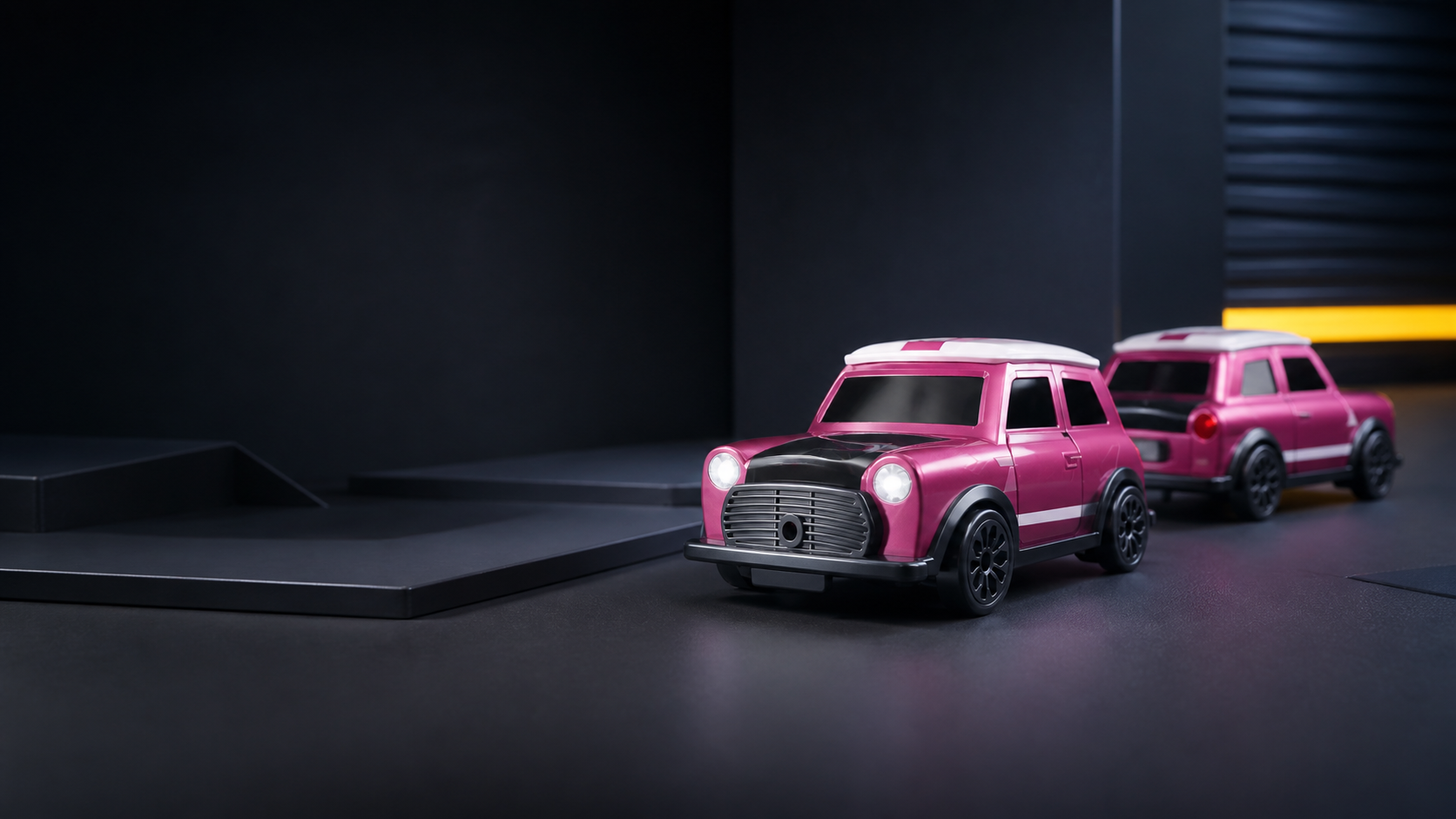
Put the money into one alloy step-up SKU when you need a defensible price story and a single file to verify; spread it across several entry minis when your real goal is learning which scale, price band and use case sells. Depth and breadth answer different tests, so match the allocation to your learning goal rather than to a generic "premium is better" instinct.
This page compares the two paths on the criteria that decide a purchase order: capital allocation, margin, shelf space, variant learning, reorder risk, audience fit, and the compliance paperwork each path multiplies. It draws on catalog records dated 2026-10-09 and official guidance on testing and CE marking. Where a number is missing, the page says so and names the document to request instead of guessing.
Tests to request
| Test or file | What it covers / What it does not prove / Ask if missing |
|---|---|
| Children's product certificate (CPC) with the underlying passing test report | Covers the specific tested configuration against applicable children's product safety rules. Does not prove that a later production lot or a revised material matches the tested sample. Ask for the report that names the exact SKU, materials, colors and production cohort, plus who coordinates the document review if a material changes. |
| Third-party laboratory report and laboratory scope statement | Covers only the safety rules the laboratory is accepted for. Does not prove that one lab covered every required test for your configuration. Ask which rules apply to the CoreRCCar and whether the laboratory's scope covers all of them. |
| CE declaration of conformity (EU) | Covers the manufacturer's own declaration against applicable EU requirements. Does not prove approval by an EU authority and does not identify the product's origin. Ask for the exact product file and the applicable requirements; do not treat a CE string or image in a catalog listing as approval. |
| Battery documentation for rechargeable lithium packs | Covers the battery/charging configuration if a report exists. Does not prove the run time, capacity or safety of a pack that has not been tested as configured. Ask for the battery test report and, where applicable, the transport summary the factory holds; if none exists, record it as an evidence gap. |
| Button/coin cell access and warning review | Covers whether a coin or button cell can be accessed by children and whether required warnings appear on product and packaging. Does not prove compliance for a different battery compartment design. Ask for the compartment design review and the warning artwork for the exact SKU. |
| Radio/transmitter compliance file for 2.4GHz models | Covers the radio module as tested. Does not prove compliance for a different transmitter or frequency configuration. Ask for the test report or approval file that names the transmitter actually shipped. |
| Surface coating / finish documentation (spray and painted parts) | Covers the coating as submitted for testing. Does not prove the finish on a different color or a re-sprayed variant. Ask which file covers which finish and which lot, and note that a VOC file and a safety certificate are different papers. |
| Golden sample approval record | Covers the sample you approved, including materials, colors and packaging. Does not automatically cover a later production lot. Ask to match report SKU, materials, colors and production date/cohort to the purchase order. |
Does a CE mark mean CoreRCCar is EU-approved?
No. According to the European Commission, CE marking is the manufacturer's declaration, not approval by an EU authority, and it does not identify where the product was made. If a listing shows a CE string or a certificate image, ask for the exact product file and the applicable requirements before you repeat that claim to your own customers. The same discipline applies on the US side: according to CPSC guidance, a material change to a children's product can trigger retesting of the affected requirements and a new certificate, and an earlier report should not be assumed to cover the revised configuration.
What do the 2026-10-09 catalog records show for alloy vs plastic minis?
The strongest alloy-versus-plastic contrast in the supplied records sits between a Mini Alloy Drift RC Car listed with material "Metal, Plastic" and a 1/64 mini off-road car listed as "Plastic" — but the price band and the material claim do not line up neatly, so verify before you pay the premium. The alloy drift listing carries no MOQ in the record; the plastic 1/64 off-road listing shows MOQ 288. A missing MOQ is not a low MOQ. Ask for the actual MOQ, the price at that MOQ, and the price at the 288-unit tier before you assume the cheaper unit price wins.
Two 1/43 drift SKUs in the records both sit at MOQ 108, and a 1/16 drift car with a self-spray feature and a 1200 mAh battery title sits at MOQ 54. Those are the lowest entry points in the supplied data, which is exactly why breadth looks attractive on paper: three small commitments instead of one larger one. What the records do not give you is run time, charge time, speed, motor type, battery capacity for the 1/43 units, or any test report. Treat every one of those as unverified until a document names the SKU.
For the wall-climbing model with auto return and follow-me, the recorded reference is USD 7.50–8.32 at MOQ 180 with single-item packaging and a 6.0 kg weight, and the record itself states it is a reference only — sample, quote, packing, destination documents, certification, age suitability, licensing, stock and factory capacity are not established. That is the honest status of most catalog numbers: a starting point for a quote, not a landed cost.
Verify the alloy claim before you pay the alloy premium
"Alloy" in a product title can mean a full metal chassis, a thin decorative plate, or metal-look plastic. The price gap in the records is real; the material gap is not yet proven. Before you allocate budget to the higher-priced SKU, ask the factory for a bill of materials with part-level material callouts and a sample you can disassemble. If the metal content turns out to be cosmetic, you are paying a premium for a word rather than for durability.
For the performance claims that decide whether a drift or off-road mini is worth stocking, the records give you almost nothing to check. Range and channel counts appear in titles; speed, run time and charge time do not appear at all. Ask for the factory's internal test report or a third-party report that states the test method and the sample configuration. If no report names the exact SKU and lot, treat the claim as unverified and price your return risk accordingly.
Functional features deserve the same treatment. Auto return and follow-me are field-failure candidates. Ask for a demonstration on the actual production sample rather than a marketing clip, and ask what happens when the follow-me signal is interrupted. A vague answer here is a support cost waiting to happen.
Total cost: the cheap mini is not always the cheap program
Unit price is the least useful number in this decision. One premium SKU concentrates sample approval, packaging artwork, manuals, spare parts and reorder decisions into a single file. Several entry minis multiply each of those lines, and each variant adds its own defect pattern and its own reorder call. Ask for packaging dimensions and carton quantity per SKU: if carton quantities differ, your freight and warehouse cost per unit will differ even when the unit price looks lower.
Compliance scales with SKU count, not with order value. Each additional configuration is a separate question for testing scope, document matching and warning artwork, and a material change on any one of them can force retesting of the affected requirements. If you plan to switch between an alloy and a plastic body, or between a 1/43 and a 1/64 shell, decide up front who coordinates the document review and whether the existing report covers the revised configuration. Do not assume it does.
Then ask the two questions that decide reorder risk: what is the reorder lead time, and what is the minimum reorder quantity per SKU. Neither appears in the supplied records. A low unit price attached to a long or uncertain reorder lead time can strand a shelf just as effectively as a bad sell-through rate.
FAQ
Should I buy one premium alloy RC SKU or several entry minis with the same budget?
Choose one alloy step-up SKU if shelf space is the binding constraint or you need a single defensible price story and one file to verify. Choose several entry minis if your real goal is learning which scale, price band and use case converts before you lock capital into one item. The records show entry points as low as MOQ 54 and 108, which is what makes breadth tempting — but each added SKU adds its own documentation and reorder burden.
Is "alloy" in the product name proof of a metal body?
No. A listing title can describe a full metal chassis, a thin decorative plate, or metal-look plastic. Ask for a bill of materials with part-level material callouts and inspect a sample you can disassemble. In the supplied records, one "Mini Alloy" car is listed with material "Metal, Plastic" while a 1/64 "Mini Alloy" off-road car is listed as "Plastic" — the naming alone does not settle it.
What MOQ should I expect, and can I mix SKUs in one carton?
MOQ is a factory- and SKU-specific commercial term shaped by resin, mold, decoration, packaging and production quantity, so there is no universal industry number. In the supplied records, MOQs range from 54 to 360 across mini-RC listings, and at least one alloy listing shows no MOQ at all. Ask for the actual MOQ per SKU, the price at that MOQ, and whether the factory accepts mixed-SKU cartons or requires a per-SKU minimum.
Which documents should I request before placing a purchase order?
Ask for the test report that names the exact SKU, materials, colors and production cohort; the laboratory's scope statement for the applicable safety rules; the battery documentation for any rechargeable pack; the coin/button cell access and warning review where applicable; the radio compliance file for the transmitter actually shipped; and the golden sample approval record. Where a file is absent, record it as an evidence gap rather than assuming compliance.
Does a CE mark in a catalog listing mean CoreRCCar is EU-approved?
No. The European Commission distinguishes the manufacturer's CE declaration from approval by an EU authority, and CE marking does not identify a product's origin. Ask for the exact product file and the applicable requirements instead of repeating an approval claim. The same caution applies to any certificate image you cannot trace to a specific SKU and lot.
How do I handle reorder risk if one SKU underperforms?
Spreading across several SKUs, and ideally more than one supplier, reduces the chance that one factory delay or one failed document review stops the whole category. The trade-off is that each SKU keeps its own file, packaging and reorder decision. If you cannot staff that, concentrate on one SKU and negotiate a shorter reorder lead time and a defined minimum reorder quantity instead.
Sources
- Alloy Vehicle Models
Next step
Before you commit the open-to-buy, send the factory one list: actual MOQ and price tier per SKU, packaging dimensions and carton quantity, the test report and laboratory scope for each configuration, battery documentation, and reorder lead time. Compare the answers side by side — the SKU that answers cleanly is usually the one that survives a full season.