
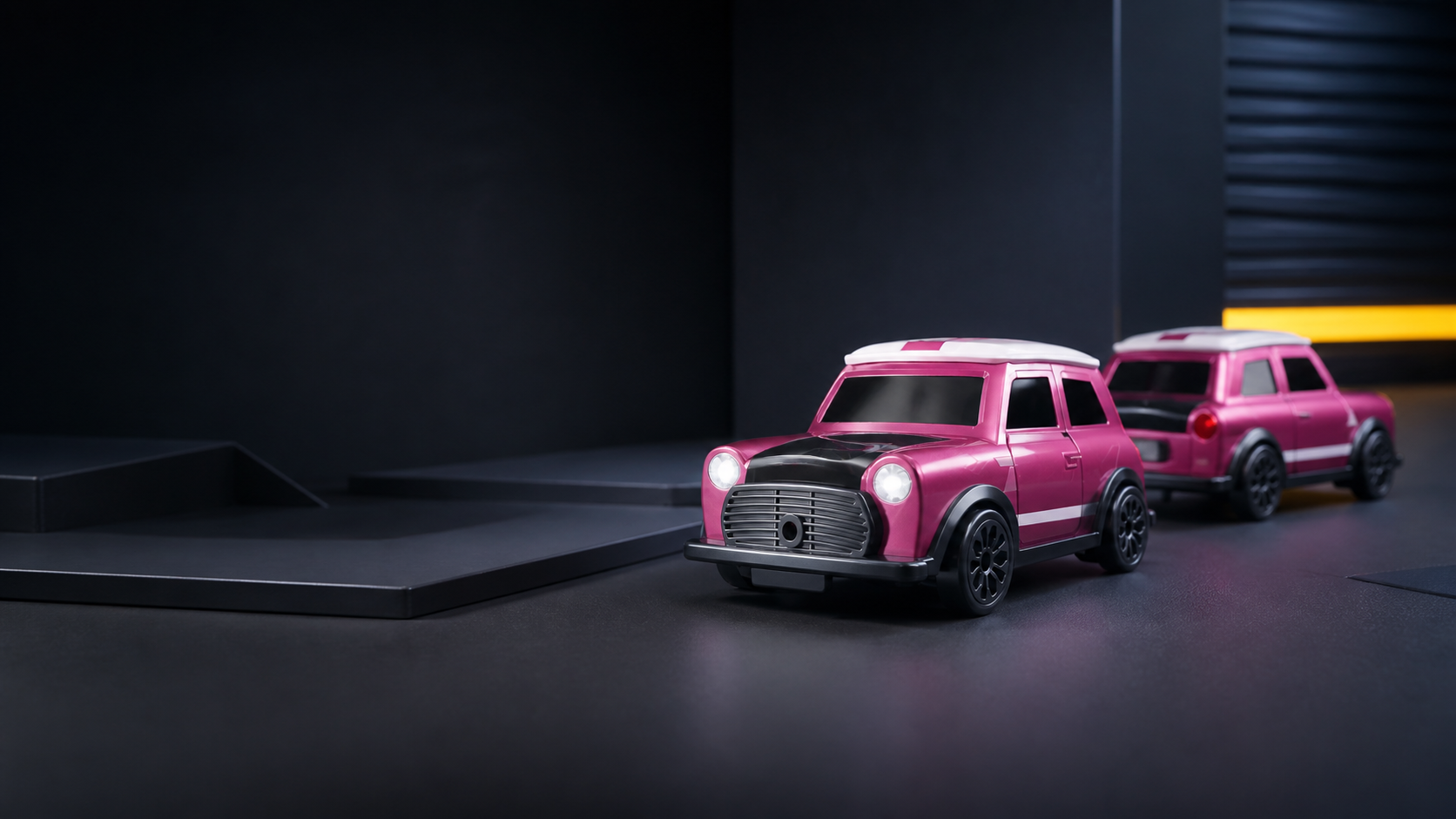
The most reliable wholesale RC cars for e-commerce conversion are the ones whose headline features are already visible in a still photo: LED lights, stated scale, body proportions, transmitter layout, and included charger. If a feature exists only in the copy — spray, top speed, control range, battery capacity — and you cannot photograph it or attach a factory report, treat it as a listing risk, not a selling point.
This page is for importers, Amazon sellers, supermarket buyers, gift distributors, and private-label buyers deciding which RC products can be communicated accurately through marketplace images and video. It groups the catalog SKUs on this site by how demonstrable their features are, separates what belongs in a caption from what must be verified against a sealed golden sample or a lot-matched factory file, and lists the RFQ questions to settle before a PO is committed.
Key takeaways for buyers
- Photo-friendly first: LED lighting, scale ratio (1/43, 1/32, 1/20, 1/16, 1/14), wheel and body geometry, transmitter button layout, and charger inclusion can all be shown truthfully in stills. Lead your listing with these.
- Video-dependent features: gesture sensing, double-sided 360-degree stunt driving, and auto-return are hard to prove in a single image. A 15-60 second clip is the honest medium — a static claim invites returns.
- Report-gated features: spray, lithium battery capacity, control range, and any FCC or IP claim must come from the factory's actual report for the specific lot. If the report does not exist or does not match the lot, caption it out.
- Approval discipline: a sealed golden sample on the QC shelf — not a photo, not a Canton Fair hero unit — is the physical standard for colour, fit, flash, and function. Get the tool number and revision on paper.
- Generic styling travels without paperwork; licensed styling does not. Keep marketplace captions to scale, colour, and function unless you can show written authorization.
Which RC features can you show truthfully in a marketplace photo?
Start with what the camera can prove. LED lights, scale ratio, body silhouette, wheel count, and the presence of a charger are all visible. A buyer scrolling on a phone can verify these without reading a word, which is exactly why they convert.
The 1/43 mini drift car and the 1/32 light-up race car are the easiest listings to shoot: small scale reads instantly next to a hand or a coin, and the lights show in an off/on pair of frames. The 1/20 and 1/14 4WD drift cars give you more body surface to photograph — panel lines, wheels, and LED housings — without needing motion to explain them.
What you cannot photograph is a number. Speed, range, and battery capacity are copy claims. Either attach the factory's actual report or rewrite the caption around what the image shows: 'LED light-up body' rather than a speed figure you have not verified.
Which RC features need video, not stills?
Gesture sensing, gravity sensing, double-sided driving, 360-degree flipping, and auto-return are motion features. A still image of a car mid-flip tells the buyer nothing about whether the flip is controlled or a lucky shot.
The gesture and gravity-sensor stunt cars, the double-sided 360 rotating stunt truck, and the app-controlled auto-return drift truck all belong in a short clip. Show the hand gesture, the flip, and the return in one continuous take — no cuts between the setup and the result.
The honest caption for these is descriptive, not superlative: 'double-sided driving with 360-degree rotation' describes the mechanism. Avoid stacking speed claims on top unless the factory report supports them.
Which RC features must be backed by a factory report before you caption them?
Spray, lithium battery capacity, control range, FCC, and IP ratings are the claims most likely to trigger a marketplace dispute or a customs question. None of them can be photographed reliably, and none of them should be written from a catalogue sentence.
The six-wheel gesture stunt car with music, lights, and spray is the clearest example. The spray function is visible in video, but the mechanism and any performance claim behind it need the factory's actual documentation for the lot you are buying. If the report does not match the lot, the paperwork is not paperwork — it is a future claim.
The same rule applies to lithium cells: ask for the lot-matched test summary, not a generic certificate. And for any FCC or IP statement, ask which report covers which market and which lot before it goes near a listing.
Two testing points are worth writing into the PO. According to the U.S. Consumer Product Safety Commission, its Regulatory Robot can help identify potentially applicable rules, but a screening result does not replace the actual rule text or the certification program. And flammability testing must use the method and specimen orientation required for CoreRCCar type — a raw-resin flammability rating may not represent a decorated CoreRCCar.
Use case | material to ask | test to request
| Indoor drift / shelf display (1/43, 1/32 mini cars) | ABS or plastic body — ask which resin grade and whether ribs are used for stiffness without thick walls. Test to request: colour and finish against the sealed golden sample; check for sink marks and flash on assembled parts. |
|---|---|
| Outdoor stunt / double-sided driving | Impact-grade plastic — ask about wall thickness at the wheel hubs and chassis corners. Test to request: drop-and-recover check on the CoreRCCar, plus warpage measurement on the assembled body, not a loose part. |
| Light-up body (LED SKUs) | Transparent or translucent plastic over a light housing — ask how the LED is seated and whether the lens yellows under UV. Test to request: on/off lighting photos under neutral light, plus a colour-match check against the golden sample. |
| Spray-feature stunt car | Sealed reservoir and plastic housing — ask which factory report covers the spray mechanism for the specific lot. Test to request: the actual report; if it does not exist, remove the spray claim from the listing. |
| Battery-powered SKUs (any lithium cell) | Ask for the lot-matched battery test summary and charging documentation. Test to request: the actual file for the lot on the PO, not a generic certificate from a previous order. |
| Licensed or character-styled body | Ask for written authorization before any branded styling goes into a caption or image. Test to request: the authorization document; if absent, keep the listing to generic styling only. |
Where are these RC products typically produced?
Injection-moulded plastic RC cars — the bulk of what is on this page — are typically produced in Chenghai, the Shantou-area cluster that has built its supply chain CoreRCCar injection moulding, tooling, and assembly. That is where you look for tool number, revision control, and golden-sample discipline.
CoreRCCar cluster around Yunhe, plush around Yangzhou, and general merchandise around Yiwu. Those clusters matter if your RC order is part of a mixed container: the filler goods and the RC goods may come from different regions, and the paperwork, packaging spec, and inspection plan have to be written per supplier, not per container.
How should you brief listing photos and video for RC cars?
Shoot the scale cue first. A hand, a coin, or a phone next to the car communicates size without a dimension claim, and it is the single most useful image for reducing sizing returns.
Then shoot the details a buyer would check in a store: transmitter buttons, battery compartment, charging port, LED lens, wheel and hub, and everything that ships in the box. Accessories shown as included must actually be included — no implied extras.
Keep the retouching realistic. Over-whitened backgrounds, over-smoothed plastic, and fake shadows destroy the trust the photo was supposed to build. Colour accuracy matters more than polish, because a colour mismatch is the fastest route to a return.
For video, keep it short and continuous. Show the gesture, the flip, or the light-up sequence in one take, and caption what the clip actually demonstrates. Marketplace image rules — pure white main image, product filling most of the frame — are baseline compliance, not a substitute for truthful captions.
How we picked these SKUs
The catalog is grouped by how demonstrable each product's headline feature is in stills versus video versus factory documentation. A SKU with visible lights and a stated scale ranks as photo-friendly. A SKU whose main selling point is motion ranks as video-dependent. A SKU with spray, lithium, or a certification-adjacent claim ranks as report-gated until the factory file exists.
Ranking is not by unit price, MOQ, or margin, because those numbers move with order size, packaging, and destination market. Where a figure appears on this page it comes from the catalog record; where it does not, the page says what to ask the factory instead.
No buyer reviews were available for this article, so none are quoted. The QC and approval principles come from factory-floor practice: sealed golden samples, revision cards, lot-matched paperwork, and inspection plans agreed on the PO.
FAQ for buyers sourcing photo-friendly RC products
Which RC car features can I safely put in a listing photo without extra documentation?
Visible features: LED lights, stated scale ratio, body shape, wheel count, transmitter layout, and included charger. These are verifiable in a still image. Speed, range, battery capacity, spray performance, and any FCC or IP claim are not photo-verifiable and should be omitted or backed by the factory's actual report.
Do I need a factory report for a spray-feature RC car before listing it?
Yes, if you intend to caption the spray function as a product claim. Ask the factory which report covers the spray mechanism for your specific lot. If the report does not exist or does not match the lot, remove the spray claim from the listing and show only what the video demonstrates.
How do I verify the colour and finish before approving bulk production?
Approve against a sealed golden sample held on the QC shelf, not a photo and not a trade-show display unit. The golden sample is the physical reference for colour, fit, flash, and function. Buyers who approve only a photo typically pay for it on the second production lot.
What should I ask for when the RC car contains a lithium battery?
Ask for the lot-matched battery test summary and charging documentation, plus the packaging spec for transport. A generic certificate from a previous order is not sufficient — the file must match the lot on your PO.
Can I use generic styling on the body without licensing paperwork?
Yes, generic styling is the safe default for marketplace listings and private-label programs. Licensed or character-specific styling requires written authorization before it appears in a caption, image, or packaging. Without that document, keep the listing to generic styling only.
What MOQ should I expect for custom RC car orders?
It varies by SKU, packaging, and customization level. The catalog records on this page show MOQ bands in the 48-180 unit range, but custom colour, logo, or packaging will typically move the number. Treat any MOQ as an RFQ item to confirm in writing, not a catalogue constant.
Sources
Request a quote or a golden-sample check
If you are deciding which RC SKUs to list and what to caption, send the product list, your destination market, and the features you want to show. You will get a straight answer on which claims need a factory report before they go near a listing, and which can be photographed as-is. No spec is quoted without the file behind it.