
A ready-to-ship RC car can still fail its launch if the paperwork, packaging, or support plan doesn’t match the actual product. Launch readiness is cross-functional: product, logistics, content, support, and compliance must be ready together, not one after another. This checklist walks you through each workstream, tells you what to verify, and gives you the exact questions to ask your factory before you commit to a pilot run.
Key Takeaways
- Treat the golden sample as the only production standard — a Canton Fair photo or hero unit does not set the spec.
- Match every compliance file (CPC, UKCA, VOC) to the specific SKU and lot, not to the factory door.
- Write a booking file with explicit packaging specs (double-wall, corner boards, ECT, pallet height) — a thank-you note is not a booking instruction.
- Never invent AQL, mAh, range, FPS, or cert numbers in your listing; pull every claim from the factory’s actual test report.
- Assign one owner per workstream and set a replenishment trigger before you sell the first unit.
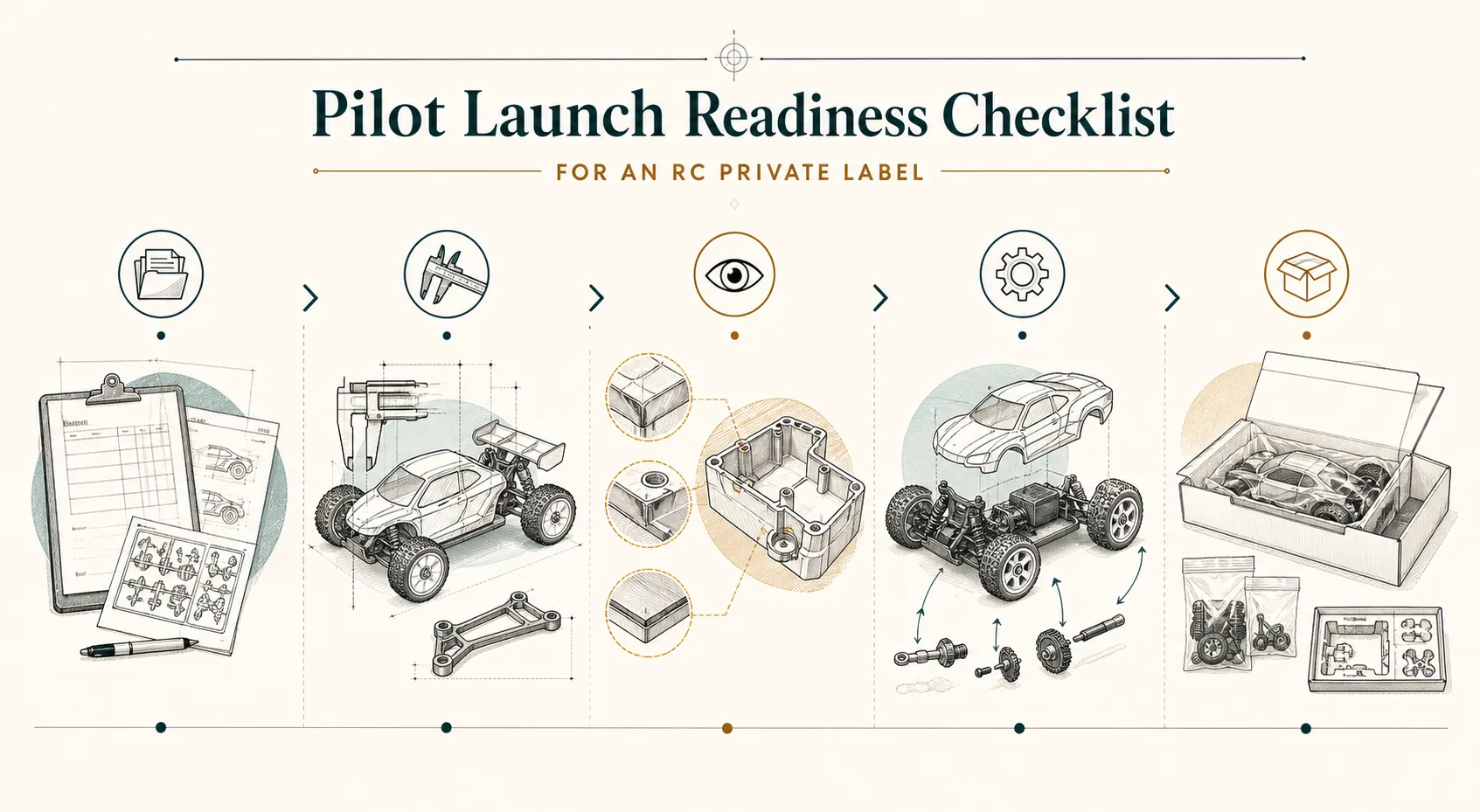
Product workstream: golden-sample check
Start by comparing a production unit against the golden sample, not against a photo from the Canton Fair. Fair lighting lies, and a booth sample is often a hero unit. Label the tool number and revision on the comparison table, and refuse to accept a Fair photo as the production standard.
Verify that the SKU you’re shipping matches the CPC (US) or UKCA/VOC file (UK/EU). Paperwork that does not match the lot is not paperwork. If a defect turns up, isolate the failed lot, record the defect class, and release only after rework. Buyers who want an AQL number get it from the agreed inspection plan on the PO, not from a catalogue sentence.
Ask your factory: “What is the agreed AQL and defect class definition in the PO inspection plan?”
Logistics workstream: booking file
The booking instruction is where claims are won or lost. Write explicit packaging specs: double-wall, corner boards, ECT, pallet height. A thank-you note is not a booking instruction. LCD tablets and other corner-sensitive goods die in LCL when the booking file is vague.
Confirm the barcode and tracking label content on the product or pack: manufacturer, date, lot. Tracking labels are not decoration. Also check that the barcode data assignment matches the retailer or GS1 owner record — a pretty barcode without the right data is useless.
Ask your factory: “What are the exact packaging specs (double-wall, corner boards, ECT, pallet height) for the LCL booking?”
Content workstream: listing assets
Your listing copy and images must match the actual production revision, not the hero unit photo. If you claim a feature — spray, lithium battery, FCC compliance, IP licensing — use only facts from the factory’s test report. Do not invent mAh, range, FPS, MOQ, cert numbers, or retailer volumes.
For a product like a 2.4GHz 7-channel RC car with lights, sound, and spray, confirm which of those features are covered by a test report and which are just marketing. Ask the factory for the report number and the lot it covers.
Ask your factory: “Can you provide the actual test report for [spray/lithium/FCC/IP claim]? What is the report number and which lot does it cover?”
Support workstream: spare parts, FAQs, returns
Before launch, confirm that spare parts are available for your SKU and that your FAQ answers match real product behavior. A buyer who asks “does it come with a battery?” needs an answer that matches the actual pack contents.
Define the returns process: who handles counter returns, and what happens when a customer returns a unit with a scratch? Some distributors turn the display into a “test zone” where customers squeeze before buying, which cuts returns and acts as free marketing. Decide whether you’ll do the same.
Ask your factory: “What spare parts are available for this SKU, and what is the replacement part list?”
Compliance workstream: market mapping
Map each market to the file that covers it. UKCA and a VOC file on an electric bubble machine are different papers; one certificate does not cover both. The same logic applies to an RC car with spray and sound — confirm which test covers which feature.
For the US, keep the CPC matched to the SKU, not to the factory door. A factory-wide certificate that doesn’t name your SKU and lot is not proof of compliance. Also note that Incoterms define risk transfer, not product-safety compliance or ownership of test reports.
Ask your factory: “Does the CPC/UKCA/VOC file cover this specific SKU and lot, or is it a factory-wide certificate?”
Traceability and replenishment: owners
Assign one owner per workstream — product, logistics, content, support, compliance. Without an owner, a checklist is just a list. Then set a replenishment trigger: when stock hits X, reorder. Confirm the MOQ and lead time with the factory; do not invent them.
Traceability on the product or pack (manufacturer, date, lot) is not optional. It’s how you win a claim and how you pull a lot if a defect shows up.
Ask your factory: “What is the MOQ for replenishment, and what is the lead time?”
Pilot Launch Readiness Checklist
| Golden sample | Production unit matches golden sample (tool number and revision); no Fair photo used as standard. |
|---|---|
| Compliance files | CPC/UKCA/VOC file matches the lot and SKU; no cross-use of one certificate for another test. |
| Booking file | Double-wall, corner boards, ECT, pallet height specified; barcode and tracking label content verified. |
| Listings | Copy/images match the production revision; all claims (spray, lithium, FCC, IP) traceable to factory report. |
| Support | Spare parts confirmed; FAQ answers match product behavior; returns process defined. |
| Compliance mapping | Market, lot, and test file mapped per destination; CPC matched to SKU, not factory door. |
| Owners and replenishment | Owner assigned per workstream; replenishment threshold set; MOQ and lead time confirmed with factory. |
Worked example (illustrative, not a real shipment)
Imagine you’re importing 500 units of a 2.4GHz RC car with spray, split between a US Amazon FBA shipment and a UK retail order. The factory sends you a UKCA file that covers an electric bubble machine, not your RC car. If you ship to the UK with that file, customs will hold the lot — that’s a failed launch. The fix: ask the factory for the test report that names your SKU and lot, and map which file covers which market before you book freight.
What to look for this year (2026)
Regulatory updates CoreRCCar (e.g., ASTM F963 revisions, EU GPSR) are not static. Check the official text for the effective date that applies to your product category — a year in a secondary article title is not an application deadline. If the official text does not confirm the date, treat the timeline as unconfirmed. Also note that the Digital Product Passport and the GPSR are separate regimes; do not merge their deadlines.
FAQ
What is the minimum order quantity for a pilot RC launch?
MOQ varies by factory and product spec. For a 2.4GHz 7-channel RC car with spray, some factories set MOQ at 216 units. Confirm the exact MOQ and lead time with your factory before you commit.
How do I know if my RC car’s spray feature is compliant?
Ask the factory for the actual test report that covers the spray mechanism, and verify it names your SKU and lot. A generic factory certificate may not cover this feature. Do not assume compliance from a marketing claim.
What should I check before shipping to the US vs the UK?
For the US, check the CPC matches your SKU and lot. For the UK, check the UKCA file covers your product and lot. These are different papers; one does not cover the other. Map your market, lot, and test file before booking freight.
How do I set a replenishment trigger for my RC private label?
Base it on your sales forecast and factory lead time. When stock hits the reorder point (covering lead time plus safety stock), reorder. Confirm the factory’s MOQ and lead time — do not invent them.
What are the red flags in a factory’s compliance paperwork?
A certificate that doesn’t name your SKU and lot, a file that covers a different product type, or a barcode with no tracking label content. Paperwork that does not match the lot is not paperwork.
Sources
Related Products & Categories
Request a Quote
Ready to pilot your RC private label? Get a quote from a factory that can provide the actual test reports and a clear inspection plan. Start by sending your product spec and target market — we’ll help you map the compliance files.