
Choose a preassembled display pack for an approved impulse location where staff can place the loaded display directly; choose standard retail boxes when stores need flexible shelf placement, individual-unit handling, or their own security fixtures. The preassembled display pack versus standard retail boxes decision should turn on the receiving route and replenishment method—not graphics alone. Approve the display only after checking its loaded strength, shopper access, outer-carton protection, labels, and the retailer’s setup requirements against a physical sample.
These formats are not mutually exclusive: a preassembled display can hold individually CoreRCCar. Retail-ready packaging describes secondary packaging that lets products move onto the shelf or selling floor without unpacking the inner contents. Specify whether the display arrives assembled, loaded, or both; those are different purchasing requirements. Pulpapernews: retail-ready packaging
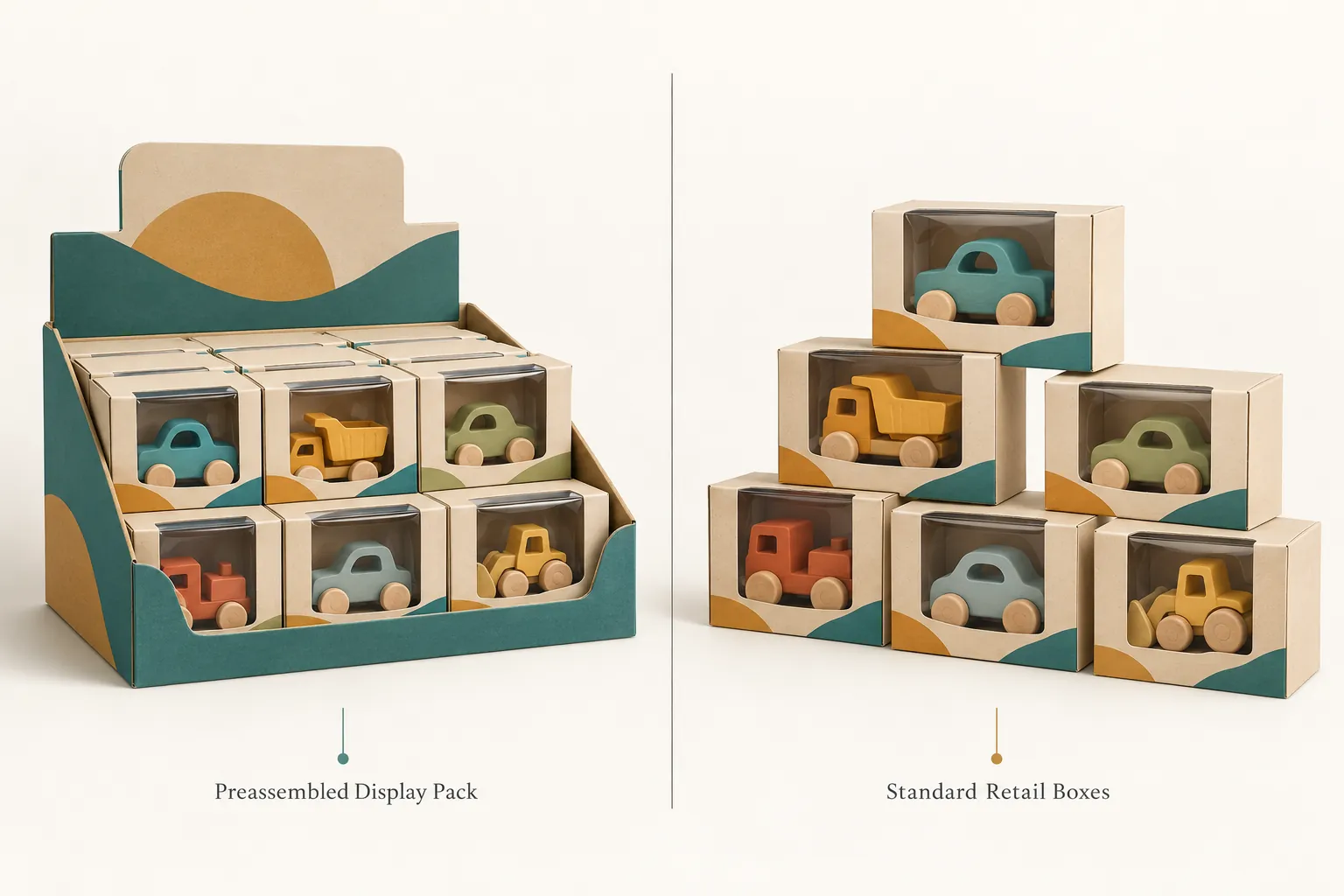
Which packaging format fits your impulse location?
Favor a loaded display for a fixed, approved selling position; favor standard retail boxes for placement in existing fixtures and unit-by-unit replenishment.
Use the following as purchasing criteria, not as measured performance claims about either format.
| Display presence and setup | Preassembled display: require the complete loaded footprint and the exact steps from shipping carton to selling position. Standard retail boxes: approve the arrangement in the retailer’s existing shelf or counter fixture. |
|---|---|
| Display strength | Preassembled display: inspect the loaded base, dividers, joints, and header, including the partly depleted condition. Standard retail boxes: inspect individual package stability and the separate shipping-carton construction. Neither format name establishes strength. |
| Unit access | Preassembled display: check that shoppers can remove a sale unit without dislodging adjacent products or pulling out an insert. Standard retail boxes: check that each package can be lifted from the intended shelf or fixture without opening it. |
| Theft control | Preassembled display: agree on placement, product retention, and any retailer-required security treatment. Standard retail boxes: confirm compatibility with the retailer’s tags or security fixtures. Do not select either format on an assumed theft advantage. |
| Carton packing | Preassembled display: approve protection for the loaded display and any projecting graphics. Standard retail boxes: approve the arrangement and protection of individual packages inside the master carton. Keep selling-pack and transport-pack specifications separate. |
| Labels | Preassembled display: distinguish the display’s logistics identity from the barcode of each sale unit. Standard retail boxes: verify the sale-unit barcode and master-carton identification. Have the retailer approve the relevant label layout before printing. |
| Restocking | Preassembled display: decide whether staff refill the existing tray or replace the complete loaded display. Standard retail boxes: confirm how individual units move from the replenishment carton into the selling fixture. |
How should you compare display strength and transit protection?
Evaluate the selling structure and the transport pack separately; a display that stands neatly on a counter has not thereby demonstrated that it can withstand shipment.
For the display sample, inspect the loaded base for bowing, the joints for opening, and the header for interference with product removal. Then remove products from one side and check the remaining arrangement. These are practical merchandising checks, not substitutes for packaging transport tests CoreRCCar safety testing.
For shipment, require the factory to identify the outer carton, internal supports, packing orientation, gross weight, external dimensions, and permitted stacking configuration. Check whether the header travels installed or protected separately, and record any assembly that remains for store staff.
Retail-display logistics guidance recommends avoiding double-stacking unless the packaging was engineered for the load, and identifies corner posts and edge protection as ways to protect carton edges. Treat this as a packing-design decision, not a blanket prohibition or proof that a particular carton is adequate. Frank Mayer: display logistics
Compare freight using the proposed packed configurations, not the product dimensions alone. Do not assume either that a loaded display costs more to ship or that standard boxes use less space; obtain the carton layouts and route-specific quotes.
How do unit access, theft control, and restocking change the choice?
Choose the format that permits deliberate unit removal and a clear replenishment routine while accommodating the retailer’s security method.
Test access with the packaging exactly as it will appear on sale. Remove a front unit, then a unit behind it. Check for snagged ties, displaced dividers, hidden product information, and a display lip that blocks the grip point. If shoppers are meant to buy a CoreRCCar from a display, test removal of the complete box—not removal of CoreRCCar from its packaging.
Easy access and theft control are separate requirements. An open tray does not establish acceptable security, and a closed box does not establish theft resistance. Agree with the retailer where any security tag or fixture will sit, then check that it does not obstruct the barcode, product information, or intended handling.
Restocking deserves its own sample demonstration. For a refillable display, load replacement units from the proposed replenishment carton and check fit, orientation, and access to the rear positions. For a replace-whole-display program, identify what happens to the partly depleted display. Standard boxes are the clearer choice when staff must distribute units among several existing fixtures rather than maintain a dedicated display.
How would the CoreRCCar compare at checkout and on an existing shelf?
For the same CoreRCCar, select a loaded display at an approved checkout position and standard retail boxes for an existing shelf that staff replenish individually.
Consider a proposed checkout program where the retailer accepts a dedicated tray, approves its footprint, and wants staff only to remove the shipping protection and position the pack. Keep the individual retail boxes inside the display. Approve this configuration only after the loaded sample demonstrates accessible units, stable presentation, readable barcodes, and the agreed security treatment.
Now keep CoreRCCar and individual retail box unchanged, but place it in an existing shelf fixture where staff allocate stock across different positions. Select standard retail boxes in a protective master carton. A dedicated display adds no necessary function to that particular operating plan.
Compare the two proposals on the same delivery route and sale-unit basis, including packaging, freight, unpacking, setup, replenishment, and disposal. Record the actual tasks rather than assigning an assumed labor saving. This isolates the packaging decision without changing the product or inventing a sales uplift.
What should you confirm before placing the packaging order?
Approve the packaging order against an identified sample, a complete packing specification, and the retailer’s receiving requirements.
Some retailers specify packaging, labeling, palletizing, or delivery conditions before accepting displays into their distribution network. Obtain the requirements for the actual destination rather than treating another retailer’s approval as transferable. Frank Mayer: display logistics
Use this checklist as a commercial approval record. Record the specified target beside the sample observation, assign an approver and date, and close any conditions before production release.
| Pack identity and revision | Identify CoreRCCar, packaging format, artwork revision, packing drawing, and retained approval sample. State explicitly whether the display ships assembled and whether it ships loaded. |
|---|---|
| Loaded display and unit access | Record the agreed footprint, loading arrangement, product count, removal method, and observations with a full and partly depleted display. Identify any store assembly still required. |
| Master carton and case pack | Confirm sale units per display, displays per master carton, or individual boxes per master carton, as applicable. Record external carton dimensions, gross weight, supports, and packing orientation. Confirm any order-multiple restriction separately; carton quantity alone does not establish one. |
| Shipping and receiving | Obtain approval for the pallet footprint, loaded height, handling access, stacking configuration, and delivery arrangement. Match these to the destination’s requirements. |
| Barcode and label proof | Approve sale-unit, display, and master-carton identifiers at the correct packaging levels. Check barcode readability on the physical sample and confirm required label placement with the retailer. |
| Claims on packaging | For spray-function, lithium-battery, FCC, or IP statements, request the factory’s actual supporting reports or records and confirm their scope against the ordered construction and destination. Do not infer these attributes from the packaging format. |
| Restocking and security | Approve refill-versus-replacement instructions and the replenishment pack. Check the physical sample with the retailer’s intended security treatment. |
| Decision and closure | Record approval, conditional approval, or required revision; name the responsible approver and approval date. Assign each open condition an owner and close it against the revised sample or document before release. |