
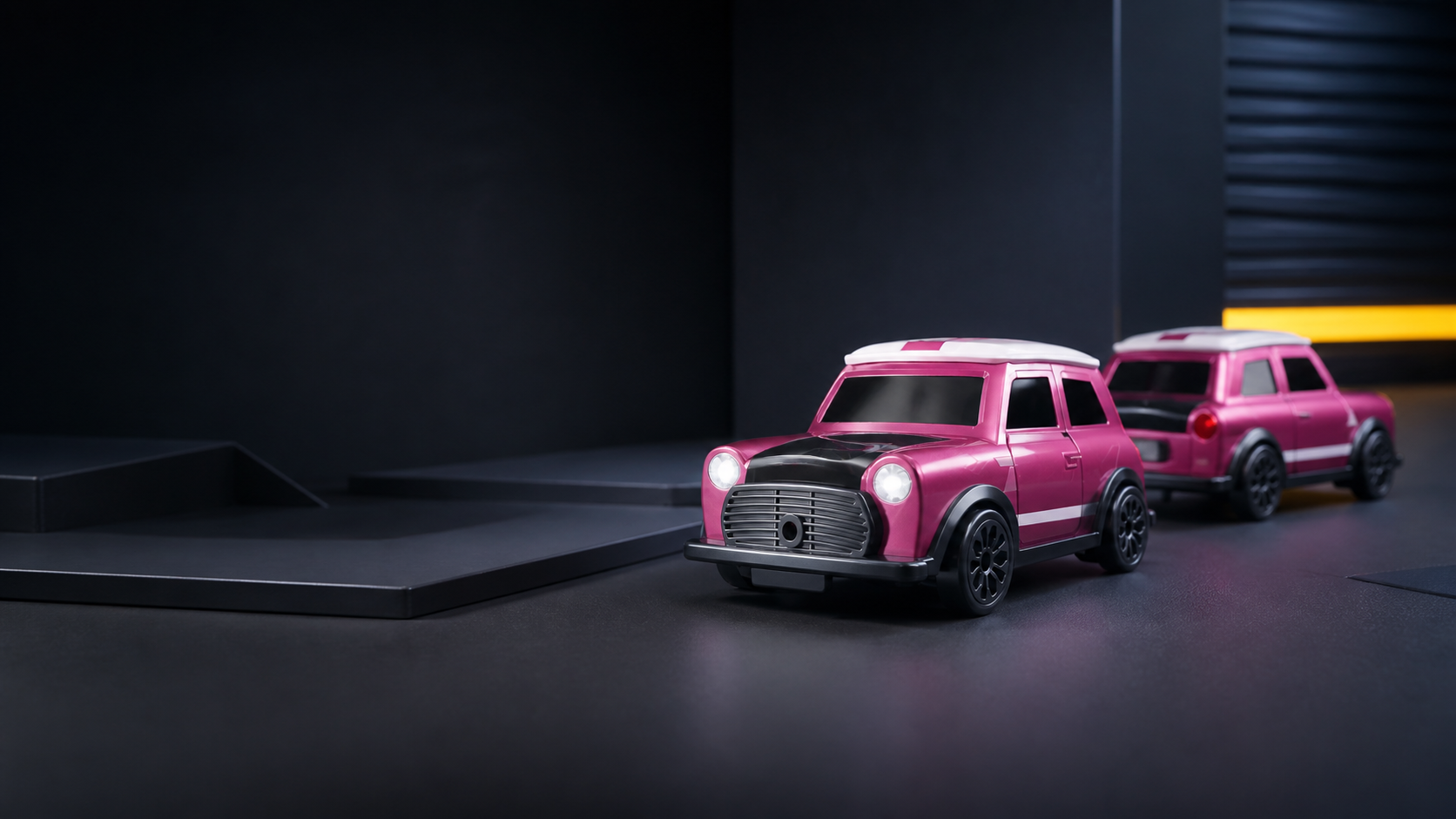
To buy lights, sound and spray modes wholesale, convert every visible effect into a spec row with four fields: trigger, expected behavior, acceptance method and packaging statement. A 30-second clip showing a car flashing, playing music and misting proves the effect exists on one hero unit; it does not tell a factory what to build, what to reject, or what to put on the carton.
This guide is for importers, Amazon sellers, supermarket buyers, gift distributors and private-label buyers who already have a supplier and a sample, and now need a document the factory, the QC team and the freight forwarder can all work from. It covers button mapping, mode sequence, indicator behavior, sound scope, spray output, tolerances, defect classification and the paperwork that has to match the lot.
What buyers should lock before the PO
- Every visible effect needs four fields — trigger, expected behavior, acceptance method, packaging statement. An effect with only a video reference is not auditable and will be argued about on the second lot.
- Approve a sealed golden sample, not a photo. Fair lighting and studio lighting both lie; the physical piece on the QC shelf is what bulk gets compared against for color, fit, flash and function.
- Sound is a scope question, not a volume number. According to the applicable US sound and volume requirements, toys designed to emit sound need an assessment of the applicable sound and volume requirements, and not every CoreRCCar has the same sound test scope.
- Button-cell compartments are a closure and warning problem before they are a function problem. Check screw closure, tool access and warning artwork before discussing what CoreRCCar does.
- For spray, lithium, FCC and IP claims, write only what the factory's actual report states. If the report has not been produced yet, the spec line stays open — a verbal number is not a spec.
How do you turn a feature video into spec rows?
Watch the clip once without pausing and list every observable event: a light turns on, a sound plays, a mist comes out, an indicator blinks. Then watch it again and write down what caused each event. That cause is the trigger, and it is the field most buyers skip.
A trigger is not "press the button." It is which button, how many presses, how long the press lasts, and what happens if the user holds it. The same physical button often carries a short press, a long press and a double press, and each one can map to a different mode. If the video shows a child cycling through effects, the spec has to say whether that was one button pressed four times or four different buttons.
Expected behavior is the observable result, described so a QC inspector can confirm it without interpretation. "Lights up" is not usable. "Front LED pair illuminates steady, rear LED pair strobes at a visible rate, both remain on until the next trigger" is usable, because two people watching the same unit will agree.
Acceptance method is how the effect gets checked — at what point in the production flow, on how many units, against what reference. That reference should be the sealed golden sample on the QC shelf, not the video and not a Fair photo. At the Canton Fair a booth sample is often a hero unit; label the tool number and revision on the table and refuse to take a Fair photo as the production standard.
Packaging statement is the fourth field and the one that gets forgotten. If the effect depends on a battery being installed, on a protective tab being removed, or on a mode being set before boxing, that instruction belongs in the spec, not in a customer service script written after launch.
What does button mapping and mode sequence actually look like on paper?
Write the mode sequence as an ordered list with the entry condition and the exit condition for each state. A CoreRCCar-grade sequence runs: power on, default mode, then each subsequent trigger advances one step, then wraps to the default. The spec must state whether the wrap is automatic or requires a long press, because that single detail is what buyers complain about when CoreRCCar "gets stuck" on the loudest mode.
Memory behavior is a separate line. Some units remember the last mode after power off; some reset to default. Neither is wrong, but the buyer has to pick one and write it, because the factory will otherwise pick whichever is cheaper to program. If the video shows a unit that resumes the previous mode, that is a memory claim and it needs its own acceptance check.
Indicators deserve their own rows. A charging indicator, a power indicator and a mode indicator can be the same LED or three different LEDs, and the color logic is not universal. Write the color, the state (steady, slow blink, fast blink), and what each state means. If a red light means "charging" on one unit and "low battery" on another in the same carton, that is a defect class, not a design choice.
Keep the mapping table short enough to fit on one page. If the sequence needs three pages, the product is too complex for the price point and the buyer should simplify the feature set rather than document it.
How should sound behavior and volume be specified?
Specify sound by function, not by decibel wish. Write what plays, when it plays, whether it loops, whether it can be muted, and whether the sound stops when the vehicle stops. Then treat the volume question as a compliance scope question: according to the applicable US sound and volume requirements, toys designed to emit sound need an assessment of the applicable sound and volume requirements, and not every CoreRCCar has the same sound test scope.
That distinction matters for mixed cartons. A light-up car with a short startup chime and a music-playing stunt car are not the same sound test conversation, even if they share a tooling family. Ask the factory which sound test scope applies to this specific SKU, and ask for the report that covers it.
Two practical checks belong in the spec. First, the mute or volume state at unboxing — does CoreRCCar ship loud, quiet or silent? Second, the behavior when the battery is low: does the sound distort, cut out, or continue at reduced volume? Both are observable, both are cheap to check, and both generate returns when they are left undefined.
Do not write a target SPL number into the spec unless the factory's report states it. A number copied from a competitor's listing is not evidence, and it will not survive an inspection argument.
How do you specify spray output without inventing numbers?
Spray is the feature most likely to be described in marketing language and least likely to have a test report behind it. Write the spec around observable behavior: what triggers the spray, how long the spray lasts per activation, whether it stops automatically, whether it can be triggered repeatedly, and what the unit does when the reservoir is empty.
Reservoir capacity, spray distance and mist density are all report-dependent. If the factory has an actual test report, the spec line quotes the report and names the lot it covers. If there is no report, the line stays open and the buyer decides whether to commission the test or drop the claim from the listing. What must not happen is a number entering the spec because it appeared in a video voiceover.
The refill and cleaning instruction is part of the purchase spec, not an afterthought. If the reservoir cannot be emptied and dried by a consumer without tools, that is a design constraint the buyer should know before tooling, not after the first container.
For any spray, lithium, FCC or IP claim, the rule is the same: use the factory's actual report, or ask for it. Do not fill the gap with an estimate.
What tolerances belong in CoreRCCar electronic spec?
Tolerances are where a video and a production line diverge. The clip shows one unit under studio light; the container holds thousands under warehouse light. Write tolerances for the things a buyer can actually see and argue about: LED color consistency between units in the same carton, button travel and feel, panel gap and fit, flash rate consistency, and sound clarity at the default mode.
Color is the classic dispute. The argument that ends a color fight is the sealed golden sample on the QC shelf — emails do not. Bulk gets compared to that physical piece for color, fit, flash and function. Buyers who approve only a photo pay for it on the second lot.
Fit tolerances cover battery door closure, screw seating, wheel and axle play, and any moving part that a child will operate. A door that opens with fingernails is a compartment problem before it is a fit problem, and CoreRCCar are a compartment and warning problem first: check screw closure, tool access and the warning before talking about CoreRCCar function.
Write the tolerance as a comparison instruction, not an absolute measurement, unless the factory has agreed to measure. "Compared to golden sample under the same light, no visible color shift" is enforceable on a QC bench. "Within 2% color difference" is not, unless someone has agreed on the instrument and the method.
How should defects be classified for lights, sound and spray?
Classify defects by function and by safety, and keep the two lists separate. A non-functioning light is a function defect. A battery compartment that opens without a tool is a safety issue and stops the lot regardless of how many units are affected.
A nonconformance report should state the defect, lot, quantity, containment, disposition and responsible decision rather than only a pass/fail note. That structure is what turns a QC argument into a decision: who holds the lot, what happens to it, and who signs off on release.
For recurring defects, an 8D report is a structured method for containing, diagnosing and preventing the same failure from returning. Buyers should ask for it when the same defect class appears in two consecutive lots, not for every isolated unit.
Sampling numbers belong on the PO, not in a catalogue sentence. On the floor, a failed lot is isolated, the defect class is recorded, and release happens only after rework. Buyers who want an AQL number get it from the agreed inspection plan on the PO. If the inspection plan has not been agreed, that is the gap to close before production starts, not after the container is loaded.
Which paperwork has to match the lot?
Certificates and test files are lot-specific documents, not brand-level decorations. Map market, lot and which file covers which test. A UKCA file and a VOC file on an electric bubble machine are different papers; a buyer who tried to use one certificate for both learned that paperwork which does not match the lot is not paperwork.
The same logic applies to sound, spray and battery reports. Each claim in the spec should point to a document, and each document should name the model, the lot and the market it covers. If a report covers a different revision of the tooling, it does not cover this shipment.
Incoterms belong in the same discipline. FOB without a named place has started freight arguments that lasted longer than production. Write the Incoterms version and the named place — Shantou or Shenzhen as actually booked. Incoterms are not a vibe.
Packaging instructions are paperwork too. Corner-sensitive CoreRCCar die in LCL when the booking instruction is a thank-you note. Write double-wall, corner boards, ECT and pallet height into the booking file, and keep the packaging statement attached to the spec row for the effect it protects.
Worked example (illustrative, not a real shipment)
A buyer orders 2,400 units of a light-and-sound stunt car across two destinations: 1,800 units to a US Amazon prep warehouse in a master carton with a retail-ready inner box, and 600 units to an EU gift distributor in a plain export carton with a different warning panel. Same tooling, same electronics, two packaging statements. The spec has to carry both, because the effect and the carton are not independent — the EU carton removes the display window, which changes how the light effect is presented on shelf.
At pre-production sample stage, the buyer approves a sealed golden sample and labels it with the tool number and revision. The button mapping is written as: short press cycles light modes, long press toggles sound, double press triggers the spray. The mode sequence wraps to default after the last step. The indicator is one LED, steady while charging, off when full.
At inspection, the lot is checked against the golden sample. The spray function on the sampled units triggers but does not stop automatically after the stated activation window, and the factory's report for the spray function covers a different revision. That is where the lot gets held: the effect does not match the acceptance method, and the document does not match the lot. The buyer either accepts a rework and re-test, or the claim comes off the listing. Either way, the decision is made on the spec sheet, not on a video.
Spec fields, what to check, and the red flag
| Trigger / button mapping | Check: which button, press count, press duration, behavior on hold. Red flag: video shows the effect but no one can say which input caused it. |
|---|---|
| Mode sequence | Check: entry state, step order, wrap behavior, memory after power off. Red flag: "same as sample" with no written order. |
| Indicators | Check: color, state (steady/blink), meaning per state, charging vs low battery. Red flag: same LED color used for two different meanings. |
| Sound behavior | Check: what plays, loop or one-shot, mute state at unboxing, low-battery behavior, applicable sound test scope. Red flag: a volume number with no report behind it. |
| Spray output | Check: trigger, duration per activation, auto-stop, empty-reservoir behavior, report coverage. Red flag: distance or capacity quoted from a video voiceover. |
| Tolerances | Check: LED color consistency, button feel, panel gap, flash rate, comparison instruction vs golden sample. Red flag: absolute numbers with no agreed instrument or method. |
| Defect classification | Check: function defects separated from safety defects, NCR fields (defect, lot, quantity, containment, disposition, decision). Red flag: pass/fail note only. |
| Packaging statement | Check: inner box vs export carton, double-wall, corner boards, ECT, pallet height, battery tab instruction. Red flag: booking instruction with no packaging spec. |
| Paperwork mapping | Check: market, lot and which file covers which test; Incoterms version and named place. Red flag: one certificate reused for two different claims. |
What to ask suppliers before you approve the spec
Send these as a written RFQ and ask for written answers. Verbal answers on a call are useful for speed but they do not survive a lot dispute.
Which SKU, tool number and revision does this feature video correspond to? Can you send the sealed golden sample for this SKU and confirm the QC-shelf reference? What is the button mapping — which button, how many presses, how long, and what happens on hold? What is the mode sequence, including wrap behavior and memory after power off? What are the indicator color and state for charging, full, low battery and each mode?
For the sound function: which sound test scope applies to this SKU, and which report covers it? For the spray function: what is the actual test report, which revision and which lot does it cover, and what is the activation duration and auto-stop behavior? For lithium battery, FCC and IP claims: which report, which lot, which market — and what rating is stated on the report itself?
For the battery compartment: confirm screw closure, tool access and warning artwork. For market paperwork: which file covers which test, and for which lot? What is the agreed inspection plan on the PO, and what sampling number does it state? What Incoterms version and named place will appear on the booking? What packaging spec — double-wall, corner boards, ECT, pallet height — applies to this SKU?
Ask for the answers in writing and attach them to the spec. The version that matters is the one the factory signs.
FAQ
Can I use a supplier's feature video as the production standard?
No. A video shows one unit under studio or Fair lighting and cannot define tolerances, mode order or packaging. Use it to identify which effects exist, then convert each effect into a spec row with trigger, expected behavior, acceptance method and packaging statement, and approve a sealed golden sample as the physical reference.
How do I specify sound volume for a CoreRCCar?
Specify sound by function first — what plays, when, whether it loops, whether it can be muted — and treat volume as a compliance scope question. According to the applicable US sound and volume requirements, toys designed to emit sound need an assessment of the applicable sound and volume requirements, and not every CoreRCCar has the same sound test scope. Ask the factory which scope applies to this SKU and request the report; do not write a decibel number that no report supports.
What should the spec say about spray output if the factory has no test report?
Leave the numeric line open and specify only observable behavior: trigger, duration per activation, auto-stop, empty-reservoir behavior. Then decide whether to commission the test or remove the claim from the listing. A distance or capacity figure that came from a video voiceover is not a specification and will not survive an inspection argument.
Do I need a different spec for the US and EU cartons of the CoreRCCar?
Yes, if the packaging differs. The electronics spec can be identical, but the packaging statement, warning panel and market paperwork are destination-specific. Map market, lot and which file covers which test, and keep the Incoterms version and named place — Shantou or Shenzhen as actually booked — in the booking file.
How should I classify a light that fails on some units in a lot?
As a function defect, recorded with the lot and quantity, and contained before release. A nonconformance report should state the defect, lot, quantity, containment, disposition and responsible decision rather than only a pass/fail note. If the same defect class appears in two consecutive lots, ask for an 8D report, which is a structured method for containing, diagnosing and preventing recurring production defects.
Where does the sampling number come from if not from the supplier's catalogue?
From the agreed inspection plan on the PO. A catalogue sentence is not an inspection plan. On the floor, a failed lot is isolated, the defect class is recorded, and release happens only after rework; the sampling number that governs that decision is the one written into the PO and agreed by both sides before production starts.
Sources
Turn your feature video into a spec sheet before the next PO
If you have a sample and a clip but no written spec, the gap will be filled by whoever is cheapest to ask. Write the four fields for every effect, approve a sealed golden sample, and send the RFQ list above before production starts. Buyers who do this argue about one page of paper instead of one container of product.