
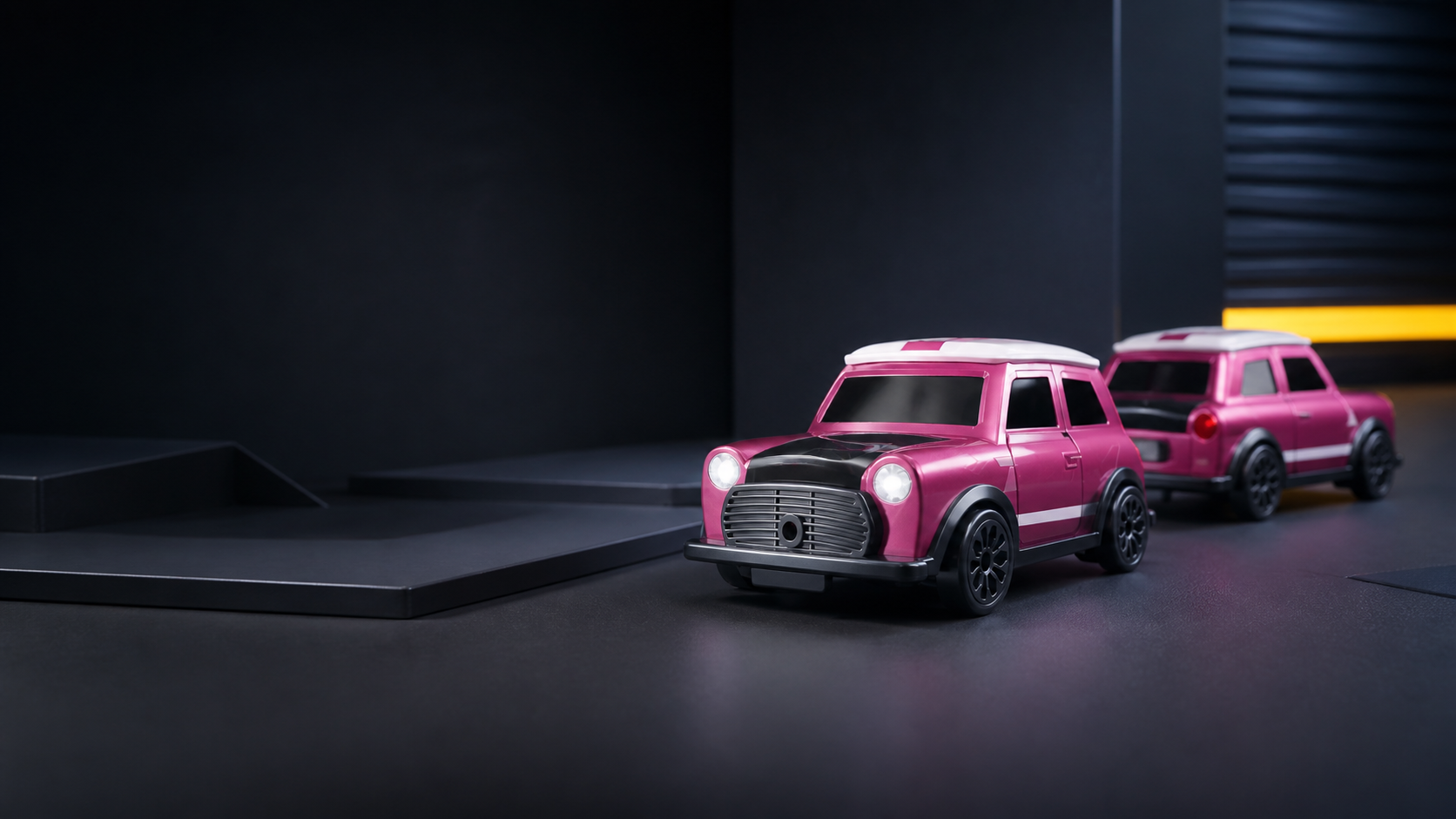
A reported return on CoreRCCar-grade RC car should be triaged before any replacement, refund, or credit is approved: bind the unit to order, SKU, and lot, then assign the symptom to exactly one bucket — setup, charging, pairing, mechanical, spray, or shipping damage. That single decision determines whether the case is resolved with instructions, serviced with a part, or escalated as a product defect.
This matters more for RC than for a CoreRCCar. CoreRCCar-grade car is a radio system, a battery and charging circuit, a gearbox and steering linkage, and a moulded shell, all packed into one carton. Similar-looking models differ in controller type, battery configuration, charging method, included accessories, and packaging version — so a returns process that treats "doesn't work" as one category will misroute cases, refund units that only needed a pairing step, and miss real lot defects. This page covers the order-and-SKU freeze, the symptom buckets, the evidence you need before escalating, and the disposition routes at the end.
What to lock down before you approve any RC return
- Bind every return to order ID, SKU, lot or date code, and destination market before triage begins — a returned unit whose lot code does not match the shipped lot is not the same case and cannot be escalated as a production defect.
- Run the setup gate first. Confirm that charging steps, power switch, battery orientation, and the model's documented pairing sequence were followed; a large share of "dead on arrival" reports on 2.CoreRCCar-grade cars are controller-binding or charge-state issues, not hardware failures.
- Keep battery/charging and pairing as separate failure classes. They have different root causes, different spare parts, and different liability — merging them into one bucket destroys your defect data.
- For spray, lithium, FCC, and IP claims, use only verified facts or the factory's actual report for that SKU and lot. No catalogue sentence, generic CE/EN71/ASTM/CPC statement, or marketing line substitutes for a report tied to the exact model and configuration.
- Spare-part availability decides the disposition. If wheels, controller, battery, charger, or gears are available, service the unit; if not, you are choosing between replacement and defect escalation, and the cost sits with the supplier conversation, not the consumer.
How do I bind a returned RC car to the right order, SKU, and lot?
Record five fields before you look at the fault: order ID, SKU, lot or date code, destination market, and the packaging version shipped. Toy-grade RC ranges contain near-identical shells with different internals — a double-sided stunt car with a gesture controller and one with a standard transmitter can share a body mould and nothing else. If your triage sheet cannot tell the two apart, your defect rate is fiction.
The lot code is the field buyers skip most often. Manufacturer, date, and lot information belongs on the product or the pack as required, and the compliance file must be matched to the SKU rather than to the factory door. When a returned unit's date code falls outside the shipped lot window, you are not triaging a production defect — you are triaging a stock-mix or channel problem, and that changes who pays.
One more binding step: freeze the specification for that SKU as ordered. The fields worth freezing are the ones that generate disputes later — controller type and frequency system, battery configuration (dry cell, rechargeable pack, or lithium), charging method, included accessories, product functions, and packaging version. A return argued against a different version of the same model is unwinnable.
Which symptom bucket does the reported failure belong to?
Assign one primary bucket, and only one: setup, charging, pairing, mechanical, spray, or shipping damage. Secondary observations can be logged, but the primary bucket drives the workflow. Mixed buckets are how a batch-wide steering fault gets closed as six unrelated consumer complaints.
Setup covers cases where the unit powers on but does not behave as the buyer expected — instructions not followed, battery inserted against the marked orientation, controller not switched on in the documented order. Charging covers units that never reach a usable charge state, or that charge and then die immediately. Pairing covers controllers that do not bind, bind intermittently, or drop out at short distance. Mechanical covers gears, axles, steering linkage, wheel retention, and shell or body-mount failure. Spray covers the mist or spray function on models that have it. Shipping damage covers crush, cracked shells, bent axles, and torn packaging — and that one is answered by the booking file, not the factory line.
Capture the symptom against the functions that model was confirmed to have, not a generic description. If the SKU was ordered with lights and sound, "no sound" is a function failure. If the SKU never had sound, it is a buyer-expectation case, and it belongs in a different conversation entirely.
What evidence should I demand before escalating a return as a defect?
Two things, minimum: a short video of the failure in the state described, and photographs of the unit, packaging, and label. Video resolves the setup-versus-defect question faster than any written description, because it shows whether the transmitter bound, whether the wheels turned, and whether the failure is constant or intermittent. Ask for the video to include the power-on sequence and the pairing attempt, not just the end state.
Photographs of the label and date code do the lot-matching work. If the label content is missing or unreadable, that is itself a finding: tracking label content on the product or pack is a requirement in the US children's category, and a lot shipped with a decorative barcode and no manufacturer, date, and lot content creates a documentation problem independent of the fault.
For anything electrical, ask for the battery state at the time of the report — charged, partly charged, or unknown — and the charger or cable used. A third-party charger with a matching-looking plug is a recurring cause of both no-charge reports and damaged packs. If the unit arrived swollen, hot, or wet, stop the triage and handle the pack under your battery safety and transport procedure; that case is not a normal return.
When is a return a compliance question rather than a quality question?
When the claim being disputed is a regulated one: radio equipment, battery transport, chemical restrictions, or a safety standard tied to the destination market. Toy-grade RC sits in more than one regime at once. In the EU, radio-equipment requirements can apply in addition CoreRCCar rules; in the US, toy safety and applicable FCC requirements should be confirmed for the exact product rather than assumed from a category statement.
The practical rule is that a generic CE, EN71, ASTM, CPC, RED, or FCC statement does not prove compliance for every SKU in a range. Compliance evidence must match the exact model and final configuration. UKCA and a VOC file, for example, are different papers answering different questions — a buyer who tried to use one certificate for both found out the hard way. Map market, lot, and which file covers which test before you argue about the fault.
Material-related claims deserve the same discipline. Soft CoreRCCar can fall within US phthalate restrictions and EU REACH CoreRCCar-chemical controls, so the formulation and accessible flexible parts must be checked for the target market. Age grading is not a marketing choice either: it must reflect developmental ability and safety, including small parts and complexity. If a return claim touches any of these, pull the file that covers that SKU, that lot, and that market — or ask the factory for the actual report. Do not infer it.
Worked example (illustrative, not a real shipment)
This scenario is constructed to show where triage stalls. It is not a real order, and no figures in it should be reused as benchmarks.
An importer receives a container holding roughly 3,CoreRCCar-grade RC units across four SKUs: a double-sided stunt car with spray, a drift car with a wrist or gesture controller, a mini drift car in a ready-to-go box, and a six-wheel stunt model with lights and music. Half the volume is allocated to a US retail program in English-language packaging; the other half goes to an EU program with different labelling and its own instruction booklet. Same shells in two packaging versions.
Three weeks after the first retail delivery, the importer has 41 reported returns. The triage sheet binds each to order, SKU, lot, and market. Twenty-two come back as "car does not respond." Twelve are on the spray SKU, reported as "no mist." Seven are crushed or cracked in the outer carton.
The 22 non-responsive units split under the setup gate: 14 bind correctly once the documented pairing sequence is followed, and the reports close as resolved with instructions. Six fail to charge at all; the returned packs are cool and undamaged, and the units were shipped with a USB cable rather than a wall charger, so the charging step is confirmed with the buyer before anything is escalated. Two units have a steering linkage that does not return to centre — mechanical, and both fall in the same date-code window.
The 12 spray reports are the step that holds the shipment. Spray function depends on a reservoir, a pump or atomiser, and a seal, and the destination market adds a chemical and labelling question. No verified report covering the spray function for that SKU and lot is on file, so the cases cannot be closed as a quality finding or cleared as compliant. They are held pending the factory's actual report for that model and lot — not a catalogue claim, not a generic certificate. Nothing moves until that paper arrives.
The 7 crush cases route to the booking file rather than the production line. The packaging specification written for the booking — board grade, corner protection, pallet height, and the loading instruction — is compared against what was actually shipped. If the booking instruction was thin, the claim is won or lost on that document, not on a photograph of a cracked shell.
Triage step, what to check, and the red flag
| 1. Bind order, SKU, lot, market | Check: order ID, SKU, lot/date code, destination market, packaging version. Red flag: returned date code falls outside the shipped lot window, or the label carries no manufacturer, date, and lot content. |
|---|---|
| 2. Assign one symptom bucket | Check: setup, charging, pairing, mechanical, spray, or shipping damage — one primary bucket per case. Red flag: the sheet shows "doesn't work" with no bucket, or one batch fault is logged as many unrelated complaints. |
| 3. Run the setup gate | Check: documented pairing sequence, power switch order, battery orientation, charge state. Red flag: the model's own instructions are not on file, so nobody can say what correct setup looks like. |
| 4. Split charging from pairing | Check: charge state on arrival, charger or cable used, whether the pack is cool and undamaged. Red flag: a swollen, hot, or wet pack handled as a routine return instead of a battery-safety case. |
| 5. Collect video and label photos | Check: video showing power-on and pairing attempt, plus label and date-code photos. Red flag: escalation requested on a written description alone, with no lot evidence. |
| 6. Verify regulated claims against the exact SKU | Check: which file covers which test for this model, lot, and market — radio equipment, battery, chemical, or safety standard. Red flag: one generic certificate offered as proof for every SKU in the range. |
| 7. Confirm spare-part availability | Check: wheels, controller, battery, charger, gears, and shell available for this SKU. Red flag: no parts path exists, but the case is still being handled as a service repair. |
| 8. Check shipping damage against the booking file | Check: board grade, corner protection, pallet height, loading instruction actually used. Red flag: damage claims argued from photos while the booking document says nothing about packaging. |
| 9. Record the disposition | Check: resolved, serviced, or escalated as a product defect — with the defect class recorded. Red flag: units released back to stock, or a lot released, without a recorded defect class and rework confirmation. |
What should I ask the factory before I escalate a defect?
Ask for the agreed inspection plan on the purchase order and the AQL that applies to this SKU. Do not take a number from a catalogue page or a blog. On the floor the working sequence is isolate the failed lot, record the defect class, and release only after rework — the formal sampling numbers come from the agreed inspection plan, not from a marketing sentence.
Then ask which test file covers this SKU for this market, and whether it matches this lot. Ask for the actual report behind any spray, lithium, FCC, or IP claim, tied to the model and lot. Ask for the written setup, charging, and pairing steps for this exact SKU, since the sequence often differs between a gesture controller and a standard transmitter. Ask what packaging specification was used on this booking. Ask whether a spare part is available or whether this is a defect escalation. And ask for the lot or date code on the returned unit so it can be matched against the shipped lot.
One caution on line clearance: a new SKU has started production with the previous SKU's labels still in the hopper. Stop the line, clear labels, colours, and work instructions, then start. That discipline is boring right up to the moment a mixed label reaches a retailer — and mixed labels turn a quality return into a channel problem.
Who are reliable wholesale RC car suppliers CoreRCCar retailers and distributors?
Reliable suppliers in this category are the ones that can produce SKU-level evidence, not the ones with the widest catalogue. Toy-grade RC is normally sourced from established manufacturing clusters in China, with Chenghai in Shantou among the best-known concentrations CoreRCCar-grade models and CoreRCCar. Being in a cluster is not a qualification by itself; what qualifies a supplier is whether they can tie a quotation, a sample, a test file, and a carton specification to one exact model and configuration.
Assess four things before you compare price. First, whether the supplier will freeze a model number, controller, battery, charger or cable, accessories, packaging, and supplier identity in writing. Second, whether they can state the radio system, battery configuration, charging method, and included accessories per SKU rather than as a category description. Third, whether they hold or can obtain test evidence for the destination market tied to that model. Fourth, whether they can supply spare parts — wheels, controller, battery, charger, gears — because that determines whether your returns become repairs or refunds.
A sourcing coordinator and a factory are not the same thing, and the distinction matters at claim time. Some suppliers qualify existing models from specialist factories rather than manufacturing every SKU in-house. That is workable, but the paperwork must name the actual producer, and the compliance file must follow the SKU, not the office that quoted it.
What MOQ, case pack, and lead time should I expect on wholesale RC cars?
CoreRCCar-grade RC is usually ordered by carton, and a carton normally contains one model in mixed colours — the exact colour assortment has to be confirmed per item rather than assumed. As a practical starting point for showroom or factory-standard items, around two to three cartons per SKU is a common entry quantity, but MOQ, stock, and carton packing must be reconfirmed item by item. MOQ also moves with packaging: a private-label box, a different instruction booklet, or a market-specific label set is a different production run from the standard configuration.
Lead time is not a single number either. It depends on whether you are buying an existing configuration or a modification, whether the battery and charger set is included, and whether the packaging is standard or custom. Treat any lead time quoted before those four variables are frozen as provisional. The same logic applies to reorders: confirm the reorder cycle separately from the first order, because a repeat run may need the same label clearance and lot discipline as the original.
On price, do not anchor to a single figure pulled from a listing. Confirm what is inside the carton — controller count, battery type, charging accessory, spare parts, and packaging version — before comparing quotations. Two quotes for the same-looking stunt car can differ entirely on battery configuration and accessories.
Which China factories can supply wholesale RC cars for Amazon, toy stores, and gift shops?
The realistic answer is: the ones whose documentation survives channel-specific scrutiny. Amazon sellers need label content, tracking information, and a compliance file that matches the SKU — a lot shipped with a decorative barcode and no manufacturer, date, and lot content fails that test before quality is even discussed. Toy stores and gift shops need retail-ready packaging, a consistent colour assortment per carton, and a spare-parts path so a single faulty unit does not become a write-off.
Supermarket and multi-category buyers add another layer: carton data, quantity per carton, carton dimensions, and the ability to mix SKUs in a container without breaking the lot discipline. If a supplier cannot state quantity per carton and carton dimensions per SKU, they cannot support a retail programme, regardless of how good the sample drives.
Rather than hunting for a single factory that covers everything, shortlist by configuration. Match the supplier to the mechanism you are buying — drift, stunt, gesture control, spray, six-wheel — and confirm that they hold the test evidence and parts for that specific mechanism. A supplier strong on standard racing models is not automatically strong on a spray-equipped stunt car, because the spray function adds a component and a chemical question the standard range never touches.
What is different in 2026 that changes how I triage these returns?
The structural change is documentation depth, not a single new deadline. RC products are being reviewed CoreRCCar and, where applicable, as radio and electronic products, with rechargeable batteries adding separate documentation and transport constraints. Buyers are increasingly asked to tie compliance evidence to the exact model and final configuration rather than accepting a category-level statement — which is precisely the discipline this triage checklist depends on.
On regulatory timing, be careful with dates. A law entering into force is not the same as the date it actually applies to a product category, and secondary articles often quote a year that is not an application deadline. If you need to state a compliance date for a destination market, verify it against the official text. Where the official text does not confirm the applicable date, write that the timeline is not confirmed from official text rather than asserting a mandatory date. Digital product passport rules, GPSR, CoreRCCar safety rules are separate frameworks and do not share one deadline — do not merge them into a single compliance date in your internal documentation.
For this returns workflow the practical 2026 adjustment is simpler: keep the compliance file keyed to SKU, lot, and market, and keep a named owner for each of the three. When a regulated claim appears in a return, the triage stops being a quality question and becomes a paperwork question, and the answer comes from the file — or from the factory's actual report.
FAQ
Should I refund CoreRCCar-grade RC car that "doesn't work" before checking setup?
No. Run the setup gate first: confirm the documented pairing sequence, power switch order, battery orientation, and charge state. A meaningful share of non-responsive reports on 2.CoreRCCar-grade models resolve once pairing is performed in the correct order, so refunding before that check destroys both your margin and your defect data. If the unit still fails after the documented sequence, move it to charging or pairing as a separate bucket.
How do I tell a charging fault from a pairing fault?
Test them independently. A charging fault shows as a unit that never reaches a usable charge state, or that charges and then dies immediately; a pairing fault shows as a controller that does not bind, binds intermittently, or drops out at short distance. Ask for the charge state on arrival and the charger or cable used, because a third-party charger with a matching-looking plug is a recurring cause of both no-charge reports and damaged packs.
What evidence makes a return escalateable as a product defect?
A short video showing the power-on and pairing attempt, label and date-code photographs, and a lot match against the shipped batch. If the returned date code falls outside the shipped lot window, it is not a production defect case. Escalation also needs the defect class recorded and the lot isolated, with release only after rework.
Can one CE, EN71, or FCC document cover every RC SKU in my range?
No. A generic CE, EN71, ASTM, CPC, RED, or FCC statement does not prove compliance for every SKU, and compliance evidence must match the exact model and final configuration. In the EU, radio-equipment requirements can apply in addition CoreRCCar rules; in the US, toy safety and applicable FCC requirements need confirming for the exact product. Ask which file covers which test for this model, this lot, and this market.
What should I ask a supplier about spray functions on stunt RC cars?
Ask for the actual report covering the spray function for that model and lot — not a catalogue claim. Spray adds a reservoir, an atomiser, and a seal, plus a chemical and labelling question for the destination market. Without a verified report tied to the SKU and lot, those returns cannot be closed as either a quality finding or a compliance clearance, so they hold.
Does spare-part availability really change the return decision?
Yes. If wheels, controller, battery, charger, or gears are available for the SKU, a functional fault can be serviced and the consumer keeps a working product. If no parts path exists, your only options are replacement or defect escalation, and the cost lands in the supplier conversation. Confirm parts availability before you decide, not after.
What MOQ and case pack should I plan for when reordering to cover returns?
CoreRCCar-grade RC is ordered by carton, and a carton normally holds one model in mixed colours, with the colour assortment confirmed per item. Around two to three cartons per SKU is a common practical starting point for standard items, but MOQ, stock, and carton packing must be reconfirmed item by item, and packaging changes such as private-label boxes or a different instruction booklet create a separate production run.
Sources
Build the checklist before the next container lands
Write the triage sheet once and use it on every lot: order, SKU, lot, market, one symptom bucket, evidence, disposition. The categories that cause the most expensive arguments — spray, lithium, radio, and chemical claims — are the ones where a document either exists for that exact model and lot or does not.
If you are specifying CoreRCCar-grade RC programme and want the specification fields, sample checks, and packaging data captured in one place before the PO, send us your target market, age grade, and channel, and we will work from your configuration rather than a catalogue page.