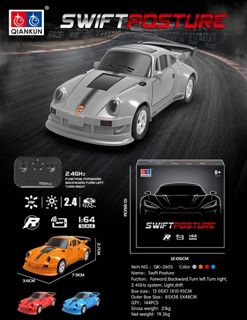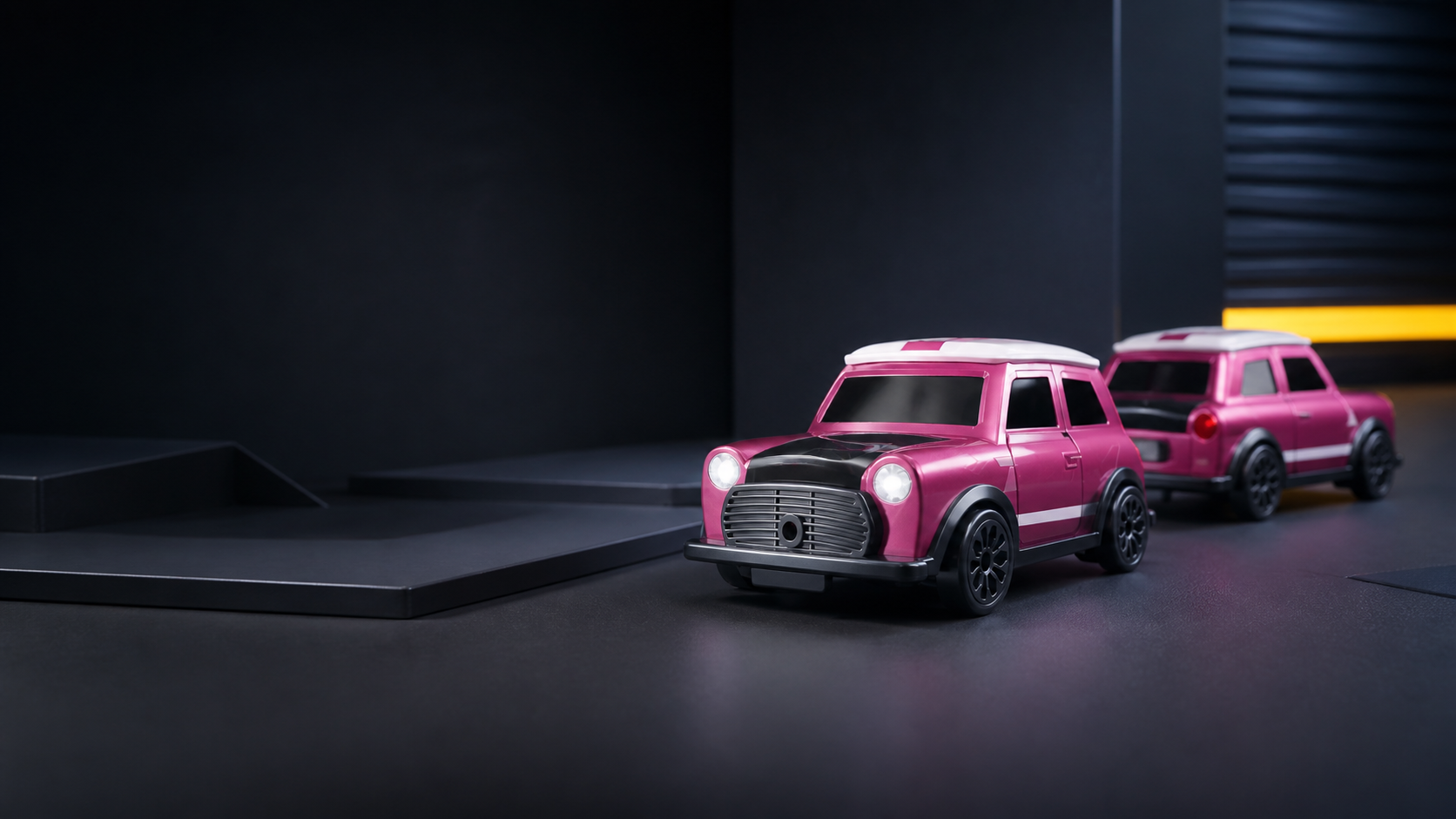
If you are sourcing mini RC cars for a retail channel, the first decision is not scale or price—it is the play pattern you intend to sell. RWD sports minis suit precision driving on smooth floors, while stunt minis deliver immediate spectacle through flips and spins; choose by control behavior, not superficial size similarity. This guide compares the two families across steering, stunt claims, surface needs, learning curve, and verification steps, so you can spec the right product for your customers and avoid mismatched inventory.
The market offers both 1/43 and 1/64 scale options, but the real difference is how each behaves in a child's hands. A 1/43 RWD drift car (around $14.88) promises finer control and speed; a 1/64 stunt coupe (around $4.03) promises tricks and durability. Your merchandising language—listing copy, demo videos, instructions—must match the behavior you can actually deliver.
The trade-offs, verification steps, and three factory questions are detailed below.
Key Takeaways
- Choose RWD sports minis when your play pattern is racing on smooth floors and your customers expect steering precision and speed; expect a higher price point (around $14.88) and MOQs from 108 units.
- Choose stunt minis when your play pattern is flips, spins, and immediate gratification on varied surfaces; expect lower unit costs (around $4.03–$5.25) and MOQs ranging from 48 to 432, with lower MOQs for some stunt models.
- Surface needs differ: RWD sports minis likely prefer hard, smooth floors, while stunt minis may handle varied surfaces—but confirm with the factory's TDS, as no surface data is provided in our catalog.
- Learning curve matters: RWD sports minis reward practice and skill, while stunt minis are immediately accessible—align your instructions and demo content with the expected skill level.
- Verify any 'drift' or 'stunt' claim by requesting the TDS, a demo video of the production unit, and a physical golden sample before committing to bulk.
Comparison: RWD Sports Minis vs. Stunt Minis
| Product family | RWD Sports Minis (e.g., 1/43 Mini Drift RC Car 2.4GHz Full Proportion 4WD High Speed, $14.88) |
|---|---|
| Stunt Minis (e.g., 1:64 Mini Stunt Drift RC Sports Coupe, $4.03; 1/64 4WD Drift RC Sports Car with Lights, $5.25) | Stunt Minis (e.g., 1:64 Mini Stunt Drift RC Sports Coupe, $4.03; 1/64 4WD Drift RC Sports Car with Lights, $5.25) |
| Typical play pattern | Precision driving, speed, drifting on smooth floors |
| Stunt-focused: flips, spins, tricks, immediate spectacle | Stunt-focused: flips, spins, tricks, immediate spectacle |
| Steering behavior | Potential proportional control (verify via TDS); finer turning radius expected |
| Likely on/off steering; stunt mechanisms (verify via TDS) | Likely on/off steering; stunt mechanisms (verify via TDS) |
| Surface needs | Smooth hard floors preferred; carpet may reduce performance (ask TDS) |
| Hard floors and varied surfaces; confirm with factory (ask TDS) | Hard floors and varied surfaces; confirm with factory (ask TDS) |
| Learning curve | Rewards practice; skill-based control |
| Immediate accessibility; low skill barrier | Immediate accessibility; low skill barrier |
| Material | Not listed for 1/43 model; ABS for 1/64 4WD drift cars |
| PVC/ABS for 1:64 stunt coupe; ABS for 4WD drift cars | PVC/ABS for 1:64 stunt coupe; ABS for 4WD drift cars |
| MOQ (units) | 108–432 depending on SKU |
| 48–432 depending on SKU; some stunt models start at 48 | 48–432 depending on SKU; some stunt models start at 48 |
| Price (USD) | 14.88 (1/43); 4.03–5.25 for 1/64 variants |
| 4.03–5.25 | 4.03–5.25 |
What Play Pattern Are You Selling?
The core question is whether your customers want to race or want to show off. RWD sports minis are built for control—think smooth turns, speed, and a satisfying drift on hard floors. Stunt minis are built for spectacle—flips, spins, and self-righting tricks that work on varied surfaces and need no skill to enjoy.
If your retail channel is CoreRCCar store where kids expect instant fun, stunt minis are the safer bet. If your channel is a hobbyist-leaning gift shop or an online listing that emphasizes precision and speed, RWD sports minis match that promise. The price gap—$14.88 versus $4.03—also signals different margin and replacement dynamics: a stunt mini is a lower-risk impulse buy, while an RWD sports mini is a considered purchase.
Scale similarity can mislead. A 1/43 and a 1/64 may look alike in a photo, but the play pattern is fundamentally different. Match the product's behavior to your merchandising story, not the other way around.
Steering Behavior: Precision vs. Spectacle
Steering behavior is the first differentiator. RWD sports minis typically offer proportional or near-proportional steering, meaning the car responds to how far you turn the wheel, not just on/off. This supports a learning curve where kids improve their control over time—a play pattern that rewards practice.
Stunt minis often use simpler steering with a focus on stunt mechanisms like 360° spins or flips. The control is less about finesse and more about triggering the next trick. This is immediately accessible but offers less depth for older kids or adults who want to master a line.
Before you commit, ask the factory for the TDS that specifies steering type. If it says 'proportional,' verify with a demo video of the actual production unit. If it says 'on/off,' expect a different play experience than your listing copy might imply.
Surface Needs: Where Will It Run?
Surface needs are a practical constraint. RWD sports minis likely perform best on smooth, hard floors—tile, vinyl, or low-pile carpet. Thick carpet can bog down a fine-steering car and kill the drifting effect. Stunt minis, with their robust bodies and simpler mechanisms, may handle varied surfaces, but that is not guaranteed.
Our catalog does not list surface compatibility for any SKU, so you must ask the factory. Request a video of the production unit running on the surface you plan to feature in your listing—hard floor for sports, maybe carpet for stunts. Do not assume a 'drift' label means it works on every floor type.
Returns hinge on this. A customer who buys a drift car and tries it on thick carpet may be disappointed, generating negative reviews. Align your surface claims with verified behavior.
Learning Curve and First-Session Satisfaction
The learning curve determines whether the first session is a win or a frustration. RWD sports minis reward practice—a child may need a few minutes to master steering, but the payoff is a sense of skill. This play pattern suits older kids (8+) and hobbyist-leaning buyers.
Stunt minis are immediately satisfying. Flip the car, it spins; press a button, it does a 360. No skill required, which makes them great for younger kids (5+) and for gift purchases where the buyer cannot test the product.
Your instructions and demo content should match this. For sports minis, include tips on steering technique. For stunt minis, keep instructions short and visual—remember that complex instructions can kill a play pattern, as seen in school programs where simple packaging and short instructions helped adoption.
Verifying Steering and Stunt Claims Before You Commit
A product name like 'drift' or '4WD' is a marketing claim, not a specification. Before you pick between the RWD sports mini and the stunt minis, ask the factory for the TDS or specification sheet that lists steering type (proportional vs. on/off), turning radius, and any drift or stunt mechanism. If the sheet does not exist, request a video of the actual production unit performing the claimed maneuver on the surface you intend to sell for—hard floor, tile, or low-pile carpet. A booth demo at a fair is a hero unit, not the production standard; label the tool number and revision on the table and refuse to take a fair photo as proof.
For the RWD sports mini (1/43, $14.88), the key question is whether 'full proportion' means the steering and throttle are continuously variable or just two-speed. If the TDS does not state proportional control, ask directly: 'Is the steering servo proportional or on/off?' For the stunt minis (1:64, $4.03–$5.25), the question is whether 'stunt' means a specific mechanism (e.g., self-righting, 360° flip) or just a marketing label. Ask for the mechanism description and a video of the production unit performing the stunt on the surface you plan to feature in your listing.
Surface needs are a separate verification. A 1/43 scale car with fine steering may struggle on thick carpet, while a 1/64 stunt mini may be designed for hard floors. The TDS should list recommended surfaces; if it does not, ask the factory to test on your target surface and provide a video. Do not assume that 'drift' implies a specific surface—drift behavior changes dramatically between smooth concrete, vinyl, and carpet, and the factory's test conditions may not match your retail environment.
Design Risk: Material and Build Tell You—and What They Don't
The stunt minis are listed as PVC/ABS or ABS, and the RWD sports mini does not list a material. ABS is a CoreRCCar plastic, but the material name alone does not tell you impact resistance, flex behavior, or whether the body will crack on a hard landing. The TDS should include Shore hardness and tensile/tear strength for the body and any flexible parts. If those numbers are missing, ask for the TDS row that lists them. Do not accept a generic 'ABS' as proof of durability—the wall thickness, ribbing, and attachment points determine whether the shell survives a stunt, not just the resin name.
For the stunt minis, the design risk is in the impact zones: the bumper, the wing, and the wheel mounts. Ask the factory which parts are designed to flex and which are designed to break (sacrificial parts). A car that breaks a wing on the first flip may generate replacement sales, but it also generates returns and negative reviews. For the RWD sports mini, the design risk is in the steering linkage and the differential—a fine-steering car with a fragile linkage will fail in a different way than a stunt car. Ask for the failure mode analysis or the inspection plan that covers drop and impact testing, and request the defect class definitions from the agreed inspection plan on the PO, not from a catalogue sentence.
Line clearance is a separate design risk: if the factory runs multiple SKUs with similar bodies, a mixed label or a wrong color can reach the retailer. Ask the factory how they clear the line between SKUs and whether they label the tool number and revision on the unit itself. A car that looks identical but has a different steering mechanism or battery configuration is a recall risk, not just a quality issue. The paperwork must match the lot—a UKCA file for one product does not cover another, and a VOC file for a bubble machine does not cover CoreRCCar car. Map which certificate covers which lot and which test, and ask for the actual report, not a summary.
Compliance Snapshot
According to ASTM International, toys intended for children under 14 in the US must comply with ASTM F963, now enforced via 16 CFR Part 1250; the F963-23 version became effective April 20, 2024 [source: https://www.szhjjcjs.com/list_140/750.html]. Confirm with your factory that the specific SKU you order has a test report matching the lot—do not accept a generic certificate. For the EU, EN 71 applies, and warnings must be intelligible and visible. Ask for the actual report per market, not a summary.
FAQ
What MOQ should I expect for RWD sports minis vs. stunt minis?
RWD sports minis in our catalog range from 108 to 432 units per SKU; stunt minis range from 48 to 432, with some stunt models starting as low as 48. Confirm the exact MOQ with the factory for your chosen SKU.
How do I verify that a 'drift' claim is real before ordering bulk?
Ask the factory for the TDS that specifies the drift mechanism, and request a video of the actual production unit performing the drift on the surface you plan to sell for. Never rely on a fair booth demo or a product name; verify with a physical golden sample.
Which certification applies to these CoreRCCar for the US market?
ASTM F963 is the CoreRCCar safety standard for children'CoreRCCar in the US, enforced via 16 CFR Part 1250; the F963-23 version became effective April 20, 2024. Ask the factory for the test report matching your lot, not a generic certificate.
What surface is best for RWD sports minis vs. stunt minis?
RWD sports minis likely perform best on smooth hard floors; stunt minis may handle varied surfaces, but this is not guaranteed. Ask the factory for recommended surfaces in the TDS, and verify with a video on your target surface.
How does the learning curve affect my merchandising?
RWD sports minis reward practice and suit older kids; stunt minis are immediately accessible for younger kids. Tailor your instructions and demo content to match—short visual instructions for stunts, technique tips for sports.
What are the three questions to ask the factory before ordering?
1) Is the steering proportional or on/off? 2) What is the stunt mechanism (e.g., self-righting, 360° flip) and can you show a video on my target surface? 3) What is the Shore hardness and tensile strength of the body material, and do you have a test report matching my lot?
Sources
Request a Quote
Ready to spec the right mini RC car for your channel? Contact us with your target play pattern and volume, and we'll share TDS, MOQs, and golden-sample options.