
Approve an RC sample for bulk production only when it matches the agreed written specification and design requirements, with discrepancies closed and the release decision signed. Sample-before-bulk approval should cover pairing, charging, driving functions, any specified spray feature, materials, dimensions, finish, accessories, packaging, and supporting documents. Only then should the reviewed unit become the retained production reference. A showroom demonstration or a certificate bearing a similar product name is not enough to approve the ordered configuration.
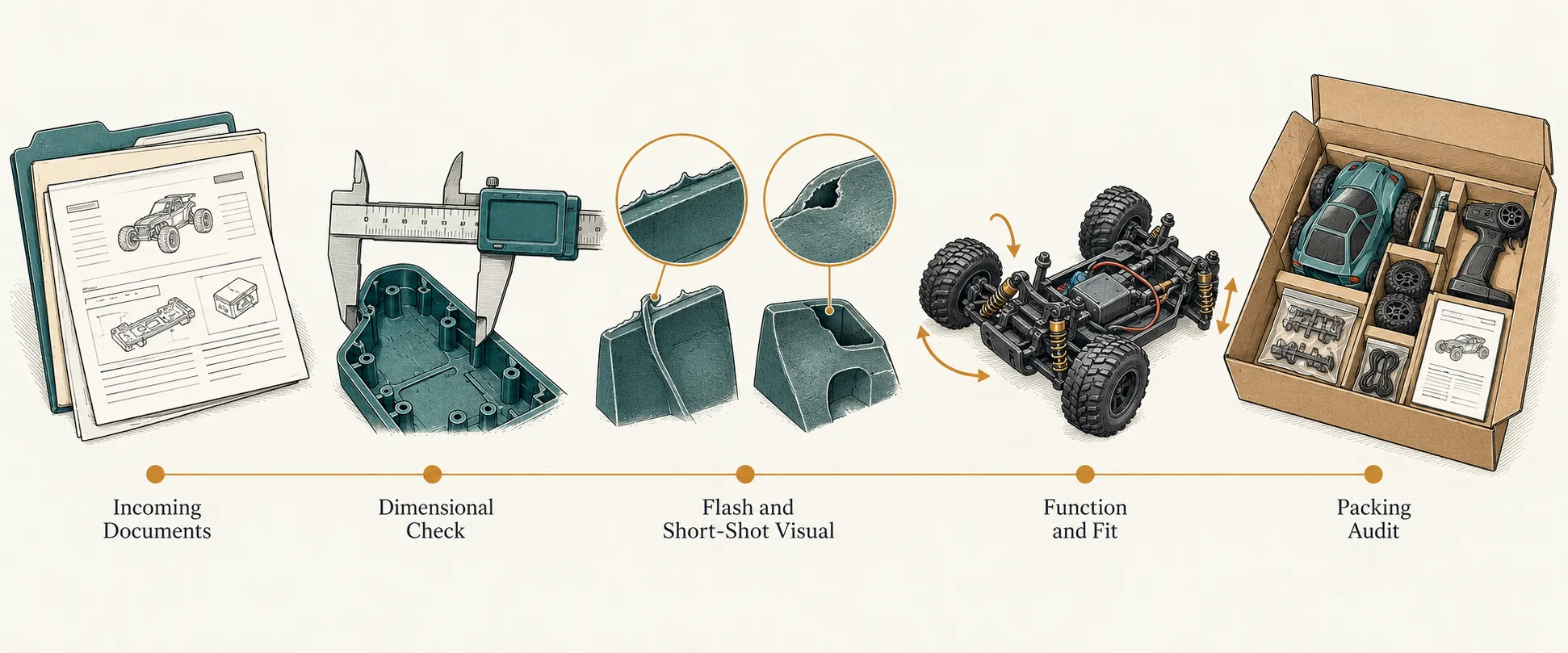
What should the first RC sample be compared against?
Compare the first sample against the agreed written specification, drawings, artwork, accessory list, and packaging requirements—not against a reference sample that has not yet been approved.
Identify the order item and revision before checking it. List the required functions, component materials, dimensions, finish, controller, battery configuration, charging equipment, instructions, and packaging. Define measurable acceptance limits where they matter, including the measurement method and units. These are agreed purchasing criteria, not automatically legal or industry standards.
A stock sample can demonstrate a platform or general workmanship. It cannot establish approval of a different battery, revised controller, private-label artwork, or packaging it does not contain. Ask the factory to identify which parts of the submitted sample represent production and which are temporary, handmade, or substituted.
Retaining an approved sample as a reference for later inspection is an established purchasing recommendation. It complements the written specification and change records; it does not replace them. Why You Should Always Order a Sample Before Bulk Production
What should an RC buyer inspect before sample approval?
| Pairing and control response | Target: the agreed controller, pairing instructions, and command list. Observation: record the controller identity, startup sequence, pairing result, and response to each specified command. Failure signal: pairing fails, commands are reversed, or response is inconsistent under the recorded conditions. Next decision: hold functional approval, request correction, and repeat the affected checks on the revised configuration. |
|---|---|
| Charging and battery configuration | Target: the specified battery model, connector, charging equipment, and instructions. Observation: record component labels, cable fit, charging indication, and whether the prescribed charging sequence completes. Failure signal: mismatched components, damaged connectors, abnormal heat, swelling, or failure to complete the stated sequence. Next decision: stop the check where abnormal behavior appears and obtain technical review before resuming. A charging observation does not establish battery safety. |
| Driving and other specified functions | Target: the agreed driving, steering, lighting, sound, or stunt functions. Observation: record each function separately, together with the surface, battery preparation, and other relevant conditions. Measure runtime or range only against an agreed method and target. Failure signal: a required function is absent or does not meet that target. Next decision: correct the function or obtain an explicit written specification change before approval. |
| Spray, when specified | Target: the agreed spray behavior and factory operating instructions. Observation: record activation, stopping, and any visible leakage during the instructed operation. Failure signal: no spray, unintended continued operation, or leakage outside the agreed acceptance criteria. Next decision: hold the spray characteristic for correction and recheck. Visible spray does not demonstrate waterproofing or an IP rating. |
| Materials and component construction | Target: the component-level material specification and construction drawing. Observation: compare visible construction, assembly, component markings, and the factory's material declaration. Failure signal: a different component, an unexplained substitution, or construction inconsistent with the drawing. Next decision: resolve the discrepancy and obtain appropriate material evidence where needed. Touch and appearance cannot verify resin chemistry. |
| Dimensions and fit | Target: dimensioned drawings, defined measurement points, and agreed tolerances. Observation: enter measured values with units, instrument, and method; check wheel clearance, controller fit, and accessory fit where specified. Failure signal: a measurement outside the agreed limit or interference during operation. Next decision: request correction or formally revise the requirement before signing. |
| Finish and artwork | Target: the agreed color reference, finish requirements, artwork revision, and label placement. Observation: note scratches, coating irregularities, molding defects, sticker alignment, print legibility, and assembly gaps. Failure signal: a visible defect outside the agreed criteria or artwork from the wrong revision. Next decision: record the location and extent, then require corrected evidence or a replacement sample. |
| Accessories and instructions | Target: the agreed pack list and instruction revision. Observation: count the controller, cables, tools, and other specified accessories; check that instructions describe the supplied configuration. Failure signal: missing items, incompatible accessories, or instructions for a different version. Next decision: correct the set and repeat any function check affected by the change. |
| Retail packaging and master carton | Target: the agreed packaging drawing, artwork, packing arrangement, carton dimensions, construction, unit count, and marks. Observation: check sample fit and retention, window-box condition where specified, label legibility, packing count, and carton identification. Failure signal: wrong artwork, poor fit, damage, incorrect count, or a carton specification mismatch. Next decision: correct and review the packaging; use the agreed test or report for any specified strength requirement rather than judging strength by hand pressure. |
What happens when the sample does not match?
Record the discrepancy against the relevant requirement, assign a correction owner, and hold approval of the affected characteristic until the correction is verified.
For example, consider a window-box RC car specified with lights, sound, and spray. If pairing and driving work but spray does not activate, record the successful functions separately from the failed spray check. Do not approve the complete sample because it drives well. Request a corrected unit, identify its revision, and repeat the spray check plus any related checks affected by the repair.
A video of another version can help explain the intended operation, but it does not resolve the submitted sample's discrepancy. If the buyer instead accepts removal of the feature, revise the specification, artwork, instructions, and document review as necessary before signing. Keep the original observation and the closure evidence together so the change is traceable.
Which documents must match the RC sample?
Match supporting documents to the CoreRCCar configuration and the claims being approved, rather than accepting a similar model name as sufficient coverage.
Keep commercial sample observations separate from destination-specific regulatory review. A hand inspection does not certify safety or establish age suitability. For US laboratory review, CPSC explains that laboratory acceptance is specific to particular safety rules and that one laboratory may not cover every required test. Check the relevant acceptance scope, not just the laboratory's name. CPSC Third-Party Testing
Request the actual supporting report for any lithium-battery, FCC, or IP claim under review. Do not infer battery chemistry from the presence of a charging cable, radio authorization from successful pairing, or ingress protection from a working spray feature.
| Product identity and report scope | Compare the report's model list, product description, photographs, tested construction, and relevant component details with the submitted sample and ordered revision. Where identifiers differ, request a documented explanation linking the ordered item to the tested configuration. Do not treat a different internal item code alone as proof that coverage is invalid. |
|---|---|
| Battery and charging evidence | Confirm the actual battery chemistry, model, markings, connector, and charging configuration. If lithium is specified, request the applicable battery test and transport documents for that configuration. Review transport paperwork separately for the intended shipment; it is not a substitute for product-safety evidence. |
| FCC claims | Request the actual supporting test report and associated authorization records relevant to the claimed radio configuration. Compare model identification, equipment details, and labels with the sample. A carton logo or a pairing demonstration is not a substitute for that review. |
| IP claims | Request the report identifying the claimed rating, tested enclosure, configuration, and test conditions. Match those details to the sample. Do not infer an IP rating from appearance, a spray demonstration, or an informal water check. |
| Changes since testing | Ask the factory to identify changes to construction, materials, electronics, battery, charging equipment, and other relevant components since the tested version. Assess whether those changes affect report coverage. Do not impose an automatic rule that every batch or internal item code requires a new test. |
How should the approved sample and sign-off be recorded?
| Record identity | Enter the approval record number and revision, buyer order or project reference, ordered item identifier, factory model, variant, sample ID, receipt date, and inspection date. |
|---|---|
| Comparison basis | List the specification, drawings, artwork, instruction sheet, pack list, and packaging revisions used. State the characteristics covered by this approval and any exclusions. |
| Production representativeness | Record the factory's confirmation of which components, materials, processes, and packaging represent intended production. List temporary parts, mock-ups, and substitutions requiring later review. |
| Target versus observation | For each check, enter the specified target or tolerance, actual observation or measurement, method and conditions, result, and evidence reference. Link discrepancies to individual checks. |
| Document matching | List the documents reviewed, their identifiers and dates, covered models and configurations, and the reviewer's disposition. Record any scope clarification or technical assessment needed before release. |
| Reference sample custody | Enter the retained sample ID, seal identifier, storage location, and custodian. Add buyer and factory signatures or acknowledgments with dates. Record photograph references and any later opening, resealing, replacement, or withdrawal. |
| Decision and release authority | Select approved, conditionally approved, or rejected. State separately whether production is released or held, the exact revision and scope authorized, and the responsible buyer approver's name, signature, and date. |
| Conditions and closure | For each open issue, enter the required correction, responsible owner, due date, closure evidence, recheck result, and closure approver with date. Record the final production-release decision after conditions are satisfied. |
When should the buyer release or hold production?
Release production when the agreed approval scope is satisfied, the supporting document review is accepted, and the authorized buyer has signed the release for the identified revision.
Approve and release when the required checks pass and no release-blocking conditions remain. Name the specification revision and retained reference sample in the authorization.
Conditionally approve when the acceptable characteristics can be identified but corrections remain. Keep production on hold until those conditions close, unless the buyer explicitly authorizes a limited, clearly defined activity in writing. Conditional approval is not blanket permission to manufacture the full order.
Reject and hold when the sample does not demonstrate the ordered configuration or has unresolved discrepancies that prevent acceptance. Give the factory a specific correction list and define the resubmission checks.
Bulk inspection is the next stage. Compare production with the written specification, approved change records, retained reference, and applicable inspection plan. The sealed sample supports traceability; it does not by itself reveal an undisclosed component change or guarantee that the full run matches. Production release is also not shipment release.