
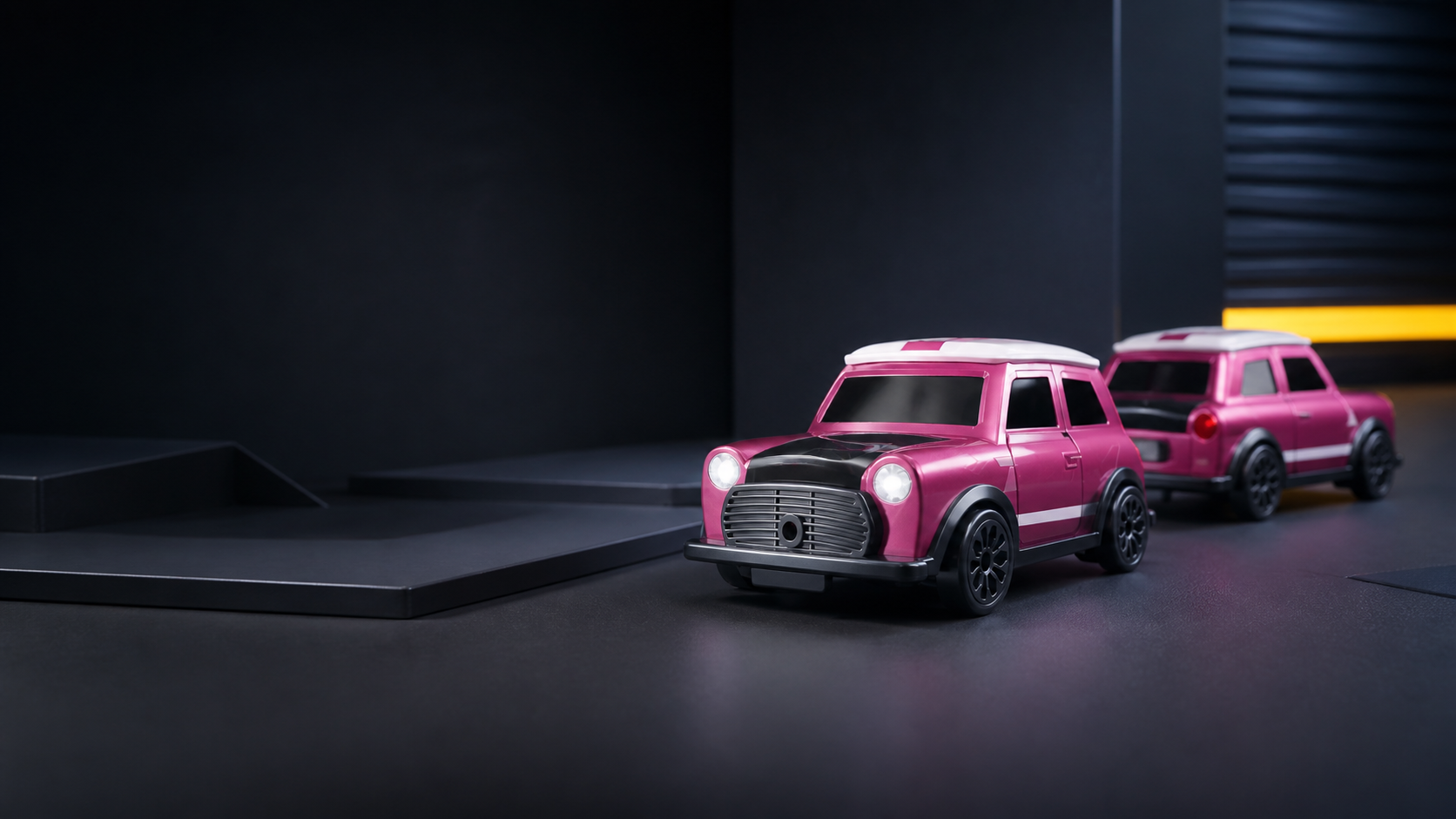
Yes. A CoreRCCar does not need a recognizable oil or logistics brand on the side to look real — fictional fleet names, invented marks and regional color palettes deliver the same shelf realism, and they are exactly what OEM/ODM customization is for. You own the artwork, the factory prints it, and no third-party identity enters the box.
This covers the four decisions that actually gate a tanker graphics program: what can be customized, what triggers tooling, how sampling and artwork approval run, and where legal review has to sit before anything is printed. MOQ and lead-time figures below come only from the factory catalog and confirmed quotes; where a number is not published, it is written as a question to ask the factory, not a guess.
Key Takeaways
- Fictional identity beats borrowed identity: an invented fleet name, invented mark and original palette give the same visual credibility as a real livery, without trade dress or logo exposure.
- A tanker SKU with a published catalog MOQ of 108 pcs (1/14 4-Channel RC Tanker Truck with Lights, ABS) is the realistic entry point for a private-label run; lower-MOQ SKUs in the same catalog start at 36 pcs, but those are not tanker bodies.
- Graphics that print on an existing body are a decoration change; graphics that require a new molded shape are a tooling change. Know which one you are buying before you accept a quote.
- Hazard and safety markings are functional, not decorative — accuracy wins over proprietary styling, and the layout should be reviewed by your compliance reviewer, not signed off from a catalog image.
- Legal review is a gate, not a formality: record sign-off on the artwork version before tooling or print, and map each market to the specific file and lot that covers it.
OEM vs ODM vs Stock + Logo: Which Tanker Graphics Model Fits Your Order?
| OEM (your design): who owns the artwork | You supply the fictional brand name, mark and layout; the factory executes to your file. |
|---|---|
| OEM (your design): MOQ | varies by spec; the cited tanker SKU carries a catalog MOQ of 108 pcs |
| OEM (your design): tooling needed? | Only if the graphics require a new molded body or a new decoration plate; print-only changes on an existing body are not tooling |
| OEM (your design): lead time | varies by spec; confirm sample and mass-production windows with the factory in writing |
| ODM (factory design + your brand): who owns the artwork | Factory's existing tanker design; you add your brand, palette and packaging |
| ODM (factory design + your brand): MOQ | varies by spec; typically lower than a full OEM tooling run, confirm per SKU |
| ODM (factory design + your brand): tooling needed? | No new body tooling; decoration and packaging changes only |
| ODM (factory design + your brand): lead time | varies by spec; confirm against the factory's current production schedule |
| Stock + Logo: who owns the artwork | Factory stock tanker; you add a logo, sticker or private-label box |
| Stock + Logo: MOQ | varies by spec; the lowest published MOQ in this catalog family is 36 pcs, but tanker bodies are listed at 108 pcs |
| Stock + Logo: tooling needed? | No tooling; artwork and packaging only |
| Stock + Logo: lead time | varies by spec; the shortest route because nothing is re-tooled |
What Can You Actually Customize on a CoreRCCar?
Color, logo, packaging and private label are the four levers that move without a new mold. On a tanker body, that means the barrel color, the cab and chassis color, the printed or pad-printed fleet mark, the hazard-symbol layout, the box artwork, the blister or kraft-box format, and the language on stickers and inserts.
Material and size are a different category. A catalog tanker in ABS is an ABS tanker; switching to another resin or changing the body dimensions is a spec change that has to be quoted and sampled, not assumed. If your market needs a different scale, treat it as a new SKU discussion rather than a graphics tweak.
Packaging language is a real customization line item. Spanish-language stickers, blisters and boxes are a documented factory capability when the buyer asks for them, and the same logic applies to any other market language: the factory prints what you supply, and you are responsible for the words.
How Do Fictional Brand Names, Marks and Regional Colors Stay Out of Trouble?
Treat the tanker side as a figurative brand identifier: a visual mark judged on overall impression and visual similarity, not on whether it contains words. A design can be too close to a real livery even with no text at all, because color combination, silhouette and layout carry the recognition.
Build the identity in three moves. First, invent the fleet name — something that reads as a plausible transport company in your market but is not a real one. Second, invent the mark: a simple geometric or letterform device, not a known logo with one element swapped. Third, build the palette from the market, not from a real brand: what reads as 'industrial' or 'regional' in one country often reads as a specific company in another.
Functional markings are a separate category. Safety colors and hazard symbols exist to signal danger, and functional features are not ownable as brand identifiers in the way an arbitrary logo is. The buyer consequence is straightforward: get the hazard layout right for the market, and do not try to make it proprietary.
Translations are where regional versions break. A fictional name that is clean in English can collide with an existing mark in another language, and a slogan can read as nonsense or as an unintended claim. Route every market's text through a native reviewer before artwork approval, and log which reviewer approved which version.
What Is the MOQ Logic for Custom Tanker Graphics?
MOQ follows the change, not the product. A logo on an existing body at an existing factory is the cheapest change and carries the lowest commitment. A new palette across a full container is a bigger change. A new molded shape is the biggest, because the mold has to be cut and the first parts have to be proven before you can sell one unit.
Use the catalog as your anchor, then ask for the real number on the real SKU. In this catalog family, the tanker truck with lights is listed at a MOQ of 108 pcs in ABS, while other RC vehicles in the same range start as low as 36 pcs. Those figures describe published catalog entries; a private-label run with a new box, new artwork and a new palette is quoted per SKU and may sit above the catalog figure.
Tooling is where quotes get confused. Ejector marks are a normal feature of injection tooling, and their position and depth should be controlled so they do not interfere with fit, function or child contact — that is an engineering conversation, not a graphics one. If your customization does not change the molded shape, you should not be paying for a mold. If it does, ask who owns the tool and what happens to it when the program ends.
How Does Sampling and Artwork Approval Work?
Sampling runs on a version-controlled loop: you send artwork, the factory returns a proof or a decorated sample, you sign off or mark it up, and only the signed-off version goes to production. Every revision gets a number. If a proof reaches the line without a signed version behind it, stop it.
For tanker graphics, the decorated sample is the evidence, not the PDF. Color shifts between a screen file and a molded part, and an approximate Pantone match is how that gap gets closed in practice — the buyer supplies the target, the factory matches to it, and the physical sample is what you approve.
Sample lead time is not a published catalog number here, so treat it as a question with a written answer: how many working days for artwork proof, how many for a decorated sample, and how many revision rounds are included before the sample is re-charged. Put the answers in the PO or the sample agreement.
The Custom Tanker Graphics Process, Step by Step
Lock the SKU and the golden sample before anyone opens a design file. Match the catalog entry to the physical reference unit and confirm material and construction. If the report or the artwork references a different model, color or construction than the unit you are selling, the paperwork does not describe your product — a test report is only useful when its identity matches the actual SKU, model, material, color, age grade and sample construction. Checkpoint: SKU, golden sample and spec sheet agree. Ask the factory: can you send the golden-sample photos for this exact SKU?
Define the fictional identity and the market list. Name the target markets, the channel and the language before palette work starts, because a palette chosen for one region can read as a real company in another. Checkpoint: written market list with language and channel per market. Ask the factory: which languages can you print on stickers, blister and box for this SKU?
Draft the regional palette and the hazard-symbol layout as two separate documents. The palette is your brand decision; the hazard layout is a compliance artifact. Checkpoint: palette with target references, hazard layout marked for compliance review. Ask the factory: can you match an approximate Pantone reference for the barrel and cab, and can you show how the hazard layout sits on the finished part?
Run translations and legal review in parallel, not in sequence. Native review catches language collisions; legal review catches mark and trade dress exposure. Checkpoint: a named reviewer and a named legal reviewer per market, with a recorded outcome. Ask the factory: can you provide a factory proof of the artwork before tooling, and what is your revision cycle?
Freeze the artwork version and confirm tooling scope. If nothing about the molded shape changes, you are buying decoration, not a mold. Checkpoint: signed artwork version number and a written tooling position — none required, or quoted separately. Ask the factory: does this customization need a new mold or a new decoration plate, and who owns the tool?
Confirm which paperwork covers which market and which lot. A UKCA file and a VOC file are different papers, and a buyer who tries to use one certificate for both ends up with a mismatch. Map market to lot to file, and keep the mapping with the shipment documents. Checkpoint: market → lot → file table, with the actual files attached, not summaries. Ask the factory: which certificate or report covers which market and which lot for this SKU?
Agree the inspection plan on the PO before mass production. The PO carries the agreed inspection plan and the release rule; a blog or a catalog sentence does not. On the floor, a failed lot is isolated, the defect class is recorded, and release happens only after rework. Checkpoint: written release rule and defect-class log format. Ask the factory: what is the agreed inspection plan on this PO, and how do you record and release a failed lot?
Ship against the signed version of everything. The box artwork, the sticker language, the hazard layout and the certificate mapping should all trace to the same frozen version. Checkpoint: shipping documents reference the approved artwork version and the market-file mapping. Ask the factory: can you confirm in writing which artwork version and which files are on this shipment?
Worked Example (Illustrative, Not a Real Shipment)
A buyer orders one container of the 1/14 4-Channel RC Tanker Truck with Lights for two destinations: a CoreRCCar-store chain and an EU gift distributor. The US run gets an English-language box and a US-market fictional fleet palette; the EU run gets the same body with a different palette, a translated sticker set and a different box. Same SKU, two market variants.
The container is packed in two lots by market. Halfway through inspection, the EU lot's box artwork shows the US palette on the side panel. The graphics are not wrong as artwork — they are wrong as a version. That lot is held, the defect class is recorded as a packaging/version mismatch, the box is reworked to the approved EU version, and the lot is released only after rework.
The hold happens at the packaging and version check, not at the molded-part check. The body was fine; the paperwork and the print were not. Buyers who check only the product and not the version ship a container that has to be re-stickered in the destination market, which is the most expensive place to fix a graphics error.
What to Watch This Year on Graphics and Identity
The legal framework around visual identity is not new, but the enforcement attention is. Non-traditional marks — trade dress, color, position and shape — remain the categories where a tanker livery can create exposure even without a word mark, and the evidentiary bar for those marks is higher than for a plain word mark. That limits how easily a competitor can claim a generic industrial look, and it means a genuinely distinctive real livery is still protected.
On the compliance side, keep the three states separate when you read any update: entered into force, actually applies to this product category, and not confirmed from official text. Do not convert a general entry-into-force date into a per-unit obligation, and do not merge separate regimes into one deadline. For this SKU family, the practical action is unchanged: ask the factory for the actual report that covers the specific market and lot, and keep the mapping with the shipment.
One adjacent rule applies to any tanker variant that carries a button or coin cell: CoreRCCar with a button or coin cell needs both battery-law review and child-access/ingestion hazard review, and one does not replace the other. If your graphics program touches a light-up or sound module, confirm both reviews before the artwork is frozen.
FAQ: Custom Tanker Graphics and Private Label
What is the minimum order to put my own fictional brand on a CoreRCCar?
The MOQ depends on which SKU and which change. The 1/14 4-Channel RC Tanker Truck with Lights is listed at a catalog MOQ of 108 pcs in ABS, and other RC vehicles in the same range start at 36 pcs. A private-label run with new artwork, palette and packaging is quoted per SKU, so ask for the MOQ on your exact configuration rather than the catalog number.
Do I need to pay for a mold to change the graphics?
No — not unless the molded shape changes. Printing, pad-printing, stickers, palette changes and box artwork are decoration changes on an existing body and do not require a new mold. A new body shape, a new scale or a new molded feature is a tooling change and should be quoted separately, with the tool ownership question answered in writing.
Can you print our logo, stickers and packaging in our market's language?
Yes, within the SKU's MOQ and the factory's confirmed print capability. Spanish-language stickers, blisters and boxes are a documented capability when the buyer requests them, and other languages follow the same route: you supply the approved text, the factory prints it. Native review of each market's text is the buyer's responsibility before artwork approval.
Will you sign an NDA and who owns the artwork and the mold?
Get the NDA signed before you send any artwork, and settle ownership in the same document. Artwork you create should stay yours; a mold, if one is cut, needs a written position on who owns the tool and what happens to it at the end of the program. Get both answers before tooling or first print, and keep them with the PO.
How do I avoid copying a real fuel or logistics brand by accident?
Check the tanker side as a visual brand identifier, judged on overall impression rather than on the presence of words. Invent the fleet name, invent the mark, build the palette from the market rather than from a real livery, and route the final artwork through legal review in each target market before it is frozen. Keep a record of the review outcome with the approved artwork version.
Which certificate covers my CoreRCCar for the US and the EU?
Ask the factory for the actual file and map market to lot to file. Different markets and different product functions are covered by different papers — a UKCA file and a VOC file, for example, are not interchangeable. A test report is only useful when its identity matches the actual SKU, model, material, color, age grade and sample construction, so verify the report matches your configuration before you rely on it.
Sources
Request a Custom Quote
Send your target markets, the SKU or reference unit, your fictional brand artwork and your packaging language, and request a quote that separates decoration changes from tooling. Ask for the artwork proof cycle, the MOQ on your exact configuration, the inspection plan on the PO, and the actual certificate or report that covers each market and lot. A useful RFQ states destination market, age grade, materials and colors, packaging language, requested tests, sample policy, tooling terms and the requested trade term — that list is what turns a quote into something you can compare.