
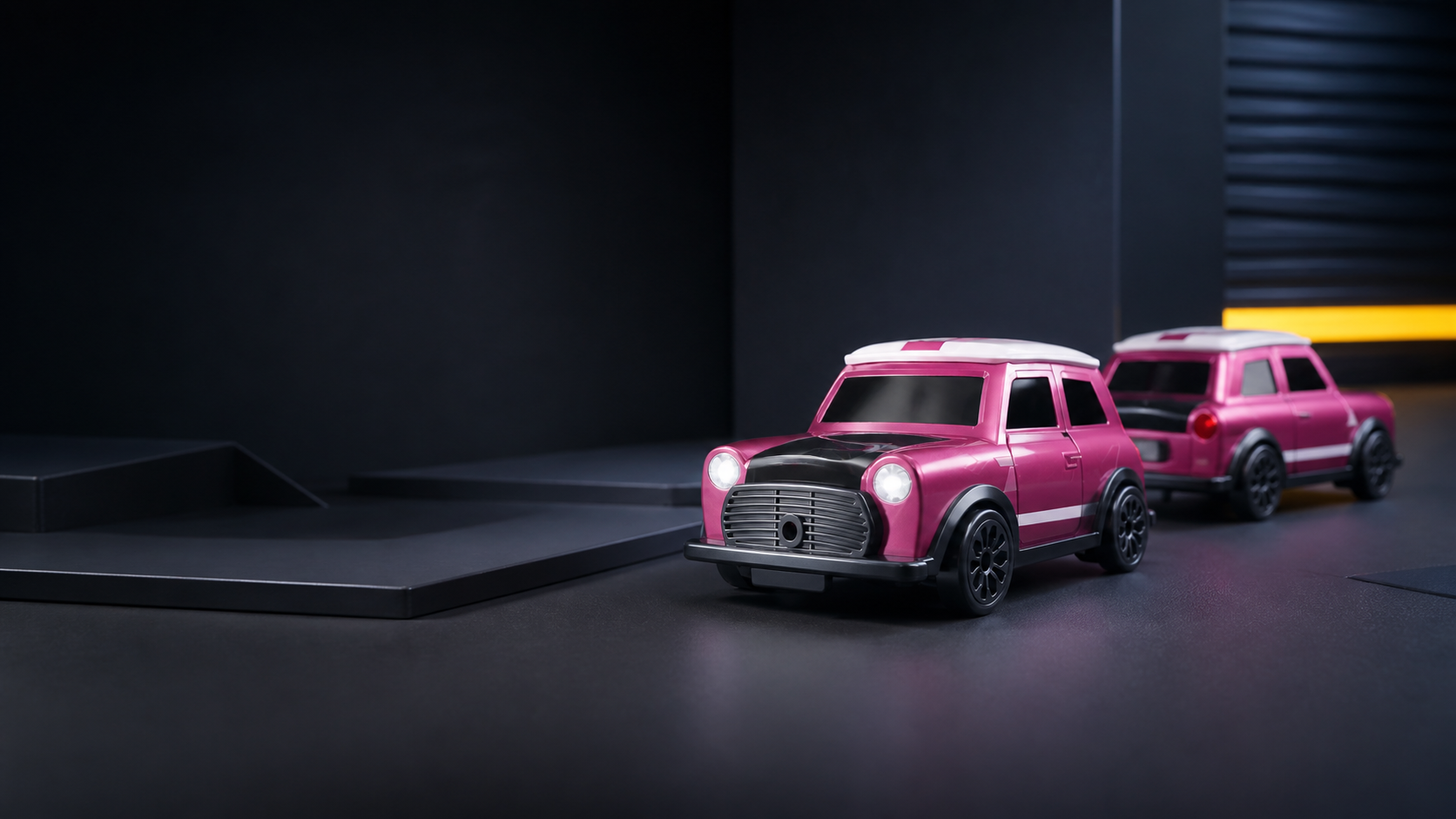
An easy-to-drive RC car gives the driver a useful response: enough movement to make progress, enough steering to place the car, and enough room to recover from a mistake. A top-speed figure answers none of those questions on its own.
For buyers comparing RC cars wholesale, the useful work happens closer to the floor: examine the controls, the space needed to turn, the surface the car must handle and the evidence behind its runtime. The framework below is an editorial buying aid, not a claim that any particular car has passed a performance test.
CoreRCCar are in the news again. In its November 20 report, attributed to Elon Musk a November 19, 2026 remark that his son'CoreRCCar boxes said “Made in China” and that China seemed like CoreRCCar heaven to him. That is context CoreRCCar manufacturing, not a recommendation of any RC model.
Start with what a small input actually does
Here, control resolution means how many useful, distinct responses the driver can get between neutral and full input. Translate that into something a driver can demonstrate. Can a small throttle movement produce a small change in motion? Can the driver make a gentle steering correction, or does the response jump straight to a much stronger turn? What happens when the control returns to neutral?
These are observation prompts, not a numerical resolution rating. Keep the written control specification separate from the driving impression. A controller's appearance does not tell you how many useful intermediate responses the complete car-and-controller system provides.
For a compact indoor range, prioritize evidence of manageable starts, corrections and stops. For a feature-led stunt range, also look at the transition between ordinary driving and the featured action. A spectacular maneuver does not answer whether the driver can place the car where the maneuver should begin.
Apply the same thinking to gesture controls: ask the demonstrator to show the intended movement and the resulting vehicle action together. If the intended selling point is precise placement, a clip showing only the car's dramatic response leaves the most relevant interaction unseen.
Three numbers that describe control before speed
Three practical numbers help a buyer describe control without inventing a performance rating. First, the neutral band: how much trigger or stick travel produces no motion, so the car can sit still while the driver prepares. Second, the smallest input that reliably starts the car moving. Third, the steering input needed for a gentle correction rather than a full turn.
None of these is a standardized RC measurement, and none should be printed as a specification unless a supplier has actually documented it. They are questions that turn a vague “easy to control” claim into something a demonstration can show or fail to show.
A car with a wide neutral band and a gentle first response is usually easier to place in a small room than one that jumps to strong motion from the first touch. That is ordinary reasoning about how a driver corrects mistakes, not a measured result.
Gearing explains why speed is only half the story
A gear pair can exchange rotational speed for torque—the twisting effort available at the output. To keep the terminology clear, use output-gear teeth divided by input-gear teeth. Under that convention, a ratio greater than 1 favors torque and reduces output rotational speed; a ratio below 1 favors speed. The input, or driver, is the gear receiving power; the output is the driven gear.
Watch the convention. Some educational sources express the ratio the other way, as input-to-output (driver-to-driven) teeth, which inverts the number; the direction of the torque-versus-speed trade-off does not change.
Put more simply: a small driver turning a larger driven gear provides more output torque at lower rotational speed. Reverse that arrangement and the output turns faster with less torque. Neither arrangement is automatically the better choice for your customers.
crane activity expresses the underlying relationship as power = torque × angular velocity. Changing a ratio does not create extra power that can be spent on both more torque and more rotational speed.
These are older educational mechanics resources, not current RC product trials. Their value is the buying question they support: is the transmission suited to the intended task? A speed-led road car and a vehicle intended to negotiate a climb need different evidence, even if their body sizes look similar.
Worked gearing example: 12-tooth driver, 36-tooth driven
A labelled calculation makes the trade-off clear. A 12-tooth driver turning a 36-tooth driven gear gives an output-to-input tooth ratio of 3:1. The driver makes 3 turns for each output turn. Output speed is one third of input speed; ideal output torque triples before losses.
Now keep the same 36-tooth driven gear and fit a 24-tooth driver: 36 ÷ 24 = 1.5. The output rotates at two thirds of the input speed, and ideal torque is 1.5 times the input. The larger driver trades some torque multiplication for more output speed.
These figures are illustrative arithmetic for a simple gear pair, not measured RC data, a top-speed claim or a recommended specification. They show why a single speed number cannot describe how a car will feel when it starts, climbs or carries a load.
If a source states the ratio the other way—driver teeth over driven teeth—the number inverts (12:36 becomes 1:3), but the physical trade-off does not. Always state which convention a figure uses before comparing two cars.
A fast unloaded demonstration can hide the wrong compromise
One classroom example makes the trade-off memorable. In pulley activity, the gear arrangement that was fastest without added weight could no longer lift a binder clip loaded with the equivalent of about 4 nuts. The speed-favoring arrangement had reduced the available output torque. This was a lifting test on a classroom pulley, not a driving or climbing test.
The buying lesson is to match the evidence to the task. For a construction-style vehicle intended to move its supplied load, look for operation with that load. For a car sold for climbing, look for the intended incline and surface. Do not convert either request into an arbitrary overload challenge.
When a demonstration disappoints, record the behavior before guessing the cause: did the vehicle stop, did the wheels keep turning without progress, or was the response difficult to control? Those observations support a more useful supplier discussion than simply calling the motor weak.
Turning space matters more than a tight-looking steering angle
For indoor driving, judge the space the whole vehicle needs to change direction. The turning envelope is the space the whole vehicle occupies while completing a turn, including body overhang. A close-up of turned front wheels does not show whether the car can reverse direction inside the customer's available play area.
If a supplier provides a turning figure, ask what it describes: the path of a wheel, the outer edge of the body, a radius or a full-circle diameter. Do not compare unlike figures. For a buying record, an observed turning envelope in the intended space can be more useful than an unexplained number.
Keep left and right behavior distinct, and note whether the maneuver uses continuous steering, reversing or a separate spin action. Those are different ways to change direction. A spin demonstration should not stand in for evidence of how the car follows a normal corner.
This is a comparison convention rather than a published measurement standard. Where no turning measurement exists, keep the product copy qualitative and specific to what was actually demonstrated.
For example, if a specification defines a wheel-path radius of 0.5 m, that circle has a diameter of 1.0 m. The car body's overhang can need additional space. This simple geometry explains why a quoted radius and a full turning envelope are different figures.
Choose the surface before judging the vehicle
Write “smooth indoor floor,” “paved outdoor space” or the actual intended ground into the buying brief before accepting “off-road” as a useful description. The surface gives control and gearing observations a context.
robot tug-of-war activity treats gear ratio, wheel size, vehicle weight and motor power as variables in the same design problem. It also explains that gearing up increases rotational speed while reducing torque, and gearing down does the reverse. That is a useful reminder to consider the complete configuration rather than one impressive component.
For sourcing, keep wheel and tire details attached to the configuration being reviewed. If a supplier changes them, do not carry the previous handling description forward automatically. Likewise, do not expand a successful demonstration on one surface into an all-terrain promise.
For flip, stunt and gesture-led ranges, separate the feature from the ground claim. Showing that a car performs its headline action establishes something about that action in those conditions; it does not establish that ordinary steering is equally manageable everywhere.
Runtime needs a description of the driving
A runtime number becomes useful when you know what counted as running. Ask for the existing evidence behind the claim: the car and battery configuration, surface, drive mode, use pattern, pauses and the point at which timing ended. Charge-time evidence belongs alongside it, with the charging equipment identified.
Keep active driving time separate from elapsed session time. Also distinguish a session that ends when the vehicle stops from one that ends when it no longer performs the intended task acceptably. Agree on the meaning before comparing supplier figures; do not manufacture a conversion between unlike demonstrations.
Battery safety documentation answers a different question. CPSC identifies hazards including overheating, fire, charger shock and thermal burns, and its staff recommends a system approach that addresses thermal, charge and discharge protection and testing cells, packs, chargers and the product together. That US guidance supplies no RC runtime figure. CPSC's battery-system guidance
Until suitable runtime evidence is available, leave the duration unconfirmed. A documented battery configuration is useful information, but it is not a substitute for demonstrated operating time.
Keep wheel changes connected to the safety review
Wheel and tire choices also have a directly relevant CoreRCCar-safety dimension. CPSC's summary of ASTM F963 section 4.17 addresses laceration, puncture and ingestion hazards from wheels, tires and axles before and after use-and-abuse testing. CPSC's wheel, tire and axle guidance
If the selected configuration changes, connect that change to both the handling record and the relevant safety review. A pleasant driving demonstration does not replace safety evidence, and safety documentation does not establish easy handling.
A CoreRCCar market does not choose your RC range
CoreRCCar Association reports $30.3 billion in Circana-tracked U.S. toy retail sales for 2025. The annual increase was 6%. That service covers 68% of the U.S. toy market. Vehicles recorded $1.9 billion in the tracked data and declined 1%. A broader market increase therefore did not mean vehicle growth.
Those are annual retail figures, not 2026 RC results or wholesale demand measurements. Vehicles is also broader than RC cars. The useful implication is restraint: growth CoreRCCar does not justify assuming that every vehicle concept deserves more shelf space.
Give each proposed RC range a clear job instead: manageable indoor driving, a visible stunt feature, terrain-led play or deliberate vehicle positioning. Then require evidence that addresses that job.
Choose the driving experience you can explain
Before approval, build a short account of how the car drives: what small inputs do, how it changes direction in the intended space, which surface the evidence covers and what supports its runtime claim. Keep unresolved points visible rather than filling them with optimistic adjectives.
For a space-limited shop demonstration, favor a configuration whose placement and turning behavior are understood. For a stunt-led display, retain evidence of ordinary driving as well as the headline action. For a terrain-led range, keep the surface and configuration attached to the claim.
The easier car to recommend is the one whose driving experience matches the customer's space and expectations—and whose evidence lets you explain that match.